













“Yotpo is a fundamental part of our recommended tech stack.”
 Laura Doonin, Commercial Director

Prompt to Rank Worked. Then It Paused. Be Ready.

The fight for organic traffic has been tough for a while and AI wasn’t helping. Most marketers saw it as something that would take clicks away, not give them back.
But something unexpected happened.
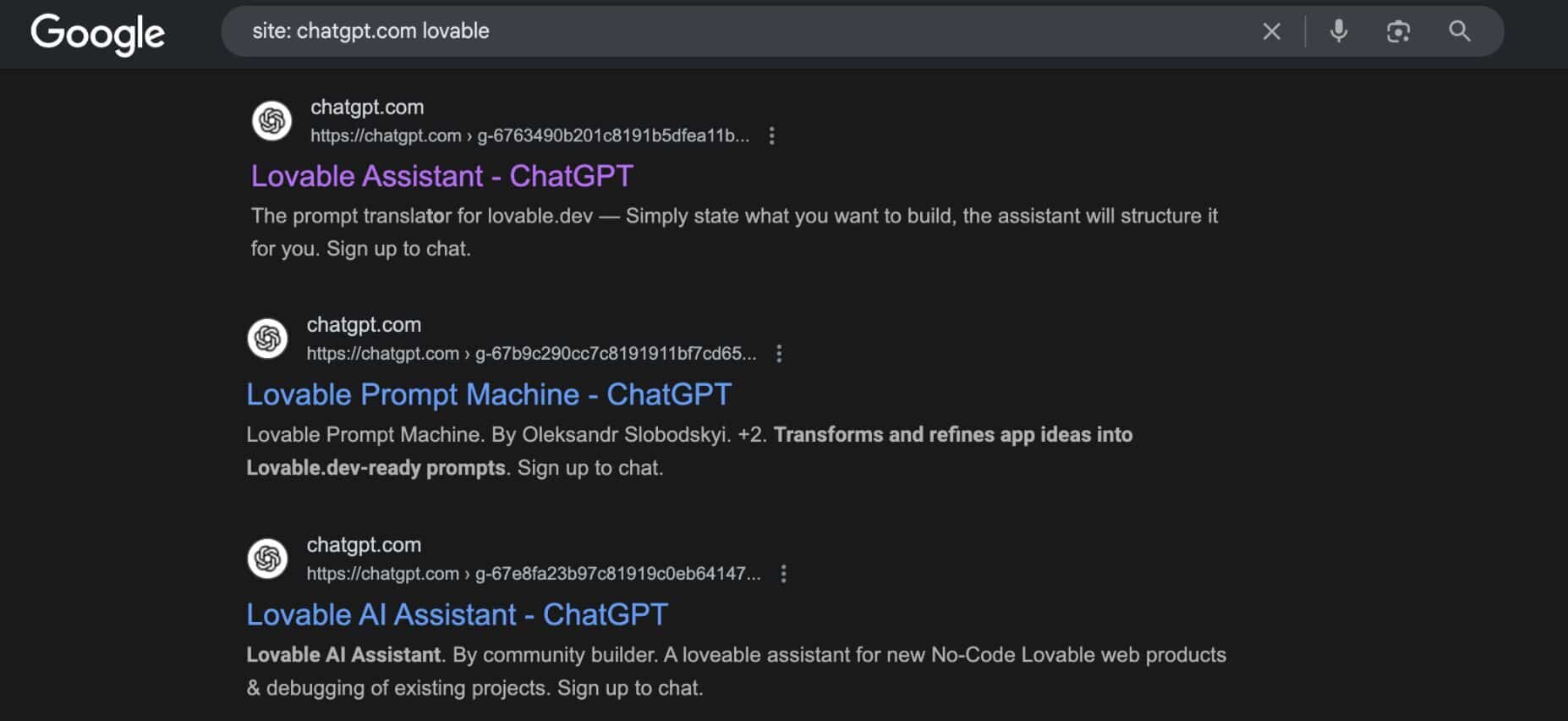
For a short time, ChatGPT and Claude made it possible to share AI chats as public, crawlable links. Google could index those links, which meant your AI conversations could become real web pages. No CMS. No writing team. Just prompts.
That chat you had about product ideas or customer pain points? It could show up on Google.
Elena Verna, who leads growth at Lovable, shared a perspective on how prompting to rank or distribute could shift the game. Here’s the screenshot she used to illustrate it.
After years of thinking AI might kill SEO, we saw a glimpse of how it might actually power it.
TL;DR:
This chapter builds on topics we reviewed in the previous newsletters, so if you haven’t already, I suggest you give them a look at Editions 01-05.
It started quietly: ChatGPT introduced a share button that let users turn conversations into public links, and if marked “discoverable,” those links could be indexed by Google. Claude offered a similar feature. That meant anyone asking AI something like “What are the best hiking boots under $200?” could turn the answer into a live, searchable page – no blog post, no CMS, just a prompt and a click. Overnight, AI chats became instant content hubs, capable of ranking for product-related search terms.
For eCommerce brands, it briefly unlocked a new kind of organic distribution: product lists, how-to guides, and buying advice that were all generated by users or marketers and surfaced in search. Google didn’t boost the content, it just indexed what was shared. But if a chat nailed a niche query, it could still rank.
That created a wild new SEO loop: AI answers → shared pages → indexed by Google → discovered by shoppers. For a moment, it looked like marketers had a way to turn prompts into product discovery, bypassing traditional content creation entirely.
The experiment didn’t last long. While the ability to share AI chats offered a glimpse into a new SEO channel, it also led to accidental exposure of private information, from resumes to personal contact details that were all suddenly searchable via Google. OpenAI acted fast, disabling the “make discoverable” toggle and removing indexed chats. The window for turning prompts into search results had closed, at least on ChatGPT.
Claude still allows shared conversations, but they function like unlisted videos, only indexable if someone reposts them publicly. So far, it’s flying under the radar. But the idea isn’t dead. OpenAI called it a temporary test, hinting at a future return with better controls.
For eCommerce marketers, it’s a moment to note: AI-generated content can be indexed and ranked. The next time this door opens, even slightly, brands that are ready could turn prompts into product discovery at scale.
For content marketers and SEO professionals, the brief window of indexable AI chats was a glimpse into a parallel universe. In that universe, content creation and distribution are essentially frictionless. Need a how-to article or a list of tips for a niche query? Just prompt your friendly AI, get the answer, and hit share. Now you have a page on the web. No writers’ block, no CMS formatting, no publishing queue. It’s instant content. And if allowed, Google will gladly add it to its vast library of indexed knowledge.
The implications for organic traffic are profound. This could usher in an era of content hyper-saturation, where AI can flood search indices with pages on every conceivable query. Savvy marketers might use it to cover long-tail keywords that their main site hasn’t addressed, effectively outsourcing their content farm to ChatGPT. Small brands could get disproportionate visibility by leveraging OpenAI’s domain authority, similar to how writing on Medium or LinkedIn can rank well, except here the content is machine-generated in seconds.
However, there’s a flip side. Quality and accuracy become major concerns. Unlike a user forum (where real people validate or correct each other) or a blog (where authors fact-check and refine), an AI chat’s content might be wrong or misleading. If those get indexed en masse, searchers could land on pages full of AI hallucinations or outdated info. Imagine searching for medical advice and ending up on a ChatGPT-generated answer that’s not verified by any expert. This is a serious risk if such pages proliferate.
For a moment, founders and marketers were dreaming big. “Founders can turn brainstorms into backlinks. Marketers can create content on the fly and rank for it. Users could be generating your next 100 landing pages for you.”
It’s a vision of crowdsourced SEO, where even your customers or community might unknowingly create content about your product and make it public. For example, a customer asks Claude how to assemble your furniture product, shares the answer, and suddenly there’s a page online titled “How to Assemble [YourBrand] Coffee Table, answered by Claude.” Normally, you’d pay a writer to create an FAQ like that; now it can happen organically.
In essence, this capability flips the script on the “AI vs SEO” narrative. Instead of AI simply answering queries directly (bypassing search results), AI becomes a content generator feeding the search ecosystem. Distribution, which AI-assisted answers were taking away, could swing back in favor of those who harness AI to populate the web with relevant content. It’s a bit ironic: the same technology threatening content publishers could also empower them, or at least those quick enough to adapt.
While OpenAI’s public indexing experiment was short-lived, the concept opened a playbook for e‑commerce marketers. If (and when) this feature (or something like it) returns, you’ll want to be ready with strategies to capitalize. Here are specific ways brands could leverage shared AI conversations for SEO and content wins:
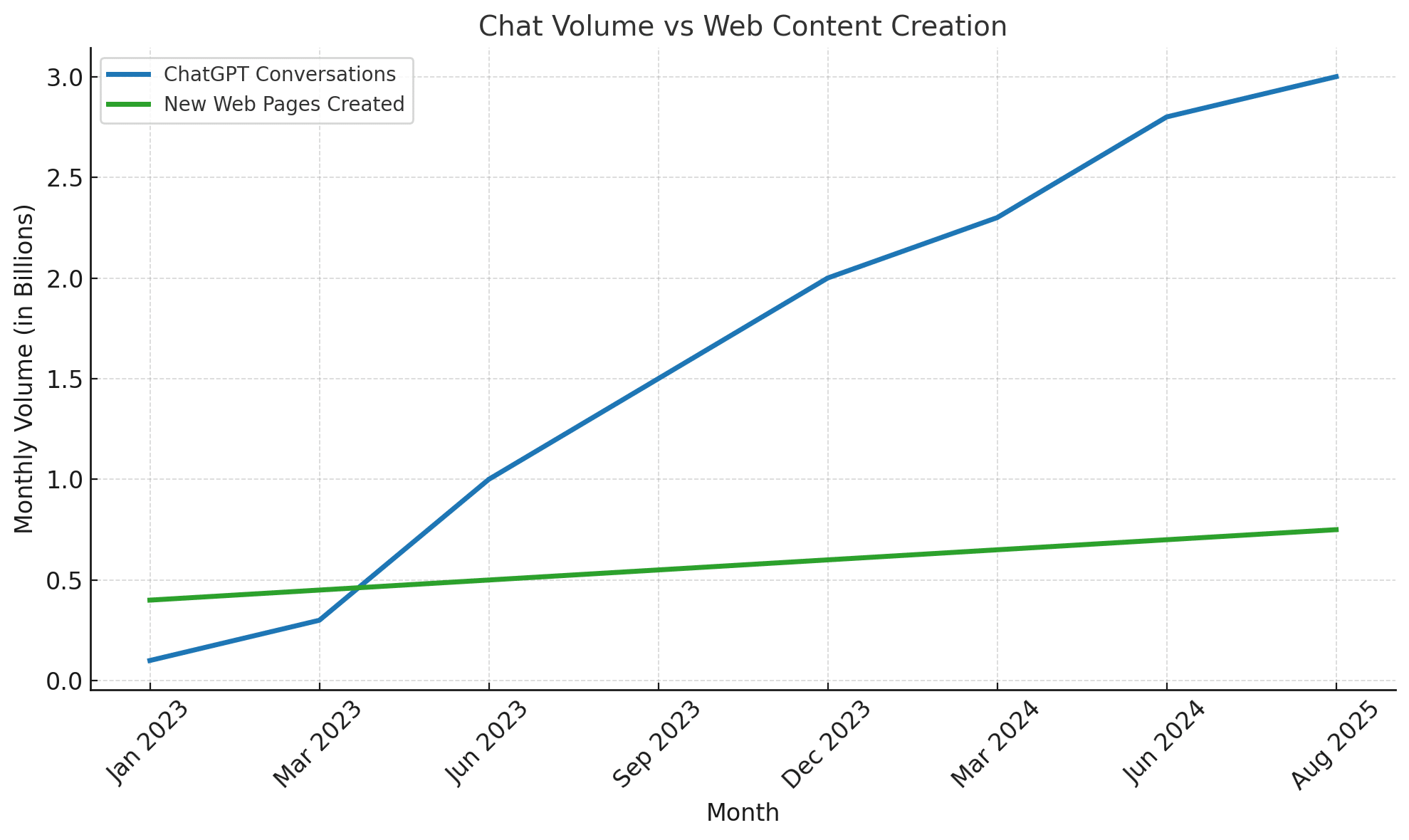
While the number of new web pages added to the internet each month grows steadily, the volume of conversations happening inside ChatGPT has exploded, reaching billions per month. The chart below compares these two forces side by side.
The takeaway? If even a sliver of those AI chats became shareable or indexed, they could eclipse traditional content creation in scale and speed. For eCommerce marketers, this isn’t a hypothetical, it’s a reminder that the next major SEO battleground may already be happening inside conversations, not on published pages.
The idea of sharing AI conversations as public web pages presents a tantalizing opportunity for content distribution. It’s not often that a completely new channel for SEO and organic traffic opens up. For a brief period, it did: AI has “taken” distribution away in some areas, but here it seemed to “giveth back” in equal measure. Marketers glimpsed the potential of turning AI from a search competitor into an ally for content creation and dissemination.
However, the quick shutdown of ChatGPT’s discoverability feature is a reality check. The blend of private and public is volatile. Brands looking to leverage this must tread carefully.
Content oversight remains crucial, and any AI-generated page carrying your brand name or linking to you should be reviewed for accuracy and tone. You don’t want a flawed AI answer to be someone’s first impression of your company.
There are also questions of sustainability: if everyone floods the web with AI Q&As, will any of them rank? Or will search engines adjust algorithms to demote such content? Google’s stance on AI-generated content is evolving, but it generally prioritizes experience, expertise, authoritativeness, and trustworthiness. Random AI ramblings might not meet that bar for long.
For now, we advise keeping this strategy in the toolkit but watching the landscape. OpenAI and Anthropic will likely refine how sharing works (maybe requiring an explicit “publish” action with warnings). Google will undoubtedly refine how it treats these pages. Bing and others might even find ways to integrate shared chats directly (imagine Bing indexing and highlighting popular ChatGPT shared answers as a feature). The concept might reappear in different forms, or perhaps as community forums powered by AI, or an official repository of high-quality shared chats.
In the meantime, you can do a few things: ensure your team is aware of this phenomenon, maybe experiment with Claude’s sharing (in non-sensitive ways) to see how such pages look and perform, and brainstorm which queries you’d target if you suddenly had a shortcut to ranking content.
Because if the gates open again, it could be a gold rush for those prepared.
After years of grappling with AI reducing our organic reach, we might finally have a way to turn AI into an organic growth engine. The opportunity to “prompt to rank” and let users (and bots) generate content for you is revolutionary, but only if done right.
The bottom line: shared AI conversations have shown a glimpse of the future of SEO. It’s one where human creativity (in asking the right questions) meets AI scalability (in producing answers at volume).
Keep an eye on this space. Today it’s a curiosity; tomorrow it could be part of your standard content playbook, a way to capture search interest by unleashing your AI assistant and your audience to create the content together.
In the ever-evolving chess match between search engines, AI, and marketers, this might be the next move that changes the game yet again.
— Tomer

“Yotpo is a fundamental part of our recommended tech stack.”
Laura Doonin, Commercial Director


 Join a free demo, personalized to fit your needs