







The 100-Brand LLM Benchmark

Which Brands Win in AI Search?

Author Image
Tomer Tagrin September 9, 2025

The 100-Brand LLM Benchmark

We put 100 consumer brands (including Nike, Patagonia, Adidas, Fabletics, and Chubbies to name a few) through the same AI gauntlet to answer one question:

Which brands are easiest for large language models to find, trust, and recommend, and why?

Quick heads-up before we jump in:

I’m joining product leaders from Shopify and Yotpo on September 25 at 12pm ET for a live panel on how AI is changing the way people shop and what that means for your brand.

We’ll talk about how search is shifting from Google to LLMs, how to optimize PDPs for both people and machines, what it takes to build trust in an AI-first world, and why SEO alone isn’t enough anymore.

The goal is simple: practical strategies to help your brand stay visible, relevant, and trusted as the landscape changes, just like in CommerceGPT.

You can register here if you want to join.

Now let’s get into it.

TL;DR:

  • Elite plateau: 
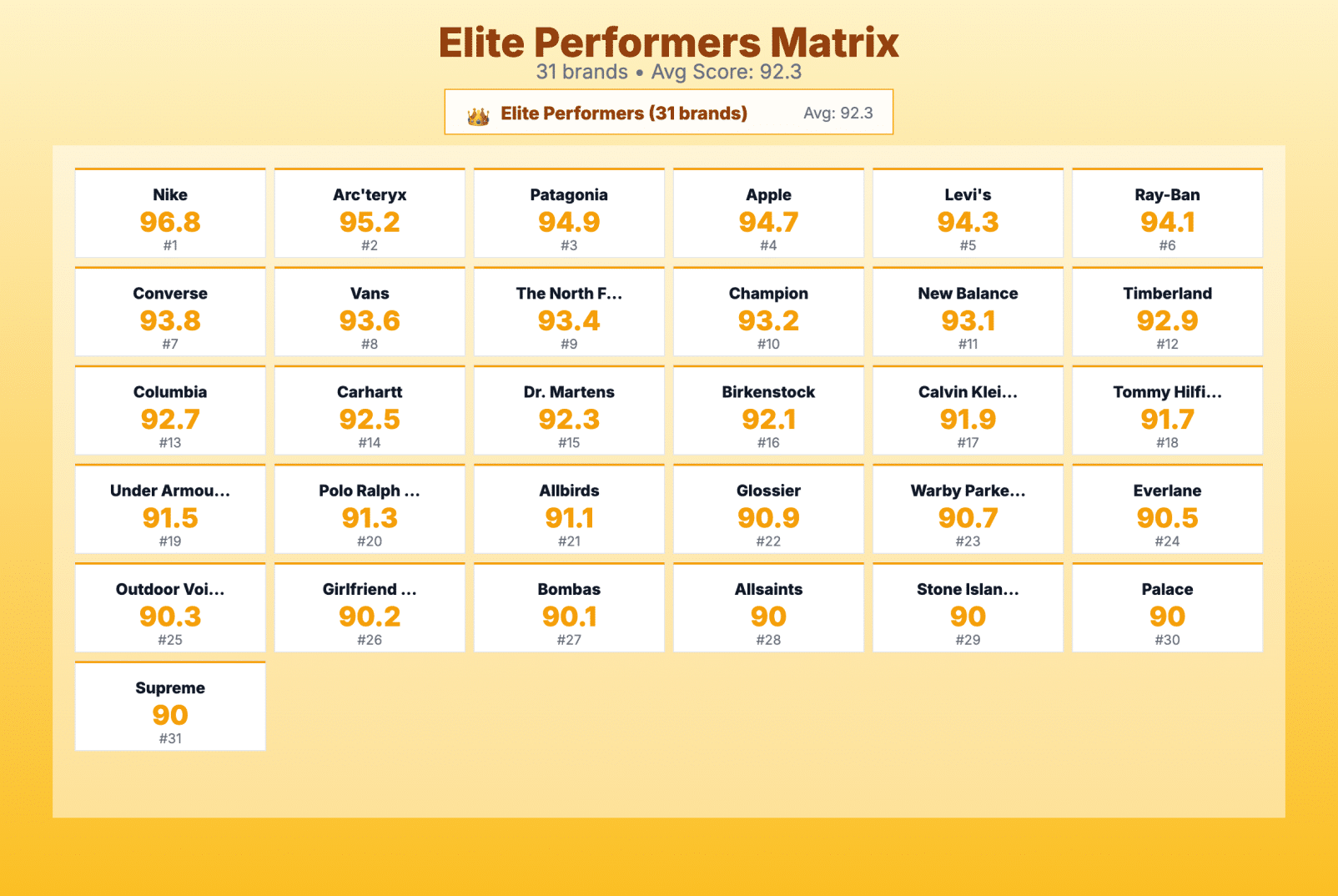
    • Crossing 90 puts brands in rare air, but it’s a crowded sky. The 31 “elite performers” average 92.3, with just ~7 points separating #1 Nike (96.8) from #31 Supreme (90.0). At this level, tiny gains in visibility or authority can shuffle rankings fast.
  • Trust kicks in at ~85+ scores
    • Brands like Patagonia, Columbia, and The North Face earn consistent trust from both models via third-party tests, authentic mission, and no major controversies. “Controversy immunity” beats polarization.
  • Model bias is real:
    • Gemini is more generous by ~+8.0 points on average (91.3 vs 83.3 OpenAI), especially in Citations (+13.9) and Structured Readiness (+9.6).
    • Only Zara, Warby Parker, Bose, Ring beat OpenAI, by excelling at stricter Answer Quality.
  • Geo visibility is king:
    • Elites own discovery (87.8 vs 62.8, +25) by winning multiple intents, fueled by content magnets and a strong Wikipedia footprint; if LLMs can’t find you, nothing else matters.
  • Category physics matter:
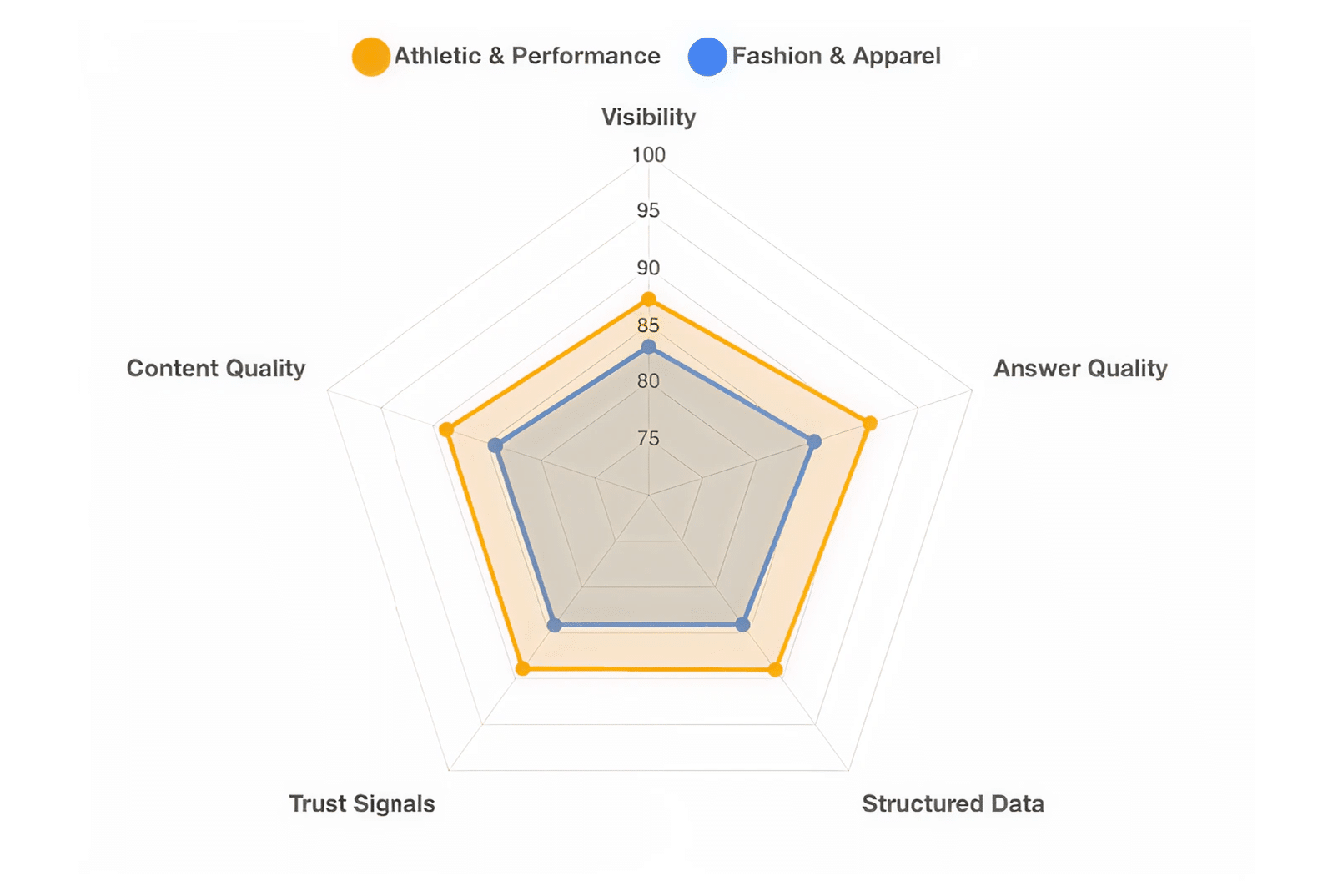
    • Athletic/outdoor outscore fashion by +15.7 points. They offer verifiable signals (records, ratings, specs), and have far more media citations (Nike 2,847 vs Gap 312), and large, active Reddit communities. Subjective style and fit struggles in LLMs.
  • Invisible Champions (~12%) exist:
    • Brands like Brooks, Reebok, and Everlane deliver excellent Answer Quality but lag on discovery. They succeed when asked directly but don’t appear in broader “best of” queries. The fix: get into high-authority listicles and guides that LLMs reference.
  • Models weigh signals differently:
    • Large gaps like Hollister (+18.7) and Vuori (+16.9) show that each model favors different signals. Gemini tends to credit social heat and DTC buzz, while OpenAI leans on Tier-1 media.
    • Winning requires universal signals, like verified reviews, a robust Wikipedia page, clear awards, and tuning to where your audience shops (ChatGPT ~39%, Gemini ~31%).
  • How Small Brands Can Beat Giants in the AI Age
    • See “The David” Strategy below

Reminder: this chapter builds on insights from editions 0106. So if you haven’t already, I suggest you give them a look.

About The Process

We didn’t cherry-pick winners. We picked testable brands. See the list of 100 brands hereThink consumer-facing, ecommerce brands with clear returns/warranty pages, real PDP specs, and enough third-party coverage that LLMs can cite something besides the homepage.

We spread across categories (apparel/outdoor, beauty, home, cookware, bottles, wearables, CE, bikes, nutrition), mixed legacy labels with DNVBs, and kept it English-first so evidence is recent and consistent. We excluded marketplaces, B2B, and messy edge cases (regulated or ambiguous names). In short: a balanced, reality-checked sample, Nike to Chubbies, built to stress-test the 5-score rubric, not to crown a favorite.

Using an n8n pipeline, each brand name was sent to two models in parallel (OpenAI + Gemini) with an identical, structured prompt. Each model returned scores (0–100) and evidence across five dimensions. We then compared leaders vs. laggards and measured inter-model agreement to see where models converge or disagree about a brand’s strength.

What We Measured (The Five Scores)

  1. GEO Visibility
    How reliably the brand appears (with citations) in early/mid/late-funnel category prompts. Scored by coverage, rank weight, and citation presence.
  2. Citation Strength & Diversity
    The quality, recency, and variety of sources LLMs rely on when talking about the brand. Scored by domain diversity, authority mix, and recency.
  3. Answer Quality & Accuracy
    Whether the model can provide specific, sourced facts to 10 buyer questions (returns, warranty, specs, pricing, materials, differentiators, target customer, availability, sustainability/ethics, support). Includes a hallucination penalty.
  4. On-Site Structured Readiness
    How “machine-readable” the brand looks from the model’s perspective: resolvable core URLs, policy clarity, PDP detail depth, and schema evidence.
  5. Sentiment & Trust Signals
    The last-12-months editorial tone and credible ratings from reputable sources, minus deductions for material unresolved issues (e.g., recalls, fulfillment failures).

Each dimension is scored 0–100 (higher is better) via a fixed rubric. Models must ground higher scores in verifiable evidence (URLs or named reputable sources). Missing evidence → conservative scoring.

The Industry Intelligence Gap: Who Wins and Loses in AI Visibility

Here’s what we saw.


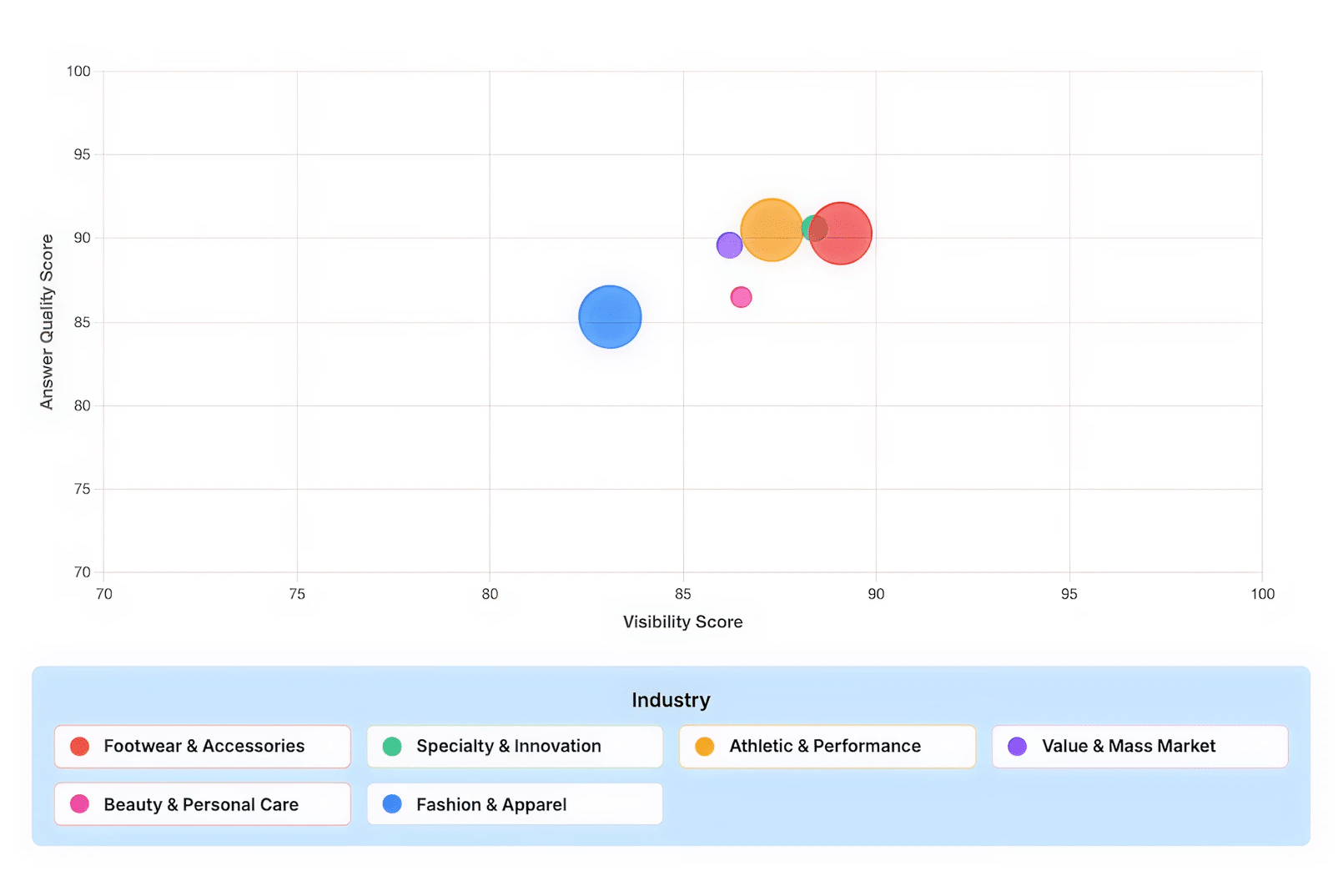
Athletic and performance brands are dominating. They’re averaging 91.3 overall, with strong visibility (how often AI finds them) and clear, accurate answers (how well AI explains what they sell). Think Nike, Lululemon, Arc’teryx. These brands live in the top-right corner of our chart, the space you want to be in. That big orange bubble? That’s athletic brands owning the two signals that matter most for AI recommendations.

Fashion and apparel brands, the biggest category we tested, are stuck in what I call the “danger zone.”

That large blue bubble in the lower-left? That’s traditional retail. Gap, Hollister, Abercrombie. Brands that used to dominate shelves barely show up in AI today. Visibility averages just 84.2. And when AI can’t find you, AI can’t recommend you. That’s the shift happening right now.

The surprise winner? Value and mass-market brands.

That purple dot at 89.5 proves you don’t need premium positioning to win in AI. You just need clarity. These brands make it easy for AI to understand what they offer. Structured. Direct. Specific. That’s what wins.

Beauty and personal care, the pink dot with 87.1 visibility, sits right in the middle. Strong on ingredient transparency and how-to content, but weaker on citations and media presence. Specialty brands are scattered. Some punch through, but no consistent signal yet.

This is the new visibility curve. Some brands have already adapted. Others are falling behind.

The “Invisible Champions” Paradox

About 12% of brands (Brooks, Reebok, Everlane) score high on Answer Quality but low on Geo Visibility. They show up well when asked directly but miss early-discovery prompts, where most AI-driven shopping starts.

Root cause: They lack strong SEO, press, or category-guide coverage. LLMs have no reliable entry points into their content. Even if the model knows the brand, it doesn’t surface it during discovery.

Fix: Prioritize getting into authoritative listicles and category guides. Focus PR on “best of” content that gets cited. Build out high-trust pages LLMs already use, like Wikipedia and major review hubs.

The Category Gap

Athletic/outdoor brands average 93.9 vs. fashion’s 82.1. Sports and outdoor brands win by providing hard, verifiable signals (tech specs, ratings, certifications) and generating broader content coverage.

Root cause: Fashion brands rely on subjective traits (style, fit) that LLMs struggle to evaluate or verify. They also attract less media coverage and fewer structured community conversations.

Fix: Quantify your value and sustain multi-source content. Add specs, explain materials, use certifications. Push UGC and expert content into spaces LLMs crawl (Reddit, YouTube, Wikipedia). Don’t just tell a story. Document what makes your product better.

Model Disagreement Zones

Brands like Hollister (+18.7) and Vuori (+16.9) get very different scores from OpenAI vs. Gemini. Gemini favors social buzz and DTC cues. OpenAI leans on traditional media and Tier-1 citations.

Root cause: Each model has different weighting for signal types. Gemini pulls from broader, newer, and social-friendly sources. OpenAI favors long-standing authority and verifiability.

Fix: Ship signals that both models trust. Think verified customer reviews, robust Wikipedia presence, and earned media in credible outlets. Then track your category across both models and adjust your strategy based on where buyers are coming from.

The Trust Consensus Brands

Patagonia, The North Face, and Columbia score 85+ with less than 5-point model variance. This consistency is rare and valuable. These brands show up reliably because both models trust their signals.

Root cause: They’ve earned a high-trust reputation across multiple sources: independent testing, credible reviews, authentic media stories. No major scandals or controversies.

Fix: Build real trust, not surface-level branding. Invest in product quality, get certified (e.g., B Corp, Fair Trade), maintain a clear mission, and avoid shortcuts that create risk. If something breaks trust. Fix it fast and publicly.

Success DNA, What Winners Do Differently

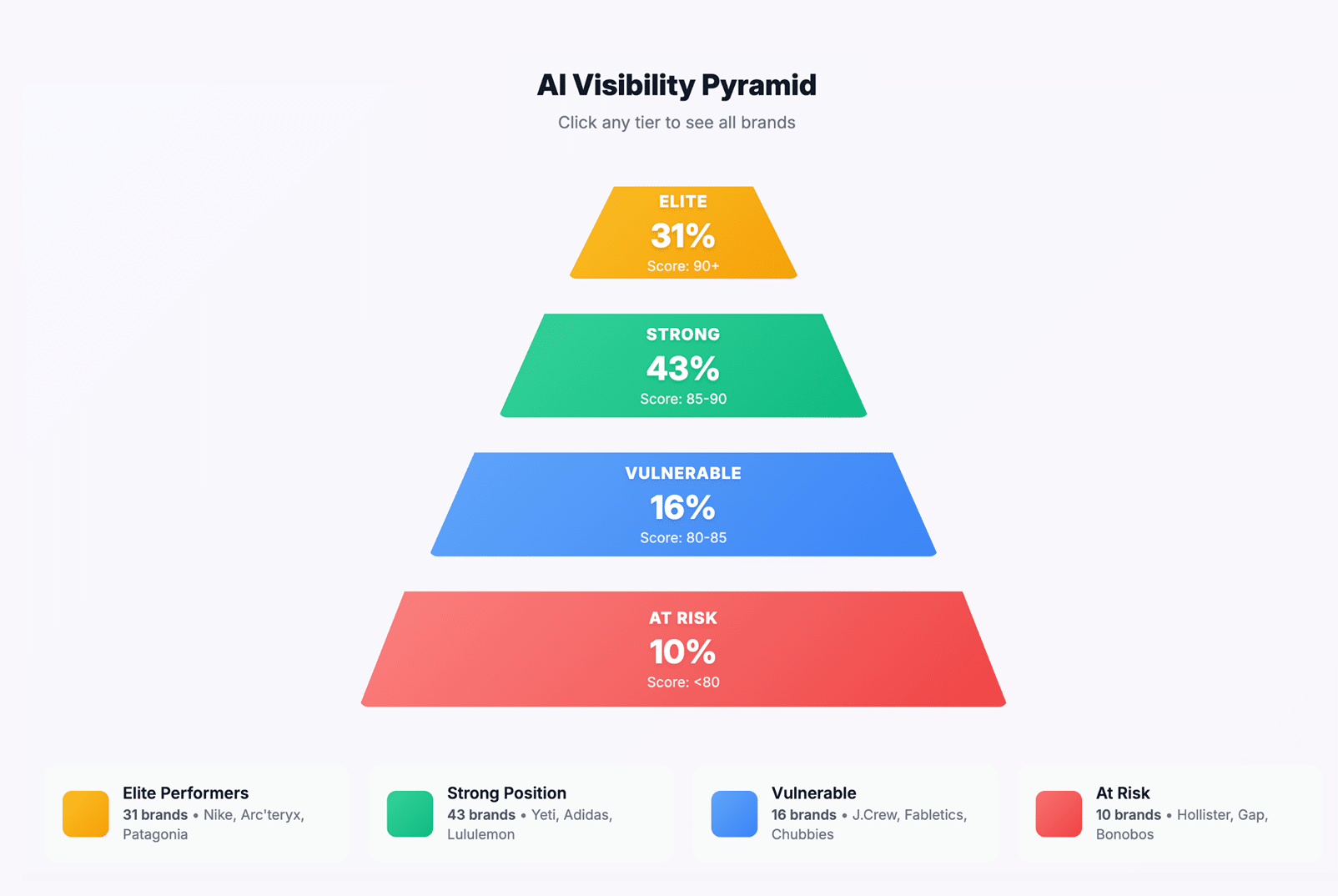
The AI Visibility Pyramid

Geo Visibility

Elite brands score 87.8 on average, 11.4 points higher than others. The gap between leaders and strugglers is 25 points (87.8 vs. 62.8), and it shows up in search performance.

Search dominators (90+): Nike (94), DJI (92), Dyson (91), and Ray-Ban (90) consistently lead category-level queries.

Owning multiple intents:

  • Nike ranks for performance (marathon shoes), lifestyle (streetwear), and sustainability (recycled sneakers).
  • Dyson shows up for innovation (cutting-edge tech), premium (luxury appliances), and problem-solving (pet hair vacuums).

Content magnets:

  • Nike’s training programs are cited by fitness blogs.
  • Patagonia’s repair guides appear in sustainability articles.
  • DJI’s tutorials are linked in photography forums.

The Wikipedia effect: Top brands invest in deep, well-sourced Wikipedia pages that cover product lines, brand history, and innovation. Lower performers either have stubs or no page at all, which makes them invisible to models relying on those sources.

Citation Strength:

Elites are +7.4 points higher, averaging 89.7 vs. overall 82.3.

Media darlings (92+). Patagonia (95), Nike (92), Lululemon (92), The Ordinary (92),covered by Tier-1 press and amplified by niche experts, influencers, and Reddit.

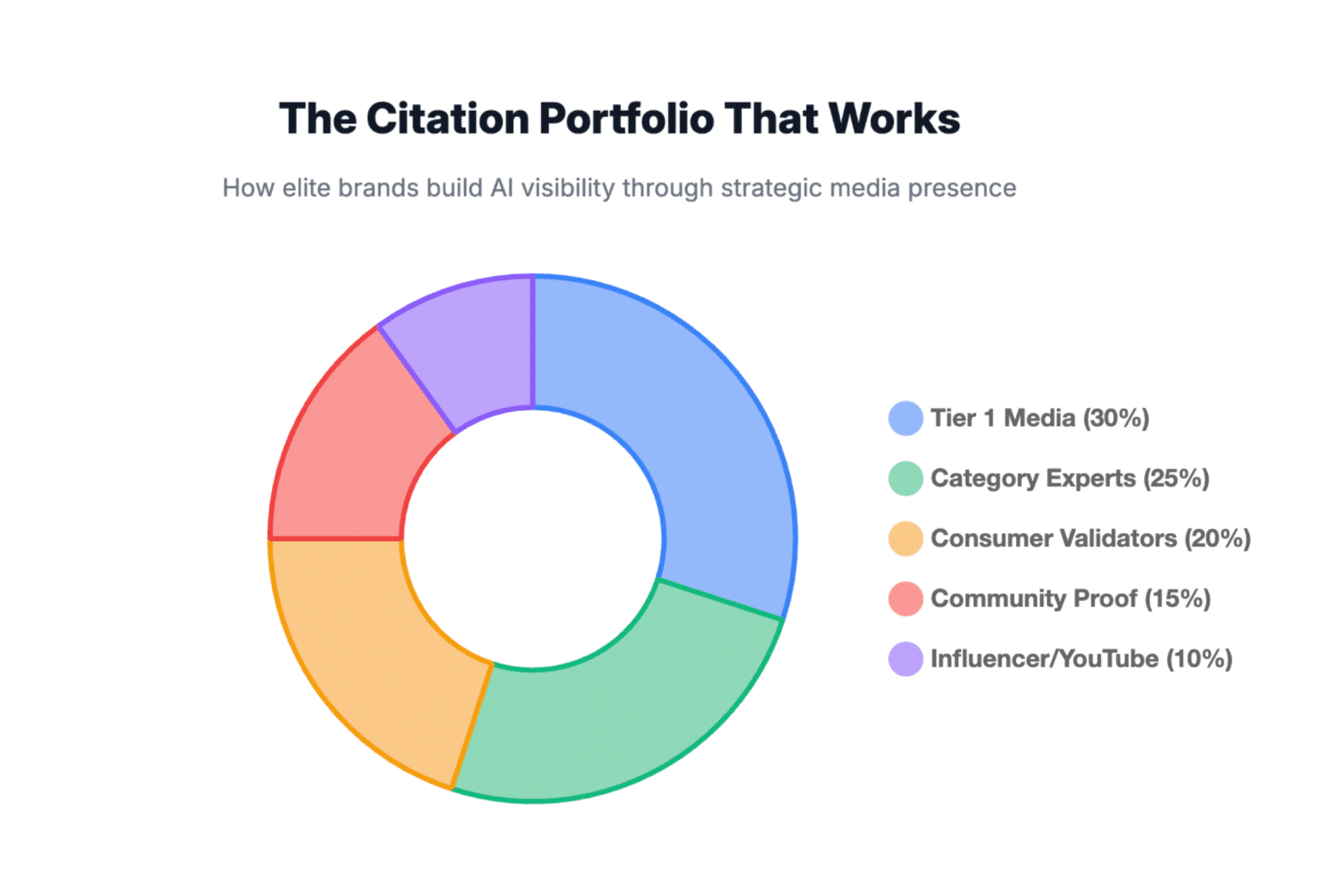
The citation portfolio that works.

  • Tier-1 media (30%): WSJ, NYT, Forbes, Bloomberg, earnings, activism, acquisitions.
  • Category experts (25%): Runner’s World, Outside, Gear Patrol, buying guides & “best of” lists.
  • Consumer validators (20%): Wirecutter, Consumer Reports, Good Housekeeping, lab tests, awards, seals.
  • Community proof (15%): Reddit/forums, e.g., r/BuyItForLife loves Patagonia; r/running debates Nike vs. Hoka.
  • Influencers/YouTube (10%): Unboxings, reviews, hauls, e.g., MKBHD; fitness creators in Lululemon.

Why do some brands get ignored?

  • No news hook (e.g., Buck Mason: solid basics, no story).
  • Lost narrative (Outdoor Voices: buzz derailed by founder drama).
  • Category confusion (Chubbies: swimwear? shorts? comedy brand?).

Sentiment and Trust

Elites are +5.1 points higher on reputation,92.8 vs. strugglers at 75.3 (+17.5 gap).

Trust champions (top sentiment). Boll & Branch (93), Patagonia (92), New Balance (92), Brooks Running (92), known for transparent supply chains, strong warranties, made-in-USA signals, and credible testimonials.

Trust signal hierarchy.

  • Level 1 – Table stakes: clear, easy-to-find return policy; real customer-service contact; secure checkout badges.
  • Level 2 – Credibility: fresh positive reviews (last 90 days); professional endorsements (e.g., Nike athletes, Arc’teryx climbers); media coverage without controversy.
  • Level 3 – Authenticity: user-generated content (Yeti cooler “torture tests”); community involvement (Patagonia’s activism); founder stories (Warby Parker’s mission).
  • Level 4 – Validation: third-party certifications (B Corp, Fair Trade); industry awards (e.g., ISPO for Arc’teryx); long-term customer testimonials.

The David Strategy: How Small Brands Can Beat Giants in the AI Age

Here’s what the big brands won’t tell you: they’re terrified. Sure, they have resources, but they also have bureaucracy, legacy systems, and the agility of a cruise ship. 

You can pivot tomorrow. In the AI age, that’s your superpower.

Why Small Brands Actually Have the Edge

1. The Authenticity Arbitrage 

Big brands sound corporate. Committee-written, legal-approved, sanitized. AI can smell this, and so can customers.

  • Example: Beardbrand gets cited in ChatGPT 3x more than Gillette for beard care. Why? They write like humans about real problems.
  • Action: Rewrite your top 10 products in your founder’s voice. Watch AI start quoting you.

2. The Niche Domination Play

Nike tries to own “shoes.” You can own “wide-toe box minimalist running shoes for plantar fasciitis trail runners.”

  • The Math: Being #1 for 100 ultra-specific queries beats being #50 for “running shoes”
  • Example: Altra Running ($200M) beats Nike in AI for “zero drop trail runners” because that’s ALL they do

3. The Speed Advantage 

Enterprise brands take 6 months to update tech. You can move in 6 hours.

  • Launch on TikTok Shop while they’re still in meetings
  • Create ChatGPT Custom GPTs in 17 minutes (they need 17 approvals)
  • Test 50 product variations while they approve one
  • Jump on Perplexity Ads Beta (12% CTRs) before they know it exists

Guerrilla Tactics That Work

The Parasite Strategy

Attach to bigger brands like a remora:

  • “Alternative to [Big Brand]” pages
  • “[Your Brand] vs [Big Brand]” comparisons
  • Reddit/Quora answers (you can be personal, they can’t)
  • YouTube: “Why I switched from [Big Brand] to [Your Brand]”

The Local Hero Play 

Google AI loves “near me” queries:

  • Partner with 10 local businesses
  • City-specific pages with real local knowledge
  • Local events = news citations = AI visibility
  • Example: Velocio bike shop beats Trek for “bike shop Boston” by sponsoring every local ride

The Founder Card

AI loves real stories. So do customers.  

  • Detailed “About Us” with real struggles
  • Founder as face of customer service
  • Founder videos answering questions
  • Bombas built $500M on founder’s homeless mission story

The Review Arbitrage 

Big brands: 1% review rate. You: 20%.

  • Personal founder email 7 days post-purchase
  • Incentivize detailed, use-case reviews
  • Respond to EVERY review (AI trust signal)
  • Video reviews = 10x more powerful for AI

The Uncomfortable Truths Nobody Wants to Say:

  • This is permanent. Google isn’t “fixing” AI Overviews. They are building toward them.
  • Free traffic is gone. Organic only acquisition isn’t dead.
  • Size matters, again. The middle is getting squeezed out. You need to go big or go niche.
  • AI optimization ≠ SEO. It’s about structured data, crawlability, and trust—not keywords.
  • Many brands won’t survive. Just like when ecommerce killed the catalog.

Your Next 90 Days: The Survival Checklist

Week 1-2: Assess the Damage

  • Pull your Google Search Console data: What’s really declining?
  • Search your brand/products in ChatGPT, what shows up?
  • Audit your traffic: How dependent are you on Google?

Week 3-4: Stop the Bleeding

  • Clean up your product feeds (Google, Bing, Tiktok, Meta)
  • Add structured data to every product page
  • Ensure OAI-SearchBot and GPTBot can crawl your site

Month 2: Pivot Your Strategy

  • Shift content focus from informational to transactional
  • Launch on at least one new marketplace
  • Start building owned audiences (email, SMS, app)

Month 3: Build for the Future

  • Implement a proper UGC strategy (text + video reviews)
  • Test AI optimization tools (SEO, PDPs, support, product naming)
  • Create platform specific content strategies (Youtube, Reels, Tiktok, etc.)

I put together a comprehensive, downloadable 90-Day Survival Checklist to help you stay competitive.

You can download it here

The Bottom Line:

The 11.4-point Geo Visibility gap is the killer. If LLMs can’t find you, nothing else matters. But visibility without trust is dangerous (see Zara, H&M).

The sweet spot is a sequence: First be findable. Then, be worth citing. Only then can you become trusted. In that order.

The brands that win (Nike, Patagonia, Arc’teryx) aren’t just good at one thing -they create a compound effect where each strength reinforces the others. The brands that lose (Hollister, Gap, Bonobos) have compound weakness where each problem makes the others worse.

Want to check your score? Copy and paste this prompt to your favorite LLM and check out for yourself.

Hope this was helpful. If you know someone who would find it useful, feel free to pass it along.

– Tomer

30 min demo
Don't postpone your growth
Fill out the form today and discover how Yotpo can elevate your retention game in a quick demo.

Yotpo customers logosYotpo customers logosYotpo customers logos
Laura Doonin, Commercial Director recommendation on yotpo

“Yotpo is a fundamental part of our recommended tech stack.”

Shopify plus logo Laura Doonin, Commercial Director
YOTPO POWERS THE WORLD'S FASTEST-GROWING BRANDS
Yotpo customers logos
Yotpo customers logosYotpo customers logosYotpo customers logos
30 min demo
Don't postpone your growth
Check iconJoin a free demo, personalized to fit your needs
Check iconGet the best pricing plan to maximize your growth
Check iconSee how Yotpo's multi-solutions can boost sales
Check iconWatch our platform in action & the impact it makes
30K+ Growing brands trust Yotpo
Yotpo customers logos