








“Yotpo is a fundamental part of our recommended tech stack.”
Why AI FOMO Is Real for eCommerce Brands (And What to Do About It)
CommerceGPT: edition 05
Something strange is happening in every eCommerce brand meeting lately. CMOs, founders, and growth leads keep circling back to the same quiet, nagging question. Now getting louder:
“Are we even showing up in AI?”
TL;DR:
- The FOMO is real. And rational. Brands sense the shift: AI visibility is now shelf space.
- AI is quietly becoming the new front door to eCommerce. If your brand isn’t mentioned in AI answers, it might as well not exist.
- It’s not just search. it’s recommendation, comparison, and conversion. ChatGPT Agents and Google’s AI Mode are shaping decisions before shoppers even hit your site.
- You’re either missing, misrepresented, or overly reliant on one SKU. And AI is already telling that story.
- You don’t need a new tool to start. Just run the 21-Prompt Test: 7 prompts each for TOFU, MOFU, and BOFU to see how your brand shows up across the journey.
Last thing before we dive in:
this chapter is built upon the topics we reviewed in the previous newsletters, so if you haven’t already, I suggest you to read Edition 02- Why You Should Care About Bing, Edition 3 – The Invisible Brands of ChatGPT, Edition 4 – The New Battleground for Product Discovery
“Are we even showing up in AI?”
That question isn’t paranoia. It’s a signal. Because deep down, brands are sensing what the data is just beginning to confirm: AI is quietly reshaping the customer journey. And if your product, brand, or category isn’t mentioned in the AI-generated answer, you might not exist at all.
AI isn’t just responding anymore. It’s deciding. ChatGPT Agents can now research, compare, and even buy on a shopper’s behalf. Google’s AI Mode is doing something similar, serving up layered recommendations and product insights before users ever visit a website. These aren’t edge cases. They’re a shift in the center of gravity.
The real story is this:
AI, and increasingly Agentic AI, is becoming the new front door to eCommerce.
And every brand can feel the stakes rising: if you’re not being mentioned, compared, or recommended inside these systems, you’re missing the shelf space that matters most. You’re invisible at the exact moment shoppers are making decisions.
The data underscores this urgency: as generative AI traffic has surged, revenue influenced by LLM-driven discovery has accelerated nearly 9x faster, proving that visibility in AI-driven ecosystems directly translates to sales.
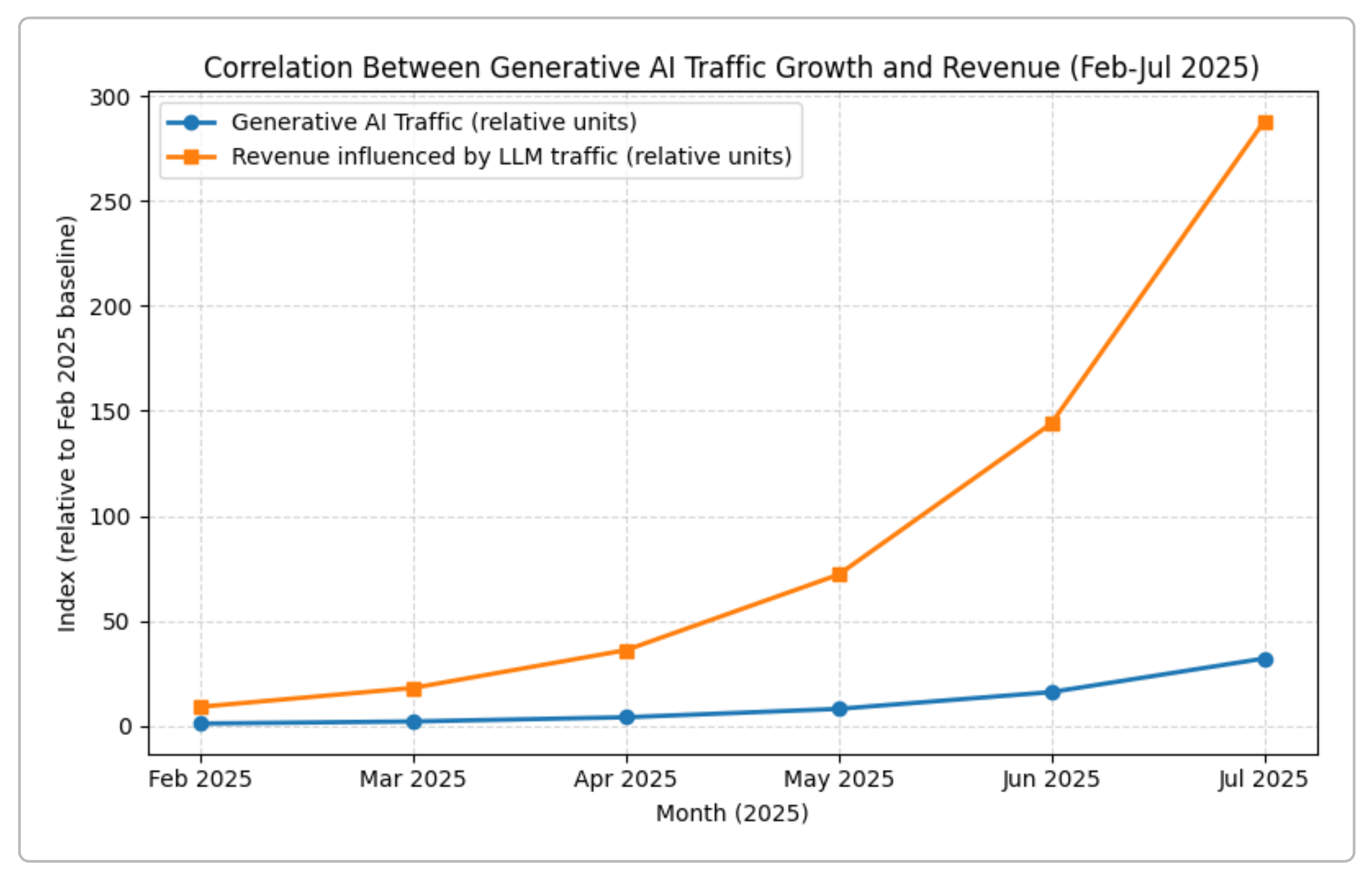
Sources: Adobe Analytics, Forbes, Seer Interactive, SALT.agency, RetailWire
Don’t Panic. Just Run the 21-Prompt Test.
As the saying goes, “Awareness is the first step toward change.” That’s exactly where this chapter begins.
If you’re feeling the FOMO, good. That means you’re paying attention. Now it’s time to move from fear to action. You don’t need a new tool, a dev team, or even a big budget to start.
You just need to ask the right 21 questions.
And no, 21 isn’t just a nice round number. It’s intentional.
This test is built around 7 prompts for each stage of the shopper journey: because each stage tells you something completely different about your brand’s visibility.
- Top-of-Funnel (TOFU): These prompts tap into that early, casual curiosity, when shoppers don’t even know what brand they’re looking for yet. Questions like “What’s a good skincare routine for dry skin?” or “Best gifts for a coffee lover?”
Most brands never get mentioned if the prompt is too general. But if yours does? That’s rare air. It means you’re part of the mental shortlist very early in the process. - Middle-of-Funnel (MOFU): Now we’re in comparison mode. The shopper is weighing options, checking reviews, testing trust. Prompts like “Is Brand X better than Brand Y?” or “What are some alternatives to Brand X / Product Z?”
This is where your story gets told. Are you positioned clearly? Do your strengths shine? Or is AI fumbling the details and favoring someone else? - Bottom-of-Funnel (BOFU): This is the make-or-break moment. The shopper’s ready to decide. And the AI’s final answer might be the only opinion that matters. Prompts sound like “Does Brand X offer free returns?” or “Is Product Y worth it at $299?”
If the AI affirms, reassures, and recommends you, great. If it dodges or deflects? You’re losing sales in the last mile.
And let’s be real – most of us have already tried it. You’re on the couch, scrolling before bed, and you toss a quick question into ChatGPT: is our product better than a competitor’s? Even that single answer can reveal something about how your brand is showing up.
But here’s the thing. Asking one question gives you a glimpse.
Asking 21, each crafted to test a different angle, gives you a full picture.
This simple test isn’t designed to be perfect or precise. It’s not a full audit. It’s a fast, practical way to see in under 30 minutes how your brand shows up in the AI world across the entire customer journey.
The beauty of this method is that it mimics how real shoppers use tools like ChatGPT or Perplexity. You’re not testing prompts like a marketer. You’re testing them like a customer.
You’ll be surprised to see that it’s not even a heavy or technical process. In fact, it’s oddly fascinating. Zooming out and seeing how AI talks about your brand, your category, and your competitors can be one of the most eye-opening exercises you run all quarter.
What the Test Can Reveal (and Why It Might Surprise You)
So what happens when you actually run the 21 prompts?
Here are a few insights we’ve seen emerge in the wild. None of them are hypothetical, and each one opened up new ways of thinking about visibility and AI-era positioning.
- You’re Missing Completely, But So Are Your Rivals
One brand was surprised to see that not a single player in their category, including themselves, appeared in early-funnel prompts. The right prompts were there, but the AI couldn’t find enough structured or cited content to confidently answer. It wasn’t a loss. It was an opening. If none of the competitors are earning that answer box yet, there’s a race to be first – through top-funnel explainers, off-site reviews, or fresh schema that helps LLMs confidently pick a name. - You’re Visible, But Only in the Context of One Product
Another brand ran the test across multiple product lines and noticed something odd: they kept showing up, but always for the same hero SKU. That flagship item had been heavily promoted, reviewed, and mentioned. But for adjacent categories, where the brand was actively trying to grow, there was silence. It raised a few smart questions: are other products being supported with enough structured content? Do UGC focus too narrowly on one item? - The AI Gets Your Product Details Wrong (Repeatedly)
There was one case where the brand showed up, but the AI got key facts wrong. Specs, pricing, and availability were all outdated. The most likely source? A mix of old blog posts, stale reviews, and third-party listings that hadn’t been updated in over a year. The brand’s own site was accurate, but the AI was pulling from the wider web. The issue wasn’t internal hygiene, it was the need to refresh the surrounding content ecosystem before old data becomes the default story.
Each of these patterns tells a different story, not just about how visible a brand is, but what kind of impression it leaves when AI fills in the blanks. Some findings feel obvious in hindsight. Others challenge assumptions. But they all have one thing in common: you wouldn’t catch them without asking the right questions.
Run the Test: Practical Checklist
Step 1: Generate Your Prompts
Pick one of the following paths:
- DIY it: Think like a shopper and write questions a shopper might ask at each stage of the journey: broad exploration (TOFU), comparisons (MOFU), and decision-making (BOFU). Keep it natural.
- Ask AI to help: Prompt ChatGPT or your other favorite LLM something like:
“Give me 7 TOFU, 7 MOFU, and 7 BOFU prompts a shopper might ask when evaluating [Your Category].” - Use our AI Discovery Evaluator: Just share your brand name + domain. Our pre-built generator does the rest, generating a full 21-prompt set tailored to your funnel.
Step 2: Test in a Clean Environment
- Open a new, anonymous ChatGPT session. No memory, no history, no brand association.
- One prompt per session. Don’t paste all 21 at once. Treat each as a unique interaction.
Step 3: Log the Raw Results
- Create a simple sheet or doc with these minimum columns: Funnel Stage, Test Prompt, Test Result. You can use this template as a starter.
- Paste each AI answer exactly as it appears unedited.
- Save the file as your raw visibility dataset.
Step 4: Analyze Your Visibility
Choose how deep you want to go:
- Quick notes: Skim each answer. Are you mentioned? Recommended? Compared? What’s the tone?
- Ask AI to analyze it: Drop the file into your favorite LLM and prompt something like: “Analyze this sheet for brand visibility across the funnel. Identify strengths, gaps, and recommendation patterns.” For a smarter take, add: “Before generating a response, ask me any follow up questions you need to know in order to provide your analysis.”
- Use our AI Discovery Evaluator: Just upload the file and the magic happens.
Step 5 (Optional): Go Further
- Run the test across multiple LLMs (ChatGPT, Perplexity, Gemini, Claude)
- Re-test monthly or quarterly to track changes
- Customize tests for different SKUs, buyer types, or languages
- Share anonymized results internally to spark strategy discussions
This shift isn’t theoretical. It’s already here.
The 21-Prompt Test won’t solve everything, but it gives you the clearest snapshot we’ve seen of how your brand actually shows up, or doesn’t, inside AI systems that are shaping more decisions every day.
Don’t overthink it. Just run the test. Share it with your team. Use it as a starting point. Because this isn’t a nice-to-have diagnostic. It’s a visibility check for the new front door of eCommerce.
And if your brand isn’t showing up there, nothing else matters.
Hope this was helpful. If it was, feel free to share it with a friend.
— Tomer


Join a free demo, personalized to fit your needs