



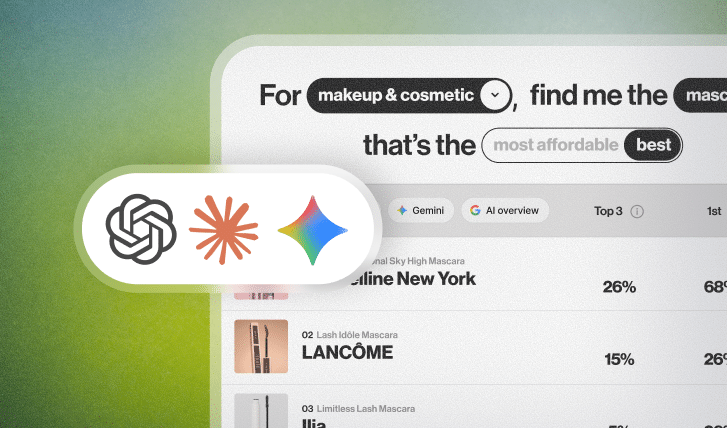










Online search has shifted heavily from traditional keyword indexing to Answer Engine Optimization (AEO). For e-commerce brands, this shift changes how shoppers discover products. When a consumer asks a conversational question, a traditional search engine returns blue links. An AI engine synthesizes a direct answer. To capture that traffic, you need to structure your Product Detail Pages (PDPs) so large language models can read them, trust them, and cite them. Below is a step-by-step framework that walks you through exactly how to do that.
Key Takeaways
- AI search traffic is growing fast, with projections showing it will reach 40% of total search traffic by 2027.
- Generative search platforms are capturing massive audience attention; ChatGPT Search, for example, reached a large and fast-growing monthly audience in Q2 2026.
- Consumers increasingly rely on these platforms, as half of consumers now consult AI at the exact moment of a buy decision.
- This shift is changing how shoppers decide: a growing share of US shoppers now use AI tools when making purchase decisions.
- Retailers adapting early see real results: 89% of retailers have adopted AI in some capacity, and most of those report measurable revenue gains from their investments.
- Strong AEO requires three things working together: technical schema, natural language optimization, and authentic customer validation.
Why This Matters: The Shift to AI Product Discovery
For years, SEO meant chasing rankings, building links, and stuffing the right keywords into the right tags. AI search platforms don’t work that way. Instead of matching keywords, they parse natural language semantics to find the most relevant answer for a given question. A page optimized only for crawl bots (stuffed with keywords but light on context) loses visibility to pages that actually answer questions well.
Picture a head of SEO at a growing DTC brand sitting at her desk at 7 PM, cold coffee beside her, watching organic clicks drift downward while a competitor she’s never taken seriously keeps showing up in ChatGPT recommendations. That scenario is playing out across hundreds of brands right now. Perplexity alone grew to a large and fast-growing monthly audience, and discovery behavior is changing faster than most teams realize (and that’s the part most dashboards still miss).
Whether AI ends up driving a modest or substantial slice of your digital traffic, missing these citations is a real business problem. AI engines need structured, well-validated information to form their recommendations. If your PDPs don’t supply clear SKU-level commerce data alongside verified social proof, models will pass over your brand in favor of a competitor who provided what they needed.
The underlying mechanism matters here. Where legacy search relied on keyword matching and backlink authority, AI search uses vector search and Retrieval-Augmented Generation (RAG) to understand the actual intent behind a query. A product page that simply repeats primary keywords in a meta description won’t surface in that process. If your technical architecture and customer reviews aren’t structured for these neural networks, your products stay invisible to the engines processing billions of conversational queries every day.
The Framework: Four Stages to AI-Optimized Product Pages
Winning citations in AI search means giving models both machine-readable facts and human-validated trust signals. This framework covers four progressive stages of optimization, each addressing a specific layer of how large language models retrieve, evaluate, and cite product information.
First, you build a clean technical foundation so crawlers can extract product attributes instantly. Next, you structure product copy to answer chat-based queries naturally. Then, you bring in authentic shopper voices to supply the third-party validation models rely on. Finally, you set up tracking workflows so you can see exactly where you stand and take targeted action when citations slip.
Stage 1: Technical Schema and SKU-Level Attribute Structure
What the Technical Layer Actually Does
AI engines don’t browse product pages the way human shoppers do. They parse underlying code to extract product attributes, pricing, and availability. If an AI crawler can’t quickly pull your product data from that code, your brand doesn’t appear. Making your SKU-level commerce data fully transparent to search bots is the baseline, and without it, everything else in this framework runs at a disadvantage.
Think of schema markup as your product’s data passport. A well-formed JSON-LD block tells every AI engine exactly what your product is, who made it, what it costs, and whether it’s in stock, without requiring any interpretation. At scale, across thousands of SKUs, that passport is what separates brands that get cited from those that don’t. When you’re running a catalog of even a few hundred products, the difference between complete schema and patchy schema compounds quickly.
How to Execute
Start by implementing rich schema markup in JSON-LD format. Go well beyond basic Product schema by adding detailed properties: brand, MPN, GTIN, color, material, and size. These precise data points help models match your products with highly specific queries, the kind of long-tail question a real shopper actually asks.
A clean JSON-LD block for a straightforward product looks like this:
{
  "@context": "https://schema.org/",
  "@type": "Product",
  "name": "Organic Cotton Crewneck Sweatshirt",
  "image": [
    "https://example.com/photos/1x1/photo.jpg"
  ],
  "description": "A mid-weight crewneck sweatshirt made from certified organic cotton.",
  "sku": "SWEAT-ORG-01",
  "mpn": "925872",
  "brand": {
    "@type": "Brand",
    "name": "EcoThread"
  },
  "offers": {
    "@type": "Offer",
    "priceCurrency": "USD",
    "price": "58.00",
    "itemCondition": "https://schema.org/NewCondition",
    "availability": "https://schema.org/InStock"
  }
}
Structured data is the baseline requirement for AI engine visibility. It’s not optional. But tracking missing or broken schema across thousands of SKUs manually isn’t realistic. Yotpo Discover handles this through its Onsite Agent, which continuously scans your store, finds structural schema gaps, and resolves them automatically.
Common Pitfalls
Many brands rely on outdated or incomplete schema templates set up years ago and never revisited. Missing identifiers like GTIN or MPN prevent AI engines from cross-referencing your product with external databases, which is exactly how models build confidence in a product claim. Validate your markup regularly using Google’s Rich Results Test, and treat schema maintenance as ongoing work, not a one-time setup.
Stage 2: Natural Language Copy and Authentic Shopper Voices
Why Conversational Copy Beats Keyword Density
AI search queries are chat-based, long-tail, and specific in a way keyword-era copy wasn’t designed to match. Shoppers no longer search for “waterproof running shoes.” They ask for “the best waterproof running shoes for wide feet that don’t cause blisters on long trail runs.” Your PDP copy has to meet that specificity, or a competitor’s page will.
This is one of those shifts that sounds straightforward but requires a genuine rethink of how product descriptions get written. It’s not about stuffing more words onto the page. It’s about answering the exact questions buyers bring to the conversation, in the natural language they’d use to ask them. When you do that well, you’re also feeding AI crawlers the vocabulary they need to match your product to the right queries, and you’re doing it in a way that reads naturally to human visitors too.
How to Execute
Rewrite your PDP copy so it directly answers specific customer questions. Use clear headings formatted as questions, followed by concise, direct answers. That structure maps cleanly to the Retrieval-Augmented Generation processes used by answer engines like ChatGPT and Gemini, which makes your content easy to pull and cite.
Customer reviews are a practical shortcut here. Real buyers write exactly the way other real buyers search: they mention fit issues, texture details, use cases, and edge cases that no copywriter would think to include. By featuring authentic review content prominently on your PDPs, you give AI crawlers a live source of chat-based vocabulary matched to genuine shopper queries. That’s one of the most cost-efficient ways to expand your natural language footprint across a large catalog.
If a model can’t find answers to highly specific customer questions on your page, it will cite whoever did provide them. The Content Agent in Yotpo Discover addresses this directly: it pulls from real shopper reviews and past order data to generate review-backed buying guides and optimized content that AI engines can trust and cite.
Common Pitfalls
Don’t pad product descriptions with repetitive keyword lists hoping to match more queries. AI engines detect those patterns and treat them as low-quality signals. Focus on clear, informative descriptions that sound like something a knowledgeable human actually wrote, because that’s what models weight most when deciding what to cite.
Stage 3: Off-Page Signals and Third-Party Validation
Why AI Engines Look Beyond Your Site
AI engines don’t evaluate your brand based solely on what you publish on your own pages. They search the broader web for third-party validation: forums, marketplaces, community platforms, social channels. If your brand appears only on your own properties, models will treat your claims with more skepticism than if real shoppers are discussing your products independently elsewhere.
This is the off-page layer of AEO, and it’s the one most teams underinvest in. Building genuine community presence across Reddit, Quora, and vertical forums is relationship-driven work, but the payoff is real, because these platforms are exactly where AI engines go to verify product quality from an unbiased source. Community-driven content is increasingly prioritized by answer engines when responding to commercial queries, precisely because it’s harder to manufacture at scale.
How to Execute
Build a meaningful presence on the high-authority platforms that answer engines frequently cite for your category. Reddit and Quora are solid starting points, but niche vertical forums often carry more weight for specific product types. When real customers discuss your product in those communities, they create the off-site signals that AI search engines weight heavily.
Encourage verified buyers to share genuine experiences on these external platforms. That organic discussion builds authority across the broader web in a way that owned content can’t replicate. The Activation Agent in Yotpo Discover automates this process: it identifies the specific platforms AI engines cite most for your category, then prompts your verified loyalty members to share authentic experiences on those exact platforms, removing the manual coordination that makes this kind of program difficult to sustain.
Common Pitfalls
Don’t try to shortcut this by creating fake forum accounts or seeding inauthentic recommendations. AI models are trained to detect unnatural sentiment patterns and manufactured community signals. Focus on activating genuinely satisfied customers, people who already love your product and just need a nudge to say so where it counts.
Stage 4: Continuous Auditing and Citation Track-and-Act Workflows
Why Visibility Requires Ongoing Work
AI visibility is dynamic in a way that keyword rankings never quite were. Search models update their retrieval pipelines on a rolling basis, and a page that’s highly cited today can slip quietly within days if a competitor improves their schema or earns fresh community signals. Tracking dynamic citation rates and share of voice across all major AI engines isn’t an optional extra. It’s the only way to know where you actually stand.
How to Execute
Start with a full readiness audit to establish your baseline visibility. This audit measures how often your products appear across ChatGPT, Gemini, and Google AI Overviews. Once you have that baseline, you can identify which specific products are losing share of voice and to which competitors, and you can prioritize your fixes with real data behind them.
Passive monitoring isn’t enough. Getting a visibility score is the starting point, not the goal. You need to move from seeing a gap to closing it, and that means deploying agents that automate the fixes rather than waiting for your team to work through a backlog by hand.
Yotpo Discover is the first AI visibility platform built specifically for the complex reality of commerce. It deploys three automated agents—the Onsite Agent, Content Agent, and Activation Agent—to execute visibility strategies continuously. These agents work together to resolve technical schema issues, generate review-backed content, and drive off-site signals without requiring manual intervention at each step.
Common Pitfalls
Many brands treat AI optimization as a one-time project. They run an audit, make fixes, and move on. But retrieval models update constantly, so what’s working today may not hold next month. Set up continuous tracking and treat citation rate as a standing metric, the same way you’d track organic traffic or conversion rate across the rest of your funnel.
Measuring Success: KPIs for AI Visibility
Evaluating performance in AI search requires a different set of metrics than the ones most teams are used to. Click-through rate and organic rank still matter for traditional search, but they don’t tell you how often AI engines are citing your products or recommending your brand in synthesized answers.
The core metric to track is citation rate: how often your products appear in AI answers for relevant queries. Pair that with AI share of voice across your product categories, and with referral traffic coming directly from AI platforms. Together, these three metrics give you a clear, ongoing picture of your standing across the new search layer.
One reason this measurement is genuinely hard: traditional rank trackers can’t parse chat-based outputs. Success here means tracking the direct citation rate of your SKU-level commerce data across different user prompts, not static positions, but share of voice within synthesized recommendations over time. Brands that build these baseline metrics early move faster than competitors still relying on legacy search data, because they see shifts in real time instead of discovering them weeks after the fact.
“AI visibility isn’t about feeding search bots more keywords; it’s about structuring your authentic customer experiences so LLMs can trust and recommend you. When you align SKU-level data with real shopper voices, you build an authority engine that traditional SEO alone can’t replicate.”
Ben Salomon, Growth Marketing Manager at Yotpo
Frequently Asked Questions
What is Answer Engine Optimization (AEO)?
AEO is the practice of optimizing web content to be easily retrieved, synthesized, and cited by AI-powered answer engines. It focuses on matching chat-based queries rather than traditional keyword indexing.
Does AEO replace traditional SEO?
No, AEO is a complementary layer that works alongside traditional SEO. While SEO helps you rank in standard search results, AEO keeps your products appearing in AI summaries and synthesized answers.
How do AI engines find product data?
AI engines crawl web pages, product feeds, and structured schema markup to extract product attributes. They also analyze customer reviews and third-party forum discussions to verify product claims independently.
Why is schema markup important for AI search?
Schema markup gives AI models clear, machine-readable facts about your products in a standardized format. That structured data lets models understand your product attributes directly, rather than inferring them from prose copy.
How do customer reviews affect AI visibility?
Customer reviews supply natural language content that closely mirrors how real shoppers search. AI engines analyze those reviews to find chat-based terms and assess how trustworthy a product’s claims actually are.
What is Yotpo Discover?
Yotpo Discover is the first AI visibility platform built specifically for the complex reality of commerce. It helps brands track and improve their visibility across major AI engines like ChatGPT, Gemini, and Google AI Overviews.
How does the Onsite Agent work?
The Onsite Agent continuously scans your e-commerce store to find and fix structural technical issues. It keeps your product pages stocked with correct, complete schema markup so AI crawlers always have what they need.
What does the Content Agent do?
The Content Agent generates high-quality, review-backed content based on real customer experiences. That optimized content becomes trusted source material AI engines can cite directly.
How does the Activation Agent drive off-site signals?
The Activation Agent identifies the specific third-party platforms that AI engines cite most for your category, then prompts your verified customers to share their authentic experiences on those exact platforms.
Adapting your store for AI search isn’t a future-state experiment. It’s something your competitors are actively working on right now. Brands like Beekman 1802 and David Protein rely on Yotpo Discover to track and improve their visibility across these engines.
To see where your brand stands today, get a free AI visibility score. Or visit the Yotpo Discover page to learn more about the platform and request a demo.



 Join a free demo, personalized to fit your needs