



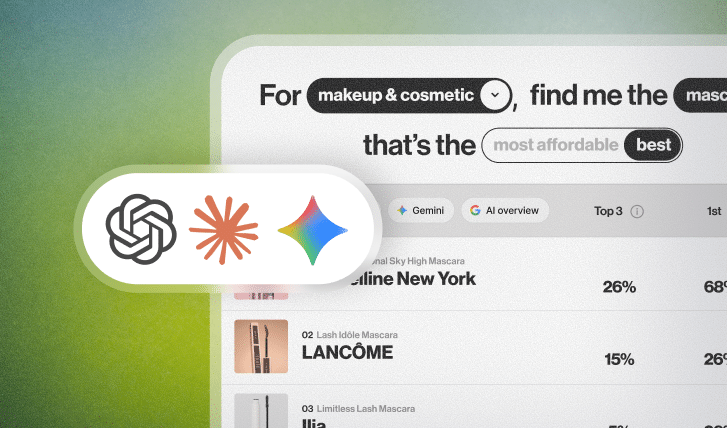










AI shopping agents are changing how online buyers find, compare, and choose products. For years, standard search engines guided traffic through keyword matching, but tools like Amazon’s Rufus, Gemini, and ChatGPT Search now evaluate products using conversational context and off-site consensus. Growing commerce brands need to adjust their technical setup to stay visible to these new automated buyers. What follows is a step-by-step framework to optimize your catalog, reviews, and off-site footprint so you can earn the recommendation of AI shopping agents.
Key Takeaways
- AI tools have become a primary resource for product research, with 53% of US consumers planning to use generative AI to shop online this year.
- Generative search is expanding fast into buying decisions, with Google AI Overviews appearing on 48% of all tracked queries by early 2026.
- Winning in AI search takes a separate optimization strategy, since only 16.7% of sources cited in AI Overviews also rank in the organic top 10.
- Traffic from conversational platforms converts well, and traffic from AI sources to U.S. retail sites rose roughly 393% year-over-year in Q1 2026.
- Customer confidence rises when AI assistants play a role in the research process, with many US shoppers now using AI tools while researching purchases.
Why This Matters: The Shift to AI Shopping Agents
Standard SEO was built for index scraping and keyword matching, but chat-based agents don’t read web pages the same way. They use Retrieval-Augmented Generation (RAG) to pull real-time product information, customer feedback, and third-party validation into a single conversational response. That difference changes what “optimized” actually means for your store.
The shift in AI visibility isn’t gradual — it’s a structural change in how consumers locate products. Where legacy systems ran on keyword matches, AI search engines run on semantic understanding and real-time retrieval. Brands that built visibility purely on keyword density now face a real challenge, because AI engines compile answers by synthesizing multiple sources. To win those placements, your product data needs to feed both the pre-training models and the live search index (and that’s the part most teams miss). Simply writing high-quality blog posts is no longer enough to earn a citation.
When buyers ask questions like “which hiking boots are best for wide feet and wet rocks,” they skip standard link lists entirely. To capture that traffic, you need to optimize your digital footprint specifically for chat-based crawlers and shopping agents. The consumer habits driving this are clear: a meaningful share of shoppers in 2026 expect to rely less on standard search engines as AI capabilities improve.
Think about what that query really demands. The user isn’t looking for a page that includes the words “hiking boots.” They want a product vetted by people with similar feet, reviewed in wet conditions, and confirmed available in their size. AI agents pull all of that from structured data, reviews, and third-party sources, not from keyword density. That’s the mental model you need to bring to every stage of this framework.
The Framework: Four Stages to Win AI Shopping Agent Recommendations
This framework is a step-by-step roadmap for making your products understandable, credible, and highly visible to AI-driven shopping agents. 57% of buyers already use AI to narrow down their choices, so optimizing early in the decision funnel matters. AI adoption is a regular habit now, with a growing number of active shoppers using AI tools at least once per week.
Brands that adjust to these crawler preferences early build a meaningful competitive edge. This roadmap covers the necessary adjustments across your technical, onsite, offsite, and monitoring systems. Each stage builds on the one before, so work through them in order.
Stage 1: Technical Catalog Structure and Schema
How AI Agents Read Your Store
AI shopping agents don’t browse websites visually the way human buyers do. They parse backend code, structured feeds, and structured data scripts to extract product specifications, pricing, and availability. If your technical data is incomplete or disorganized, the agents can’t verify your product details and will recommend someone else. It’s not personal; it’s just how the parser works.
How to Execute
To make your store readable, implement highly detailed JSON-LD product schema on every product detail page. Include micro-data for every variable: dimensions, materials, color options, weight, and inventory status. Keep your Google Merchant Center feed continuously synchronized, since many search engines use those merchant feeds as their primary source of SKU-level product data.
AI agents process catalog feeds through strict technical parsers rather than anything resembling visual browsing. If your product schema is missing specific details like exact materials, dimensions, or compatibility information, the parser simply skips the item during comparison steps. A competitor with complete schema, even a less popular brand, will win that citation instead.
Many platforms fail to update these structured scripts in real time as stock levels or product variants change. That data gap stops the AI engine from confirming whether a product actually fits the user’s specific query. And once an AI agent gets a failed result from your product data, it doesn’t revisit immediately — the miss sticks until you fix it.
Keeping structured data aligned with your active catalog is a basic requirement for agent visibility. The Onsite Agent within Yotpo Discover continuously scans your store to find and resolve structural catalog errors. It highlights missing structured data, weak internal link structures, and thin descriptions that limit your catalog’s readability to search engines.
Common Pitfalls
Many technical teams assume a standard product feed is sufficient. If your schema updates only once a day, price changes or stock shortages can cause shopping agents to display incorrect data and generate failed referrals. Avoid non-standard naming conventions for technical product specs, since AI parsers rely on standard terminology to compare brands across the web.
Stage 2: Amplifying Authentic Shopper Voices for RAG
What AI Agents Are Looking For
When an AI agent searches for recommendations, it doesn’t just read your self-written product descriptions. It verifies your claims by analyzing user-generated content: real customer reviews and testimonials. The engines look for real-world proof to confirm that your products deliver on their promises.
How to Execute
You need to gather and organize high-volume customer feedback written in descriptive, conversational language. Encourage buyers to write reviews that describe specific scenarios, use cases, and product feel. That kind of descriptive text gives RAG systems the natural language signals they need to match products with complex queries. A review that says “kept my feet dry on a three-hour hike in heavy rain” does more work than a hundred five-star ratings with no text.
Using Yotpo Discover lets you feed authentic shopper voices directly into the data layer that AI engines crawl. Our data suggests that these engines actively prioritize verified shopper summaries because they represent real customer proof rather than corporate marketing copy.
Yotpo Discover customers, including Beekman 1802 and David Protein, use this structured approach to keep their customer testimonials fully readable for AI systems. When shopping assistants look for proof of product efficacy, they find verified, well-structured customer feedback that’s easy to cite. That’s qualitative proof, not marketing spin, and AI engines treat the difference seriously.
Common Pitfalls
Relying on simple star ratings without written text won’t help you in AI search. AI crawlers need written sentences to understand context, so short reviews like “Great product!” carry very little semantic value. Make sure your customer reviews are fully accessible in your HTML rather than hidden behind heavy JavaScript tabs that crawlers might skip.
Stage 3: Off-Site Consensus and Brand Authority
Why Third-Party Signals Matter
AI shopping engines don’t evaluate your brand in isolation. To avoid biased recommendations, they cross-reference your onsite claims with third-party sites: Reddit, online forums, and major publisher blogs. If your brand has no presence on those external networks, the agents treat your store as unverified.
How to Execute
Building off-site authority takes a systematic plan to earn natural mentions across the web. You need to identify the specific communities, forums, and publisher sites that AI engines frequently use as source material. Focus on earning genuine mentions from industry experts, niche bloggers, and everyday users in active discussion groups. The goal isn’t backlinks; it’s signal. AI engines read these mentions to gauge whether real people actually trust your brand.
That off-site footprint matters a lot, because a growing share of shoppers now lean on AI to research and shortlist products before they buy. To build that third-party validation, the Activation Agent in Yotpo Discover identifies the external forums and platforms that search engines are currently citing. It then helps you prompt your loyal customers and verified reviewers to share their genuine experiences on those exact sites.
The Content Agent helps by compiling detailed outreach briefs and creating review-backed content for your own brand blog. This keeps your brand assets aligned with the authority standards that chat-based crawlers expect. It also creates a feedback loop: more genuine mentions feed better AI citations, which drive more traffic, which produces more reviews.
Common Pitfalls
Don’t try to game the system by spamming forums with fake accounts or generic comments. Modern AI engines are well-trained to detect unnatural sentiment and shallow brand drops, and being flagged for spam can permanently damage your visibility. Focus on real discussions and verified customer experiences.
Stage 4: Continuous AI Visibility Tracking and Automated Execution
Why Passive Monitoring Isn’t Enough
AI search models update their indexes constantly, so your citation status can change overnight. You can’t rely on passive tracking to maintain your position. You need to continuously test and act on your visibility metrics across all major search platforms: ChatGPT, Gemini, Perplexity, and Google AI Overviews.
How to Execute
Your optimization workflow needs continuous testing of the queries that matter most to your buyers. Analyze why competitors are winning citations when your brand gets skipped. Look at their structured data, the sentiment of their reviews, and the specific publisher sites where they’re mentioned. Often the gap is narrower than you’d expect — a few missing schema properties or a handful of well-placed forum mentions can flip the outcome.
Passive charts tell you where you’re losing ground, but they don’t fix anything. The three automated agents within Yotpo Discover, the Onsite Agent, the Content Agent, and the Activation Agent, work together to identify structural issues, build high-value content, and generate the third-party validation needed to keep your catalog visible. That combination turns passive monitoring into active improvement.
You can get an immediate read on your performance by checking your AI visibility score for a detailed analysis of how your brand appears across chat-based search platforms. It’s a good starting point for understanding exactly where you stand before you run any of these stages.
Common Pitfalls
A common mistake is treating AI visibility as a monthly reporting metric rather than a weekly operational focus. Because chat-based search interfaces are highly dynamic, a minor change to a competitor’s structured feed can push your products out of key recommendations. Tracking these movements consistently is the only reliable way to stay ahead.
Measuring Success: KPIs for AI Shopping Agent Optimization
Standard analytics dashboards weren’t built for this. You’ll need to track a different set of signals to understand whether your AI visibility work is actually moving the needle. These six metrics give you a clear picture of where you stand and what to fix next.
- AI Share of Voice. The percentage of chat-based shopping queries where your brand’s SKUs are recommended.
- Citation Frequency. How often AI assistants link directly to your product detail pages as source material.
- Referral Conversion Rate. The conversion rate of traffic from chat-based assistants compared to standard search.
- Schema Completeness Rate. The percentage of your active product catalog with fully populated JSON-LD attributes.
- Third-Party Sentiment Index. The ratio of positive to neutral mentions across crawled external communities like Reddit and Quora.
- Engine Coverage. The number of distinct AI engines (ChatGPT, Perplexity, Gemini, Rufus) actively recommending your products.
Don’t try to move all six at once. Start with Schema Completeness Rate and Engine Coverage, since these are the most directly within your control, and improving them tends to lift the others over time. Think of them as leading indicators: fix the infrastructure first, then watch Citation Frequency and AI Share of Voice respond.
“Optimizing for AI shopping agents requires moving past old keyword models. Brands must focus on providing clean, structured catalog data and rich, conversational customer reviews that these machines can easily crawl, understand, and trust.”
Ben Salomon, Growth Marketing Manager at Yotpo
Frequently Asked Questions
Does optimizing for AI shopping agents replace standard SEO?
No, Answer Engine Optimization (AEO) works alongside standard SEO on a separate signal layer. Standard SEO focuses on keyword match and page authority; AEO optimizes for LLM synthesis and chat-based search context. You’ll want both strategies running together to capture all search traffic.
What is Amazon Rufus and how does it recommend products?
Amazon Rufus is a chat-based shopping assistant trained on Amazon’s extensive catalog, customer reviews, and web data. It answers product questions, runs comparisons, and recommends specific SKUs based on user queries. It prioritizes detailed product attributes and descriptive customer feedback.
How do AI crawlers read my product catalog?
AI crawlers parse the structured JSON-LD schema in your website’s HTML along with your active product feeds. They bypass visual layouts to extract raw product attributes like size, color, material, price, and availability. Keeping that structured data clean and complete is essential for visibility.
Do customer reviews really affect AI shopping recommendations?
Yes, customer reviews are a primary input for Retrieval-Augmented Generation models. AI agents analyze them to find conversational details that aren’t present in standard product descriptions. High-volume, descriptive text written by real buyers helps the models trust your product claims.
Why is my brand not showing up in ChatGPT Search or Gemini?
Your brand might be missing if your website blocks AI crawlers in its robots.txt file, or if your product schema is incomplete. If your products have very few off-site mentions on forums or publisher websites, AI engines may not find enough third-party consensus to trust your brand.
How can I track my brand’s visibility in AI search engines?
You can use specialized AI visibility platforms to track your citation share across different chat-based engines. Standard rank trackers can’t follow these fluid, personalized results, so you need tools that analyze full chat-based outputs. Getting a regular visibility score is the best way to understand where you stand.
Can smaller DTC brands compete with giant marketplaces in AI search?
Yes, because AI models prioritize specific, highly relevant answers over raw domain authority. A smaller DTC brand with detailed product schema, rich customer reviews, and strong niche authority can win recommendations over much larger retailers. The key is providing the precise data the AI agent is actually looking for.
What role does Reddit play in AI shopping recommendations?
Reddit is a primary source of human consensus for many major AI search engines. Answer engines crawl Reddit discussions to find authentic, unbiased user opinions about different brands and products. Earning real, helpful mentions in those active communities is a reliable way to boost your chat-based visibility.
To start optimizing your store for the future of search, you first need to understand where your brand stands today. Get your free AI visibility score for an immediate analysis of your performance across major AI engines. To see how active automation can help you secure more recommendations, visit the Yotpo Discover page and request a demo of our specialized commerce agents.




 Join a free demo, personalized to fit your needs