











If your brand is showing up in ChatGPT in the US, it’s probably showing up in the UK too, right? Same language, same internet, same engine. Makes sense.
But in reality, it doesn’t work that way.
We ran the same consumer purchase journey prompts across ChatGPT, Gemini, and Google AI Mode simultaneously in the US, UK, Germany, and Australia and measured how much the cited sources actually matched from one market to the next.
So, does AI visibility travel?
Not reliably. Even the most globally consistent engine shares only about 21% of its citations across markets. The rest is local, and the US and UK, the pair you’d least expect to diverge, turned out to be the most different of all.
Key Takeaways
- Even the most consistent engine shares only ~21% of citations across markets. The other 79% are country-specific.
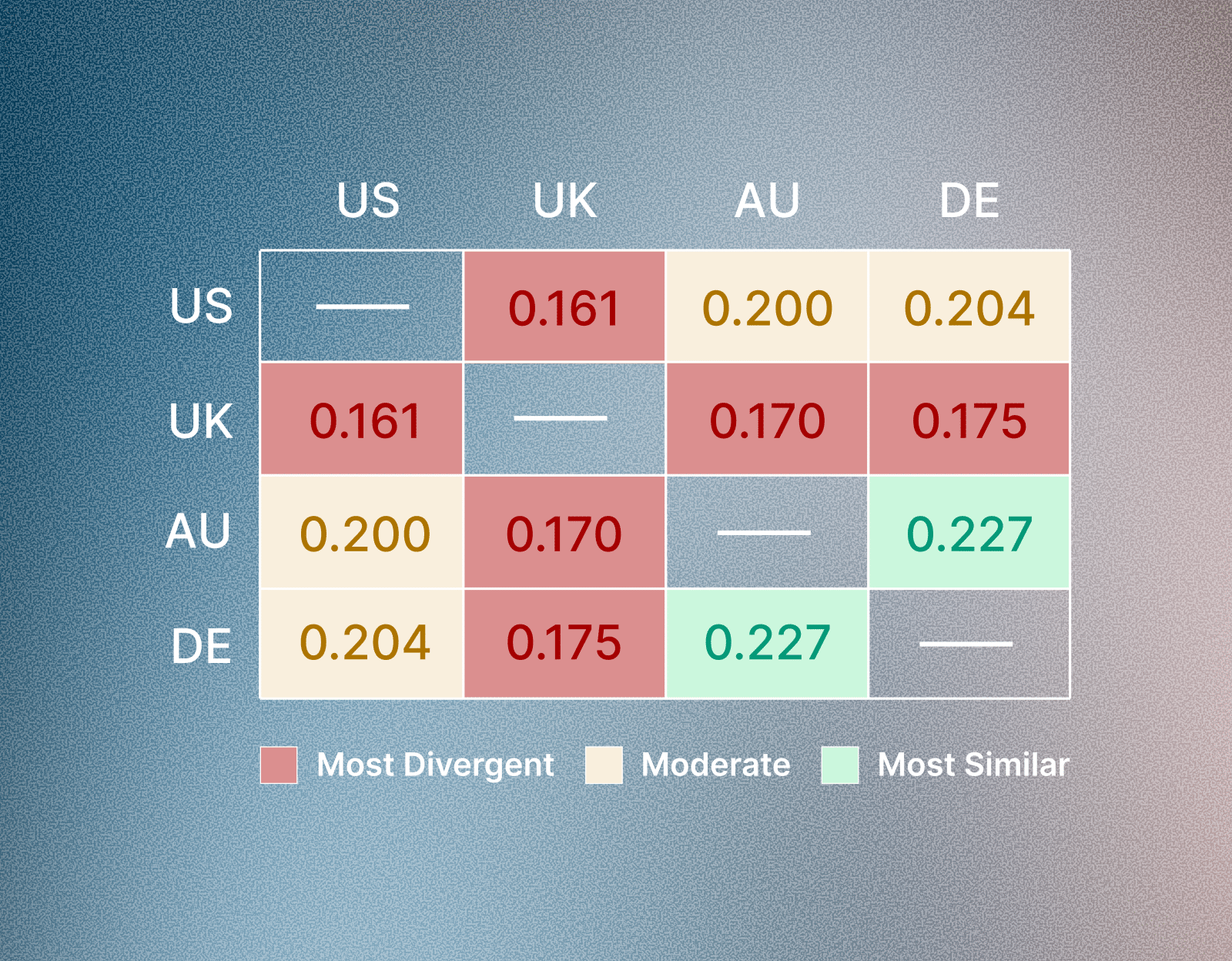
- The US and UK, same language, overlapping culture, show the most divergence of any country pair in the dataset.
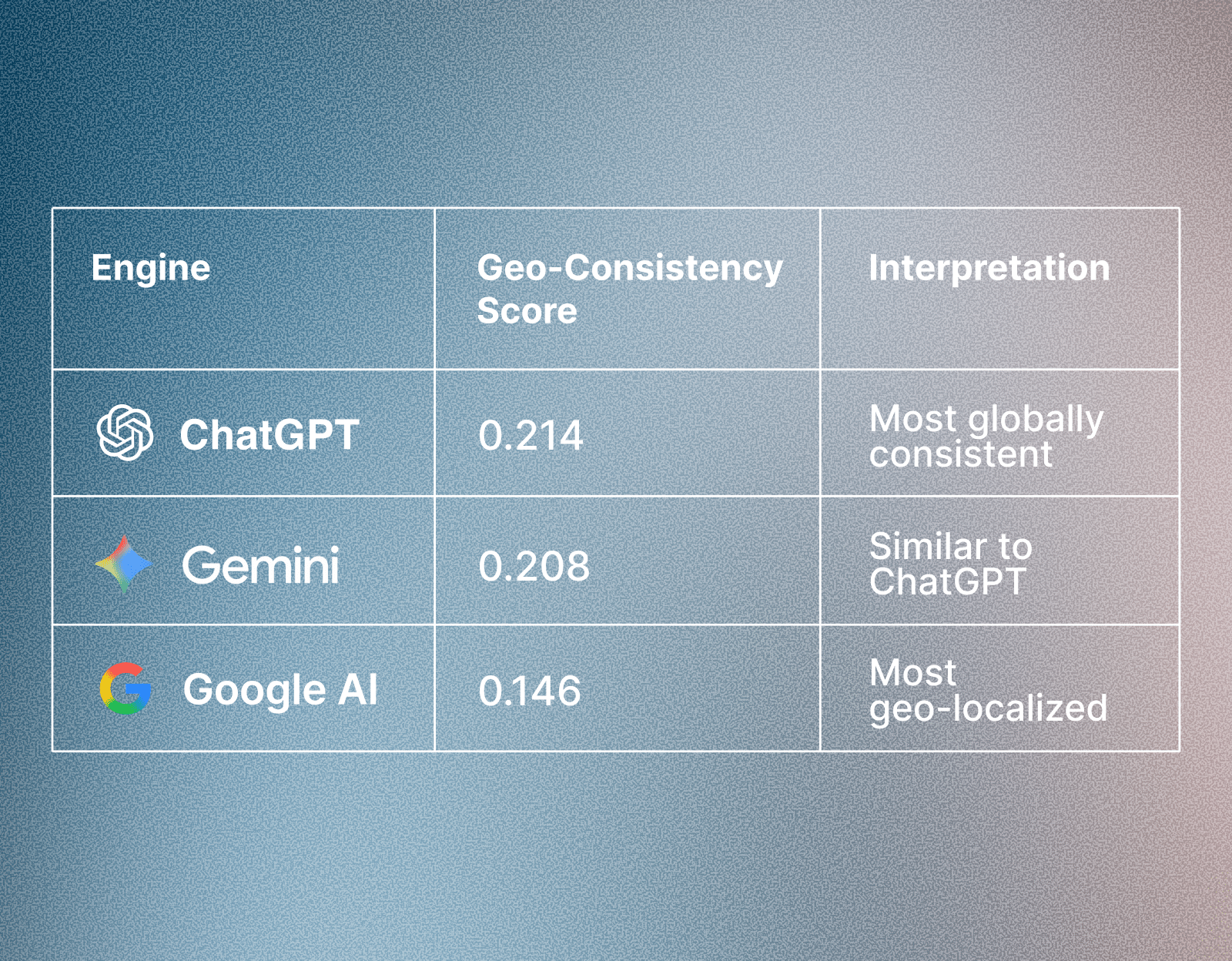
- Google AI Mode is the most geo-localized engine, with a consistency score of 0.146.
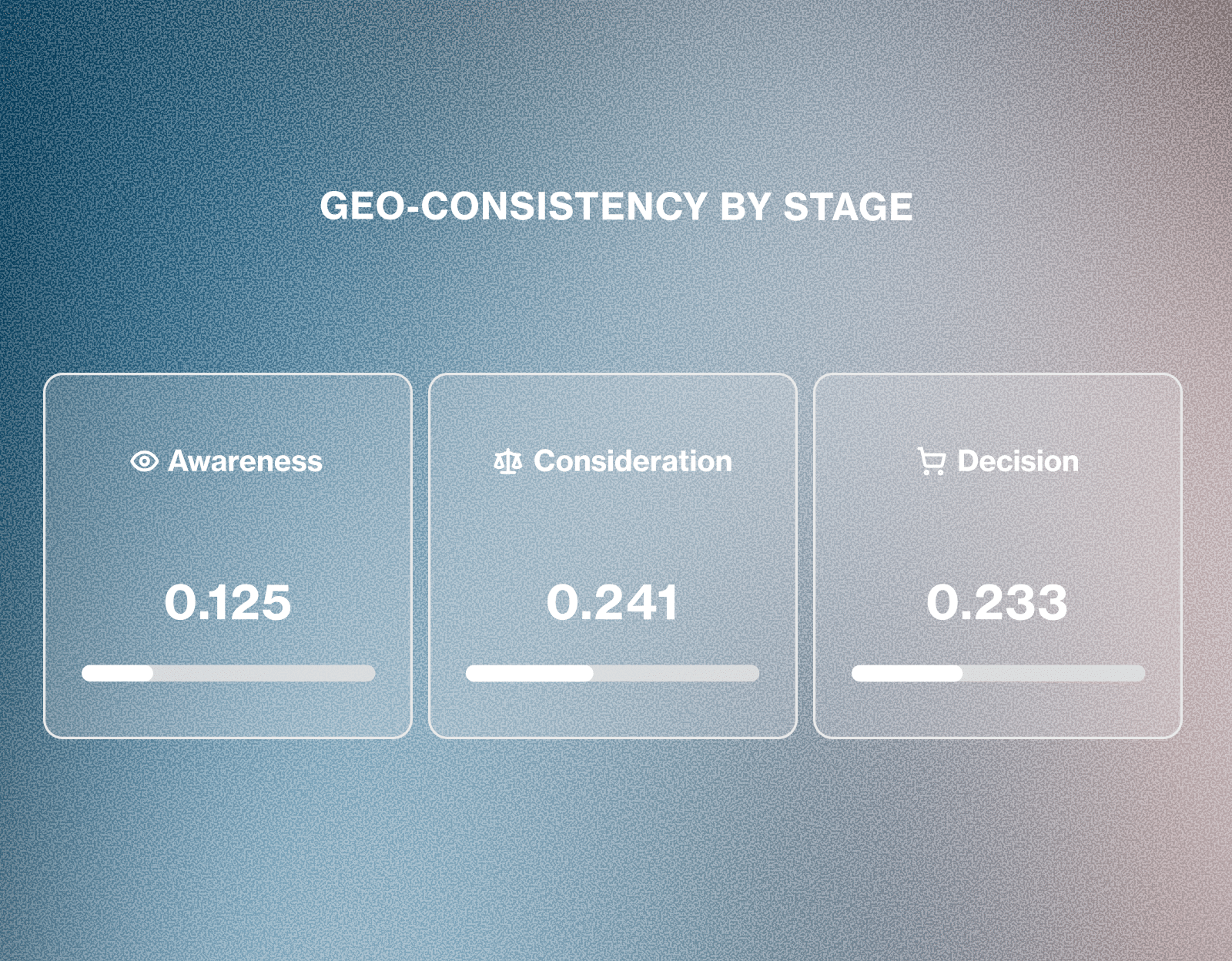
- Awareness-stage content is the most locally specific. Broad category queries pull from local publishers and media, an article written in the US won’t carry that signal into Germany or Australia.
- Consideration and decision-stage content travels better across markets, giving brands with strong product and comparison pages a head start on international AI visibility.
How We Measured Geographic Consistency
We ran identical prompts across all three engines in the US, UK, Germany, and Australia simultaneously. For each engine and each prompt, we then measured how much the citation sets overlapped between countries.
A score of 1.0 means the engine cited identical sources in both markets. A score of 0.0 means completely different sources.
Most AI Citations Are Market-Specific
On ChatGPT (the most globally consistent engine) only about 21% of citations carry across markets. On Google AI Mode, that number drops to 14.6%.
For every market your brand operates in, the engines are building a separate picture of which sources are worth citing. A strong AI presence in one country is not a strong AI presence everywhere.
The Biggest Surprise: US and UK Diverge the Most
The most divergent country pair in the dataset is the US and UK, despite sharing a language, overlapping consumer culture, and many of the same brands.
The most similar pair is Australia and Germany, which share more citation overlap than any other combination despite having less in common on the surface.
The implication for ecommerce brands: geographic proximity and shared language are not reliable predictors of shared AI visibility. The engines are finding and surfacing local publisher ecosystems that operate independently, even when the content and the query are in the same language.
Awareness Content Is the Most Locally Specific
Citation overlap varies significantly by funnel stage, and the pattern is consistent across all three engines.
Broad awareness queries pull heavily from local media, regional publishers, and country-specific editorial sources. A piece of awareness content published from a US-based brand domain carries very little signal into what gets cited in Germany or Australia for the same query.
Consideration and decision-stage content like product comparisons, brand-specific pages, policy and FAQ content travels more reliably. These pages answer specific questions, and the engines are more likely to return to the same authoritative sources regardless of which market the shopper is in.
What This Means for Brands
Publishing in your home market builds AI visibility in your home market.
A US content strategy does not automatically produce AI citations in the UK, Germany, or Australia, even for English-language content. Each market has its own citation ecosystem, and the engines are finding local sources to fill it.
For brands already selling internationally, the gap is larger than most assume.
With less than 21% citation overlap across markets on even the most consistent engine, the majority of your international AI presence needs to be built locally. Brands with strong US AI visibility and no market-specific content in their international markets are likely significantly underrepresented in those engines.
Awareness content requires the most localization.
Broad category queries pull from local publishers, local media, and country-specific sources. If your brand wants to show up when shoppers in the UK or Germany are browsing for products in your category, you need content that’s been picked up by the sources those engines trust in those markets.
Product and policy pages are your best cross-border asset.
Decision-stage content such as clear product pages, return policies, and shipping information travel better than any other content type. If you’re entering a new market, getting your core commerce pages indexed and crawlable in that market is the highest-leverage starting point for AI visibility.
Google AI Mode requires the most localized attention.
With a geo-consistency score of 0.146, it is the most market-specific engine in the dataset. Brands investing in Google AI Mode visibility need to treat each market as a separate build, what’s working in one country is the least likely to carry over.
FAQ
Does this mean a brand needs entirely separate content for every market? Not entirely, but market-specific investment is necessary for awareness-stage visibility. Product pages and policy content translate better across borders. The priority for localization is awareness-stage content: the pages and placements that get picked up by local publishers and regional media in each market.
Why do the US and UK diverge so much despite sharing a language? The engines are surfacing local publisher ecosystems (regional news sites, country-specific editorial sources, local blogs) that operate independently even when the language is the same. A US-based domain ranking well for a query in American English doesn’t automatically carry that signal into UK-specific AI retrieval.
Which engine should international brands prioritize for localization? Google AI Mode, because it is the most geo-localized. Brands that want AI visibility in a new market and have an existing Google Search presence should focus on building local signals there first, it requires the most market-specific work and has the most to gain from it.
Does this apply to brands that only sell in one market? Yes, the finding that AI search is geo-specific matters even for single-market brands. It means that what competitors are doing in your market is what shapes local AI visibility, and that local publisher coverage, local media mentions, and market-specific content are more valuable AI visibility signals than global domain authority alone.


 Join a free demo, personalized to fit your needs