









When ecommerce brands start building an AI visibility strategy, the instinct is to pick an engine to focus on and optimize for it. Showing up in ChatGPT feels like a win, and it is. But what it doesn’t tell you is whether the shoppers using other engines like Gemini or Google AI Mode are seeing your brand at all.
So we looked into what engine independence looks like for commerce. We measured citation overlap between ChatGPT, Gemini, and Google AI Mode across thousands of consumer purchase journey prompts, the same questions shoppers ask when they’re browsing, comparing, and buying, and tracked how much the sources matched across engines.
So, do the three AI engines your shoppers use share their sources?
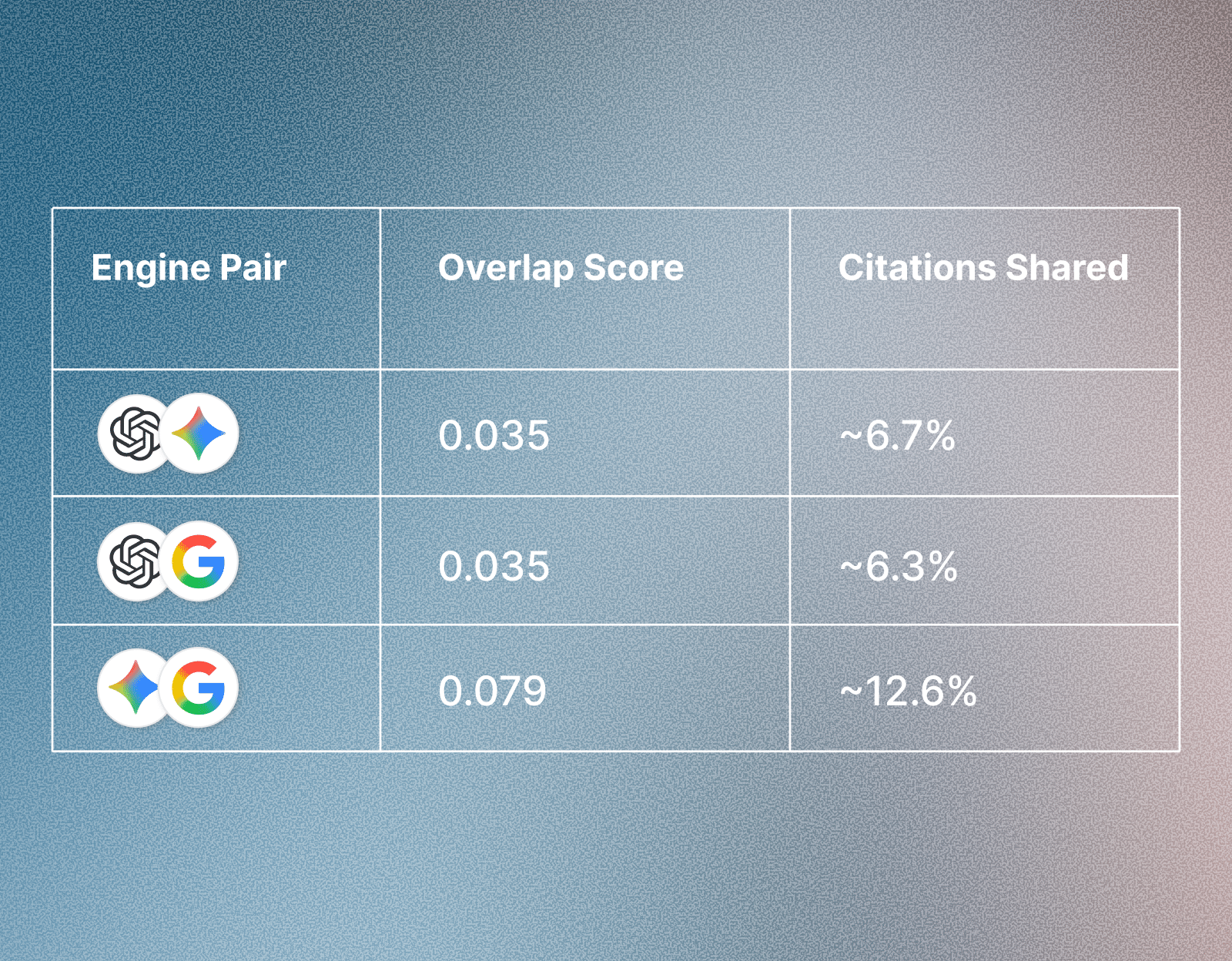
Almost never. Less than 7% of cited sources overlap between ChatGPT and either Google engine. Each is drawing from its own pool, and a brand visible on one can be nearly invisible on the others.
Key Takeaways
- ChatGPT and Gemini share only ~6.7% of cited sources when answering the same question.
- ChatGPT and Google AI Mode share only ~6.3%. Effectively separate ecosystems.
- Gemini and Google AI Mode overlap the most at ~12.6% still less than 1 in 8 sources in common.
- A brand with strong AI visibility on one engine can be nearly invisible on the others. Measuring a single engine gives you a partial picture of where your brand actually stands.
- Classic SEO carries more directly into Gemini and Google AI Mode than into ChatGPT, which operates on a completely independent signal.
How We Measured Citation Overlap
For each prompt, we measured how much the citation sets overlapped between engines, comparing different engines answering the same question in the same week.
A score of 1.0 means both engines cited identical sources. A score of 0.0 means no overlap at all.
Less Than 1 in 10 Sources Are Shared Between Engines
On any given consumer prompt, less than 7% of sources overlap between ChatGPT and either Google engine.
When a shopper asks the same question on ChatGPT versus Gemini, they’re getting answers drawn from almost entirely different websites. Each engine is running its own editorial process, deciding independently which sources are worth citing.
The One Exception: Gemini and Google AI Mode
The only pair with meaningfully higher overlap is Gemini and Google AI Mode, at 12.6%.
Both are Google products, and content that performs well in traditional Google Search carries a stronger signal into both. This is the one place in AI search where classic SEO investments translate more directly into visibility.
ChatGPT operates on a completely independent signal. Strong Google Search rankings do not reliably carry over into ChatGPT citations.
What This Looks Like for Shoppers
Consider a shopper researching a skincare purchase. They ask the same question “best moisturizer for dry skin” across all three engines on the same day.
On ChatGPT, the response surfaces a set of brand domains and editorial sites that registered for that query in its retrieval cycle. On Gemini, a different set of sources shaped by Google’s index returns different brands, different reviews, different recommendations. On Google AI Mode, the answer pulls from a different pool again and the shopper sees a third distinct set of brands being cited.
Now consider that those aren’t the same shopper. One reaches for ChatGPT, another opens Gemini, a third searches on Google AI Mode. Each one is asking the same question and each one is seeing a different set of brands in the answer.
A single-engine strategy doesn’t just leave gaps in your data. It leaves real shoppers, actively looking for what you sell, seeing your competitors instead.
What This Means for Brands
You can’t manage AI visibility you’re not measuring.
Most brands start by checking one engine, usually ChatGPT, because it’s the most visible. But with less than 7% overlap between ChatGPT and the Google engines, a brand tracking only ChatGPT is blind to the majority of its AI search presence. The first step is establishing a baseline across all three.
A commerce brand’s AI visibility on one engine tells you almost nothing about the others.
A brand cited consistently by ChatGPT may be nearly invisible on Google AI Mode, where a shopper asking the same question gets a completely different set of sources. The shopper experience varies dramatically by engine, and so does your brand’s presence in it.
Three engines means three separate citation ecosystems to build toward.
Each has its own source preferences, its own retrieval logic, and its own set of commerce brands it returns to consistently. An AI visibility strategy built around a single engine leaves the majority of AI-driven shopper touchpoints unaddressed.
For brands with strong SEO foundations, Gemini and Google AI Mode are the most natural starting point.
Their shared Google signal means well-structured, well-ranked content tends to carry into both. ChatGPT requires a separate approach, it is drawing from a different pool entirely.
The brands building durable AI visibility are treating each engine as its own channel.
That means tracking citation presence across all three independently, understanding where the gaps are, and building content that earns its place on every surface, not just the one that’s easiest to measure.
FAQ
If the engines are so different, where should a commerce brand start?
Start where your shoppers are. For most commerce brands, that means identifying which engine is most active for the query types that matter, awareness, comparison, or purchase intent, and building from there toward full coverage across all three.
Does citation overlap change depending on the type of question asked?
The low overlap between engines is consistent across all funnel stages. Even for specific brand queries, the engines are drawing from different sources. There is no query type where the engines closely align on which sites to cite.
Why do Gemini and Google AI Mode share more sources than the other pairs?
Both are Google products drawing on Google’s underlying index. Content that is well-optimized for Google Search, structured, authoritative, well-crawled, carries a stronger signal into both Gemini and Google AI Mode than into ChatGPT, which indexes and retrieves independently.
Does a brand need to create entirely different content for each engine?
The fundamentals of strong content: clear, accurate, crawlable pages that answer specific questions, help across all three. The difference is in how you build presence. Google Search optimization carries into Gemini and Google AI Mode. ChatGPT presence is built through a separate retrieval logic, where brand domain authority and regularly updated content play a larger role.


 Join a free demo, personalized to fit your needs