



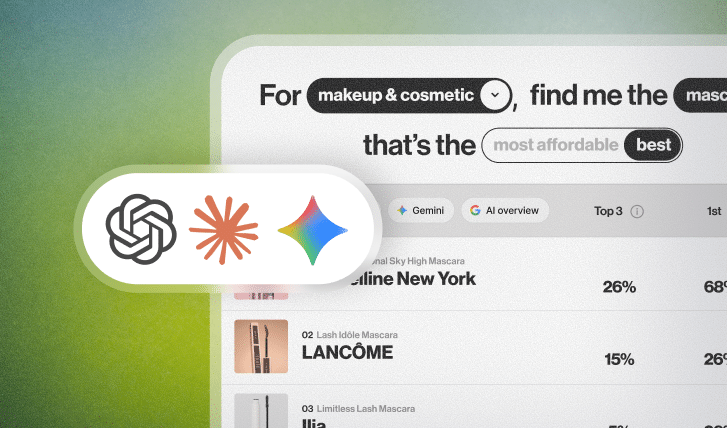










The search landscape is changing in ways that go deeper than keyword mechanics. Generative engines like ChatGPT, Gemini, and Google AI Mode don’t just match queries to pages. They synthesize answers from sources they’ve decided to trust. That’s a different game, and it calls for a different playbook: Generative Engine Optimization (GEO). This guide walks through the technical, structural, and content-driven strategies you need to capture visibility across the major AI-driven platforms, from foundational schema work to off-site citation building to tracking share of voice in real time.
Key Takeaways
- AI search adoption is accelerating, with 52% of U.S. consumers planning to use generative AI for shopping this year.
- AI engines are reshaping traffic patterns, as many consumers expect to rely less on traditional search going forward.
- Ranking in organic search no longer guarantees AI visibility: only 16.7% of sources cited in Google AI Overviews also appear in the organic top 10.
- Google AI Overviews now appear on 48% of all tracked queries, making AI-answer real estate hard to ignore.
- Retail sites that optimize for these conversational engines are already seeing meaningful gains in traffic from AI sources.
- Winning in AI search takes two things working together: solid technical schema on your site and structured, review-backed content that AI engines can actually cite.
Why This Matters: The Shifts in Search and Shopper Behavior
This isn’t a gradual keyword shift. It’s a structural rewrite of how search works. Traditional SEO operates on discrete search strings; AI engines parse conversational context to build custom synthesized answers. Brands are finding that models like ChatGPT prioritize semantic relevance and structural markup over raw keyword volume. The question for most teams isn’t whether this matters. It’s how to optimize for an engine that synthesizes rather than simply matches words.
The answer starts with transforming your content into structured, verified datasets that AI models can cite without friction. That means clean schema, authentic review signals, and off-site validation on the domains answer engines already trust. None of this replaces traditional SEO. Your domain authority and crawl pathways still matter, because they’re how AI engines find your site in the first place. But capturing the final citation requires a layer of work that most SEO teams haven’t built yet.
Consumer habits have already crossed a threshold. A meaningful share of shoppers interact with AI tools weekly, and many of those touchpoints happen directly in the shopping funnel, during product research, comparison, and decision-making. If your products don’t appear in synthesized answers, you’re simply not in the room when those decisions get made.
There’s also a timing element worth noting. The brands building this foundation now are the ones accumulating citation history while competitors are still treating GEO as a future consideration. AI engines tend to reinforce existing citation patterns. Getting in early isn’t just an advantage; it compounds over time.
The Framework: Four Stages to AI Search Visibility
Winning visibility in AI engines takes a systematic approach. This framework moves from foundational on-site work to off-site validation to automated tracking, with each stage building on the one before it.
- Stage 1: Technical Schema and Structured Data
- Stage 2: AI-Native Content with Real Shopper Voices
- Stage 3: Off-Site Citation Building and Third-Party Validation
- Stage 4: Tracking and Acting on AI Share of Voice
Let’s walk through each stage and the specific moves your team needs to make.
Stage 1: Technical Schema and Structured Data
How AI Engines Actually Read Your Site
AI search models don’t browse your site the way a human does. They parse raw data, extract structural relationships, and match product attributes against complex queries. That makes JSON-LD schema your single most important technical asset for AI visibility.
Your goal is a technical foundation clean enough that AI crawlers can extract your catalog without ambiguity. Focus on highly detailed JSON-LD schema across every product detail page (PDP). When an engine can read exactly what you sell, who it’s for, and what real buyers think of it, citation becomes much more straightforward.
What to Build on Every PDP
- Include complete product attributes: brand name, precise SKU, exact pricing, availability status, materials, and dimensions.
- Use nested product schema to group related attributes, so the relationship between parent and variant SKUs is explicit.
- Build structured Q&A schema using the actual questions your support team fields — colloquial phrasing works far better than formal marketing copy here.
- Update your product schema dynamically to reflect live inventory and pricing changes.
The Onsite Agent in Yotpo Discover continuously scans your store to find and fix these structural gaps. It flags weak internal linking, missing product schema, and catalog structures that block AI crawlers, so you don’t have to audit everything manually.
The Most Common Schema Mistake
Many brands rely on generic schema templates that leave out key product attributes. If an AI crawler can’t cleanly extract your catalog data, it moves on to a competitor with clearer markup. Incomplete schema isn’t just a missed opportunity. It’s an active disadvantage against any competitor whose PDP data is clean and complete.
Stage 2: AI-Native Content with Real Shopper Voices
What AI Engines Are Actually Looking For
AI engines prioritize content that reads as natural, authoritative, and genuinely informed. They filter out repetitive, keyword-stuffed articles quickly. To get cited, your content needs real consumer insights and direct answers to the specific questions shoppers actually ask.
The logic here runs deeper than “write better content.” When an AI engine evaluates sources for a comparative query, it looks for consensus signals and experiential validation that standard product descriptions simply can’t provide. Static copy is easy to skip, because models have already processed millions of nearly identical sentences. A structured database populated with authentic shopper voices, on the other hand, offers the kind of detail that answer engines weight heavily. (And that’s the part most content teams underestimate when they first approach GEO.)
Building Review-Backed Content That Gets Cited
Your content strategy should center on review-backed buying guides, structured comparison tables, and detailed product breakdown articles. Real customer language, the specific words shoppers use to describe their experience, is exactly what AI engines look for when building synthesis answers.
- Build buying guides that quote specific product details drawn from verified reviews.
- Structure comparison tables with clean attribute rows that AI engines can parse at a glance.
- Write product breakdowns that answer the questions your support team hears most often.
- Update content regularly so freshness signals stay strong across your key categories.
- Organize review content by use case and buyer type, not just star rating, so AI engines can match it to specific query contexts.
This is where your review strategy connects directly to search visibility. Yotpo Reviews collects structured, verified shopper feedback that becomes source material for AI citations. The Content Agent in Yotpo Discover takes that feedback and generates optimized blog posts and brand content in your exact tone, then builds outreach briefs to fill gaps on third-party sites where answer engines look for validation.
What Doesn’t Work
Publishing high volumes of generic, AI-generated articles without first-party buy signals is a fast way to get ignored. That kind of content gets flagged as redundant by AI engines and rarely appears in synthesized answers, regardless of how well it’s optimized by traditional SEO standards.
Stage 3: Off-Site Citation Building and Third-Party Validation
Why Off-Site Signals Carry So Much Weight
AI search engines don’t rely solely on your own site. They crawl forums, independent review sites, social networks, and retail marketplaces to find unbiased consensus about your brand. That third-party validation is often what tips the scale from “mentioned” to “cited” when an engine builds its answer.
Building an Authentic Off-Site Presence
Winning off-site citations takes a planned approach to community discussion and SKU-level product data across the platforms that answer engines already trust. You need your products discussed naturally on the sites AI engines crawl most frequently.
- Identify the external domains, industry publications, and directories that AI engines cite for your target categories.
- Encourage verified buyers and brand advocates to share detailed feedback on forums like Reddit and industry-specific communities.
- Partner with niche publications to secure organic product mentions that include high-intent catalog terms.
- Track which external domains appear in AI citations for your competitors, because those are your highest-priority targets for community building.
- Map your off-site citation gaps by SKU, not just by brand, since AI engines often cite at the product level.
The Activation Agent in Yotpo Discover handles the heavy lifting here. It identifies the exact Reddit threads, marketplaces, and social platforms that AI engines pull from when building their answers. Then it prompts your verified customer base to share genuine experiences on those specific spaces, creating the off-site validation that models trust.
What Gets Brands Penalized
Some teams try to shortcut this by flooding public forums with fake reviews or artificial product data. It violates community guidelines, triggers account bans, and can cause AI engines to flag your brand as untrustworthy. That’s the opposite of what you’re after, and it’s very difficult to recover from once it happens.
Stage 4: Tracking and Acting on AI Share of Voice
Why Monthly Rankings Are Too Slow
Traditional SEO runs on a monthly keyword ranking cycle. That cadence is too slow for AI search. Citation positions in ChatGPT and Gemini can shift based on a single new forum post or a competitor’s schema update. To stay visible, you need a track-and-act workflow that maps how your products perform across all major engines in close to real time.
Running a Continuous Improvement Cycle
Your team should monitor share of voice across ChatGPT, Gemini, and Google AI Mode, then run active fixes to close any identified gaps. Receiving a visibility score is useful; acting on it automatically is what separates brands that hold citation share from those that lose it gradually over time.
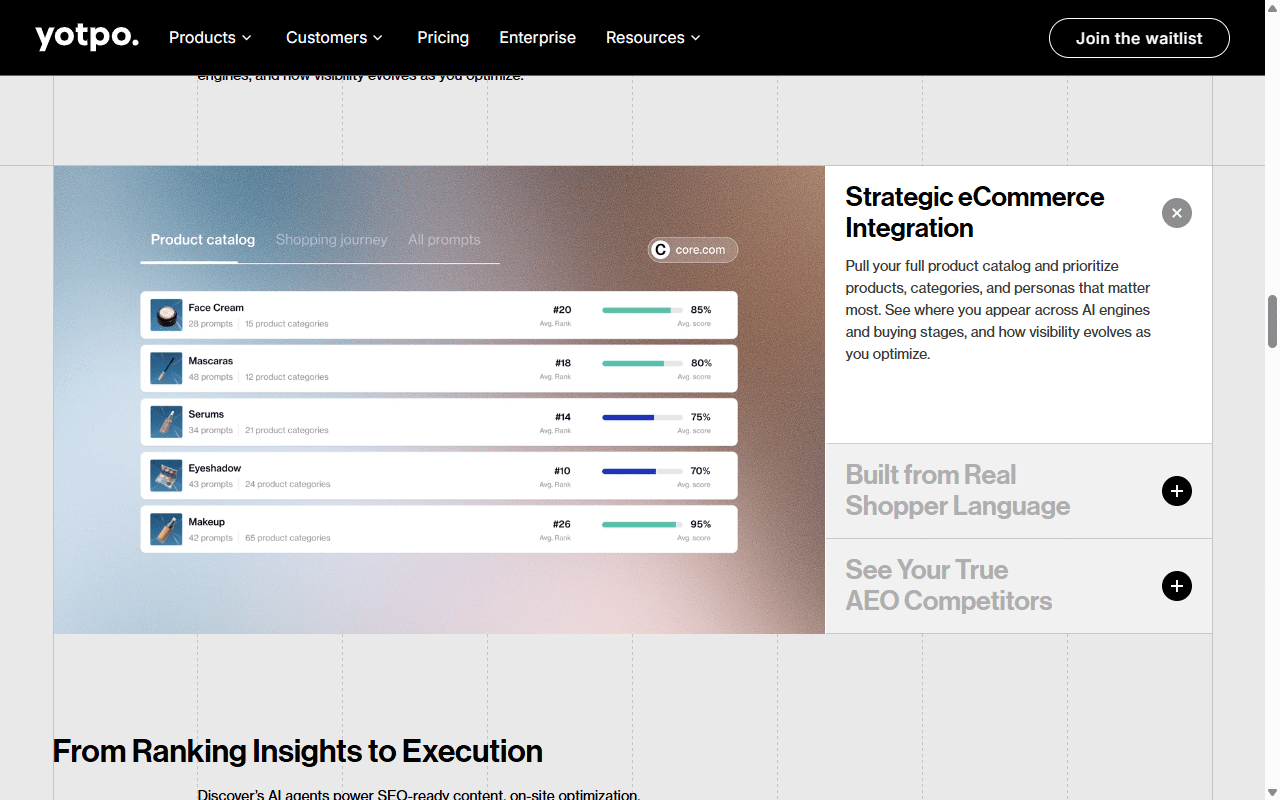
Yotpo Discover is the first AI visibility platform built specifically for the complex reality of commerce. It handles hero versus non-hero SKUs, distinct buyer lifecycles, and cross-channel regions, so you don’t lose transaction traffic because a model recommended a competitor’s variant over yours.
The platform works through three automated agents: the Onsite Agent, the Content Agent, and the Activation Agent. These agents run together to audit your schema, generate review-backed content, and drive off-site validation. Beekman 1802 and David Protein use Yotpo Discover to scale their AI visibility, keeping their products consistently chosen by major answer engines.
What Generic SEO Tools Miss
Standard SEO platforms weren’t built for this. They treat product pages like flat informational blogs and miss the SKU-level commerce data that AI models actually use to make buy recommendations. That gap matters significantly when you’re trying to hold citation share across hundreds or thousands of products.
Measuring Success: KPIs for Generative Engine Optimization
GEO needs its own set of metrics. Track these to get a clear picture of how your AI search program is actually performing:
- AI Share of Voice (SoV): The share of product recommendations your brand captures across targeted chat-based queries.
- SKU-Level Citation Depth: How often AI engines cite your individual products for specific attribute queries.
- Direct Referral Traffic: High-intent visitors arriving from chat-based engines like ChatGPT and Gemini.
- Crawler Extraction Health: How accurately and quickly AI engines read your PDP structured schema.
- Off-Site Mentions: The frequency and sentiment of your brand references on external platforms that AI engines cite.
These metrics tell you whether your GEO investment is moving in the right direction, not just whether you rank, but whether you get chosen when it counts.
“The Head of SEO role is shifting from keyword manager to data architect. AI engines don’t want to index your pages; they want to pull in your product database and customer sentiment to build answers. Structural clarity and authentic shopper voices are now your primary ranking factors.”
Ben Salomon, Growth Marketing Manager at Yotpo
Putting It Together: From Passive Tracking to Automated Execution
Most brands are somewhere in the middle of this transition. They’ve heard about AI search, maybe tracked some numbers, but haven’t yet built the systematic layer that turns visibility data into citation share. The four stages above give you that structure: fix your schema, build content with real shopper voices, validate off-site, and track continuously.
What makes this sustainable is automation. Running these four stages manually across a large catalog isn’t realistic for most teams. That’s why Yotpo Discover wraps all three execution layers, onsite, content, and activation, into agents that run continuously without requiring your team to monitor every thread and PDP update. The goal isn’t a one-time optimization sprint. It’s a durable citation presence that holds as AI engines keep evolving.
The brands building this layer now are the ones that will hold citation share as the shift accelerates. If your products don’t show up when shoppers ask AI engines for recommendations, no amount of organic ranking will close that gap on its own.
Frequently Asked Questions
What is Generative Engine Optimization (GEO)?
GEO is the process of optimizing your site’s code and content to improve visibility in AI search engines and chat-based models. It focuses on structuring data so that AI engines can easily extract, understand, and cite your brand as an authoritative recommendation.
Does AI search replace traditional SEO?
AI search is a complementary layer, not a replacement for traditional SEO. Traditional SEO maintains your site’s authority and crawl pathways, while GEO focuses on structural details and verified shopper content to secure the final citation.
Why do AI engines cite customer reviews?
AI engines weight authentic, real-world proof when building their recommendations. Customer reviews carry colloquial language, real usage details, and sentiment signals that models trust over standard marketing copy. It’s the kind of proof that’s hard to fake at scale.
How often do Google AI Overviews cite organic search results?
Only 16.7% of sources cited in Google AI Overviews also appear in the top 10 organic results. Ranking well in traditional search doesn’t guarantee AI visibility, which is exactly why dedicated GEO work matters.
What is the role of the Onsite Agent in Yotpo Discover?
The Onsite Agent continuously scans your e-commerce store to find and resolve structural technical issues. It keeps your product detail pages, internal links, and JSON-LD schema clean and ready for AI crawlers, without requiring manual audits on your end.
How does Yotpo Discover use authentic shopper voices?
Yotpo Discover connects with Yotpo Reviews to feed verified customer sentiment directly into your brand’s citation layer. That structured database helps automated agents generate highly authoritative, citation-ready content in your exact brand voice.
When should a brand pair Yotpo Discover with other tools?
Yotpo Discover is built specifically for e-commerce search queries. Brands that sell primarily through wholesale or third-party marketplace channels may want to pair it with a marketplace-specific tool to cover all their sales surfaces.
How can I assess my brand’s current AI search visibility?
You can get a complete picture of your brand’s presence across major AI engines by running a free audit at commerce-gpt.yotpo.com.
Securing your brand’s presence in AI search means moving from passive tracking to active execution. To build a reliable citation pipeline across major engines, visit the Yotpo Discover page and request a demo. You can also evaluate where you stand right now by getting your free AI visibility score.



 Join a free demo, personalized to fit your needs