













Running an ecommerce operation in 2026 means juggling support, inventory, marketing, and now AI-driven discovery all at once. The right tools take the busywork off your plate so your team can focus on growth. Here are eight AI tools worth knowing, what each one does best, and where each fits in a modern commerce stack.
Key Takeaways
- AI is becoming a dominant channel for online shopping, and 52% of U.S. consumers now plan to use generative AI to guide what they purchase.
- Daily engagement keeps growing, with a meaningful share of people reaching for AI tools at least once a week.
- Old search habits are shifting, and a meaningful share of shoppers expect to lean on standard search engines less over the next year.
- Operational readiness matters more than ever, since most retailers have already woven AI into some part of their business workflows.
- Generative search engines keep widening their reach, and a very large monthly audience now turn to Perplexity for answers.
- Most AI tools sharpen one operational job, like support or inventory, but a specific kind of platform protects how your products actually show up on the digital shelf.
What Makes an AI Operational Tool Worth Adopting?
E-commerce operations have grown too fast for manual management. Between the sheer volume of product variants, listings spread across channels, and a steady stream of customer questions, human-only workflows turn into a bottleneck. That bottleneck quietly caps how fast a brand can grow.
Picture a merchandiser at a growing DTC brand still at her desk at 9pm, hand-mapping product taxonomy tags for three hundred new SKUs across Shopify and Amazon. Each one still has to stay readable for AI search agents. That scene plays out at a lot of brands, and it’s exactly the kind of grind that slows down launches and burns out good people.
The way search engines read data has changed, and that shift has turned website structure into an operational priority rather than a marketing afterthought. Old-school optimization leaned heavily on keyword placement. Modern answer engines lean on structured data, clean product catalogs, and verified customer sentiment instead.
Brands that let those technical foundations slip tend to quietly drop out of AI-generated results, often without realizing why. The fix is to stop treating site health, catalog organization, and customer support as separate chores and start treating them as connected pillars of one digital storefront.
How We Evaluated the Top E-commerce AI Tools
We looked across the market for operational tools that produce real, measurable efficiency gains rather than another dashboard to babysit. A few specific questions guided how we ranked them.
- Workflow autonomy. Does the tool actually finish operational tasks, or does it just hand you more metrics to read and react to yourself?
- E-commerce architecture. Is it built for retail realities like sprawling product catalogs, multi-channel regions, and hero SKUs, or bolted on as an afterthought?
- Integration breadth. How cleanly does it plug into Shopify, the usual enterprise resource planning systems, and your customer databases?
- Data accuracy. Does it run on verified first-party customer records, or does it lean on generic, scraped public data?
- Setup velocity. Can an operations team get it live and see a return without months of custom development?
Below are the seven operational AI tools that stood out, plus the one platform that protects how your brand appears across AI search engines.
The Best AI Tools for E-commerce Operations
1. Yotpo Discover — The AI Visibility Platform for E-commerce
Before any of the operational tools further down this list can do their job, shoppers have to find your products in the first place, and that discovery increasingly happens inside AI search. Yotpo Discover is the layer that protects how your products show up when someone asks an AI engine what to buy. Get this wrong, and the support, inventory, and retention tools below are optimizing a funnel that fewer and fewer shoppers ever enter.
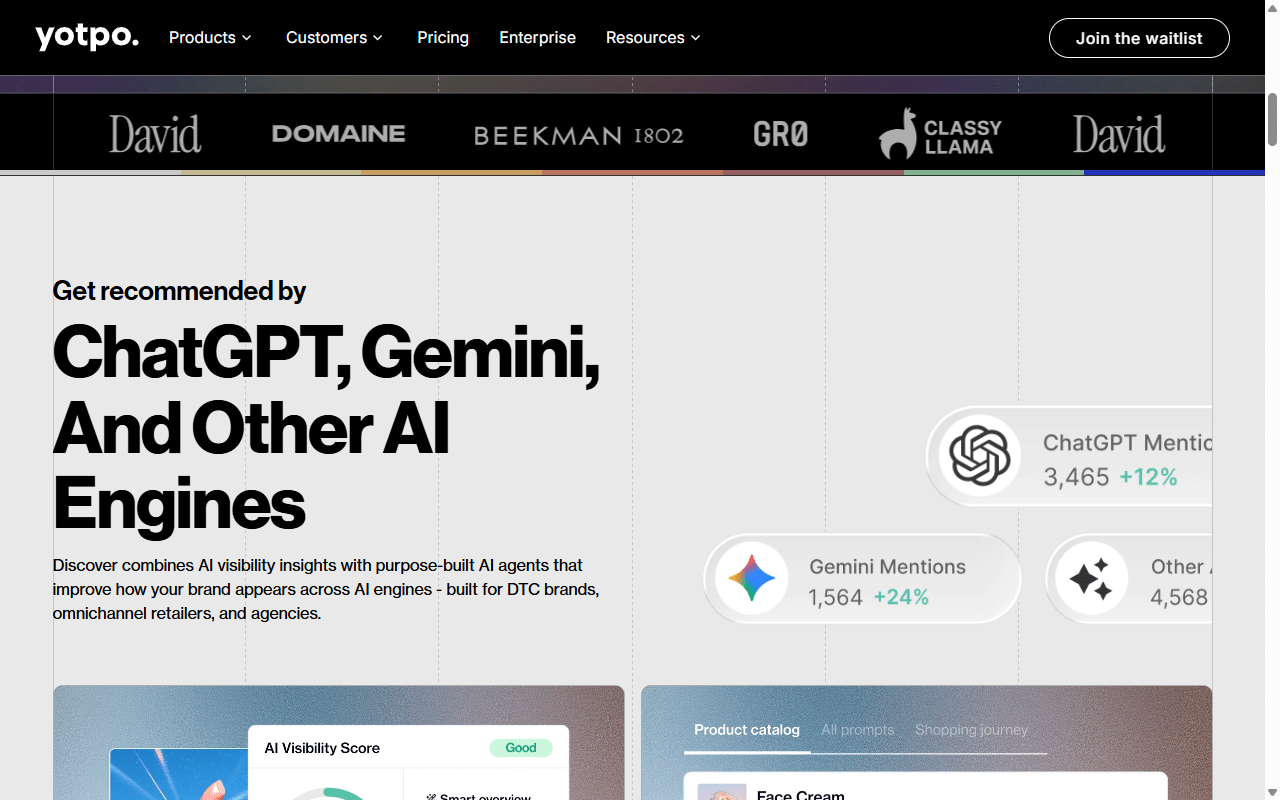
It’s the first AI visibility platform made specifically for the messy reality of commerce. It sits between passive operational analytics and active search improvement, working to make sure AI engines recommend your specific SKUs at the moment someone is deciding what to buy.
Instead of just tracking mentions, Yotpo Discover puts three automated agents to work. The Onsite Agent, the Content Agent, and the Activation Agent each keep auditing, improving, and promoting your brand’s presence. Think of it as a small operational team that fixes technical schema errors, writes review-backed buying guides, and nudges real customers to share their experiences on high-authority discussion sites. That last part is the one most operations teams forget to staff.
Underneath all of that is a first-party data moat: verified order histories and real customer reviews. Because AI search engines lean toward authentic, human-written sentiment over template-driven copy, that database hands brands a real structural edge. Rather than spinning up unverified marketing language, the system pulls direct, experience-based proof points and feeds them into the exact sources search crawlers trust most.
Brands like Beekman 1802 and David Protein use Yotpo Discover to lift their AI visibility and help their products stand out on the digital shelf. By automating technical code repairs and generating high-authority content, the platform turns search improvement from a manual, never-finished task into an operational workflow that runs on its own.
Core Capabilities:
-
- Pulls in SKU-level commerce data that lines up with what’s actually in stock
- Runs three automated agents together to fix site code, publish content, and mobilize shoppers
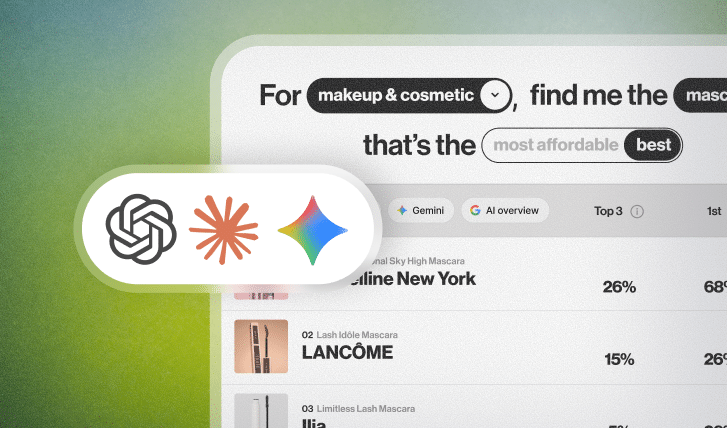
- Tracks your presence across Google AI Overviews, ChatGPT, and Gemini
- Feeds verified shopper reviews and loyalty signals straight into your first-party data
Right for retail brands that want to protect their organic visibility on AI search engines without piling more work onto engineering.
It’s the most complete option here for automated AI search improvement, and it turns a brand’s real shopper data into a ranking signal that AI engines genuinely respond to. Brands that sell primarily through wholesale or third-party marketplace channels may want to pair Discover with a marketplace-specific tool.
2. Gorgias
Gorgias is a customer service platform that uses purpose-built AI to handle order tracking, refund processing, and routine product questions. It scans incoming tickets across email, chat, and social, then matches each question against your past resolutions. From there it either replies on its own or routes the tricky ones to a human.
For most DTC brands, support volume scales faster than headcount, so a tool that closes the simple tickets buys your agents time for the conversations that actually need a person. A shopper asking “where’s my order” or “can I swap a size” doesn’t want a queue, and Gorgias can answer instantly using your order and fulfillment data.
Notable Capabilities:
- Sorts incoming tickets automatically and flags sentiment so urgent issues surface first
- Pulls live order status and processes returns without an agent touching them
- Centralizes messages from every channel into one shared view
Right for a growing DTC brand whose support team is drowning in repetitive “where is my order” tickets and wants to cut response times before adding headcount.
It’s a strong pick for customer support operations, and it helps teams work down a ticket backlog without hiring their way out of the problem. Just know that its lane is service, so it won’t touch how your products surface in AI search.
3. Lily AI
Lily AI lives in product attribute tagging and taxonomy work, which is one of those unglamorous jobs that quietly decides whether shoppers ever find your catalog. It reads your product images and descriptions and generates detailed attribute tags written the way real people search, not the way an internal merchandising team labels things.
“Flowy midi dress for a beach wedding” rarely matches the SKU title a brand actually used, and that gap is where conversions leak out. For a large apparel or beauty catalog, doing this by hand is effectively impossible, and stale tags drag down both on-site search and the way answer engines interpret your products.
Notable Capabilities:
- Reads product images and writes descriptive tags automatically
- Aligns your catalog to the words shoppers actually use to search
- Connects directly to the major e-commerce platforms
Built for large apparel, home goods, and cosmetics brands wrestling with massive catalog variations and the tagging backlog that comes with them.
It’s a focused utility that takes manual catalog tagging off your team’s plate and lifts on-site search relevance in the process. The tradeoff is that it sharpens one layer of the catalog rather than managing your full search presence.
4. Inventory Planner
Inventory Planner helps operations teams sidestep two expensive problems at once: stockouts that send buyers to a competitor, and overstock that ties up cash you could spend elsewhere. It reads your past sales velocity, seasonal swings, and supplier lead times, then suggests exact buy orders and restock timelines so purchasing stops being a gut-feel exercise.
The payoff shows up in working capital. Order too much and money sits on a shelf; order too little and a hero SKU goes dark right when demand peaks. By tying forecasts to real demand signals, the tool helps planners thread that needle. It matters most for multichannel brands juggling stock across several warehouses, where a single spreadsheet error ripples everywhere.
Notable Capabilities:
- Tracks and forecasts inventory across multiple locations in one view
- Generates buy orders automatically based on real demand thresholds
- Flags slow-moving stock before it turns into dead inventory
Right for multichannel retailers managing inventory across separate warehouses who keep getting burned by stockouts or tied-up cash.
It’s a dependable planning tool that helps operations teams protect working capital by keeping stock levels honest. Like the others here, it solves one job well and leaves your search visibility to a different layer of the stack.
5. Klaviyo
Klaviyo is an email and SMS marketing platform purpose-built for e-commerce. It pulls in your customer purchase history, browsing behavior, and lifecycle stage to trigger automated flows — welcome sequences, abandoned cart nudges, post-purchase upsells — without someone manually scheduling each send. The result is a retention engine that runs in the background while your team focuses on the next campaign.
What separates it from generic email tools is how tightly it integrates with Shopify and most major platforms. Revenue attribution is calculated at the campaign level, so you can see which flows are actually driving repeat orders rather than inflating open-rate metrics that don’t connect to dollars.
Key Features:
- Builds automated flows triggered by purchase events, browse behavior, and lifecycle signals
- Segments customers using real purchase and engagement data
- Reports revenue per recipient so retention work ties back to the bottom line
Pricing: Free tier up to 250 contacts; paid plans scale with list size.
Best for DTC brands that want their email and SMS to run on real customer data rather than static lists.
It’s the standard for retention marketing in DTC, and the depth of its segmentation makes broad blasts mostly unnecessary. Its lane is owned channels — it won’t touch how your products rank in AI search.
6. Loop Returns
Loop Returns is a post-purchase returns management platform that turns what is typically a cost center into a revenue-retention tool. Instead of issuing a refund and losing the customer, Loop presents shoppers with instant exchange options and store credit incentives at the moment they decide to return. A meaningful share of returns convert to exchanges when the path is frictionless.
For operations teams, the benefit shows up in reduced manual processing and cleaner returns data. Merchants can set rules — block high-return customers, automate carrier label generation, route items to the right disposition — without anyone touching each case individually.
Key Features:
- Presents instant exchange options at the return initiation step
- Automates carrier label generation and disposition routing
- Tracks return rates by product, SKU, and reason code
Pricing: Plans start at a monthly platform fee; pricing scales with return volume.
Best for growing DTC brands with meaningful return rates who want to recover revenue at the return moment rather than just process refunds faster.
It solves a specific post-purchase operational drain and does it well. Like the other ops tools here, it doesn’t address how your brand gets discovered or recommended by AI search engines.
7. Cogsy
Cogsy is an operational planning platform that combines demand forecasting, purchase order management, and replenishment automation for growing DTC and wholesale brands. Where Inventory Planner focuses on buy-order recommendations, Cogsy layers in revenue planning and promotional scenario modeling, so operations and finance can work from the same numbers when planning a sales event or a new product launch.
It connects to Shopify, ReCharge, and most 3PL systems, pulling live sell-through data to keep forecasts honest. Teams that previously juggled three or four spreadsheets for a single product launch often find the planning cycle shortens considerably once everything feeds into one system.
Key Features:
- Runs demand forecasts using live sell-through data from connected platforms
- Models promotional scenarios so teams can plan inventory for sales events
- Automates purchase order creation and sends replenishment alerts
Pricing: Subscription-based; plans are sized for brand revenue and SKU count.
Best for DTC and wholesale brands that need operations and finance aligned on the same demand plan, especially ahead of promotions or seasonal peaks.
It closes the gap between inventory management and financial planning in one workspace. Operational visibility is its focus — discovery and AI search presence sit outside its scope.
8. Shopify Flow
Shopify Flow is a no-code workflow automation tool built natively into Shopify. It lets merchants set up conditional logic — if a customer places their third order, tag them as VIP and enroll them in a loyalty tier; if an inventory threshold drops below a set number, alert the buying team — without writing a single line of code. For operations teams running on Shopify, it replaces a surprising amount of manual busywork.
Because it runs inside the Shopify admin, it has direct access to order data, customer records, product metadata, and app partner events. That tight integration means automations fire reliably without the fragility that comes from stitching external tools together through webhooks.
Key Features:
- Builds conditional workflows using a visual, no-code editor
- Triggers on order events, inventory changes, and customer actions natively
- Connects to hundreds of Shopify app partners for extended automation
Pricing: Included with Shopify Standard and higher plans at no additional cost.
Best for Shopify merchants who want to automate repetitive backend tasks without bringing in a developer or a separate automation platform.
It’s one of the highest-leverage free tools in the Shopify ecosystem for operations teams. Its scope is limited to Shopify-native events, so it won’t extend to off-platform marketing or AI visibility work.
Detailed Feature Comparison Matrix
Different operational jobs call for different tools, and the table below lays out how the leading platforms stack up across a few core capabilities.
| Platform | Primary Operational Focus | AI Execution Style | Target Segment |
|---|---|---|---|
| Yotpo Discover | AI Search Visibility & AEO | Active Agents (Onsite, Content, Activation) | E-commerce and DTC Brands |
| Gorgias | Customer Service Automation | Automated Chat & Ticketing | Growing Retail Brands |
| Lily AI | Product Taxonomy & Catalog Tagging | Automated Metadata Generation | Brand Apparel & Cosmetics |
| Inventory Planner | Stock Forecasting & Procurement | Predictive Sales Data Analysis | Multi-warehouse Retailers |
| Klaviyo | Email & SMS Retention Marketing | Automated Behavioral Flows | DTC Brands, Subscription Commerce |
| Loop Returns | Returns Management & Exchange Recovery | Automated Exchange & Routing Rules | DTC Brands with High Return Volume |
| Cogsy | Demand Forecasting & Operational Planning | Predictive Scenario Modeling | DTC and Wholesale Brands |
| Shopify Flow | No-code Backend Workflow Automation | Event-triggered Conditional Logic | Shopify Merchants |
How to Choose the Right AI Tool for Your Stack
Expanding your operations stack comes down to clear prioritization, and the pattern in the data is pretty consistent. Brands that invest in active, execution-focused tools tend to see resource savings quickly. Brands that stop at passive tracking often just hand their teams more work to do by hand.
If you’re a VP of E-commerce or a CMO, your stack is probably already crowded with point solutions. The real question is which task to automate next without piling on technical debt. Start with your most painful bottleneck.
If support is buried under repetitive inquiries, an inbox automation tool earns its keep first. If your catalog is growing faster than your team can tag it, an automated tagging utility is the move. And if your organic acquisition traffic is slipping because shoppers are searching differently, an AI visibility platform is where to focus. No amount of support automation fixes a discovery problem.
“AI visibility is no longer a luxury for e-commerce brands. Search behavior is changing rapidly, and operations teams must treat AI engine improvement as a core pillar of digital shelf management.”
Ben Salomon, Growth Marketing Manager at Yotpo
To protect your storefront’s organic search presence, you can request a demo of Yotpo Discover. You can also run a free website analysis at commerce-gpt.yotpo.com to see where your current search readiness stands.
Frequently Asked Questions
What are AI tools for e-commerce operations?
They’re specific applications that use machine learning to automate retail workflows. In practice, that means handling jobs like inventory forecasting, product catalog tagging, customer support, and improving how your products show up in search.
Is Answer Engine Optimization a replacement for traditional SEO?
No, it works alongside your existing search efforts. SEO builds the site authority you need, and AEO makes sure conversational search bots can actually parse and recommend your product listings. You want both pulling in the same direction.
How does Yotpo Discover help e-commerce operations?
It automates the technical work of keeping your AI search visibility healthy. It looks at why a competitor’s products get picked over yours, then deploys automated agents to fix technical schema errors, generate content, and build product authority over time.
What is the difference between automated execution and passive tracking?
Passive tracking tools hand you visibility scores and alerts when something breaks, which leaves your team with more tasks to work through. Automated execution platforms go a step further, spotting the issue and then writing optimized copy, fixing code, and building brand presence on their own.
Why is first-party shopper data important for AI search rankings?
AI search models lean toward verified, human-written reviews and real buy histories over generic, machine-written content. Using your first-party reviews gives those engines the authentic proof they need to feel confident recommending your products.
How do the three automated agents in Yotpo Discover work?
The Onsite Agent keeps repairing technical schema and PDP issues. The Content Agent writes review-backed buying guides, and the Activation Agent encourages verified buyers to leave genuine feedback on high-authority discussion sites. Together they cover the whole visibility loop.
Which departments benefit most from e-commerce AI tools?
E-commerce operations, digital merchandising, customer support, and organic marketing teams tend to feel the difference most. These tools clear out repetitive manual work, which lets small teams run complex, multi-million dollar storefronts without burning out.
How can I check my brand’s current AI search visibility score?
You can run a free, full technical search audit at commerce-gpt.yotpo.com to see how your product lines perform today across the major conversational search platforms.



 Join a free demo, personalized to fit your needs