



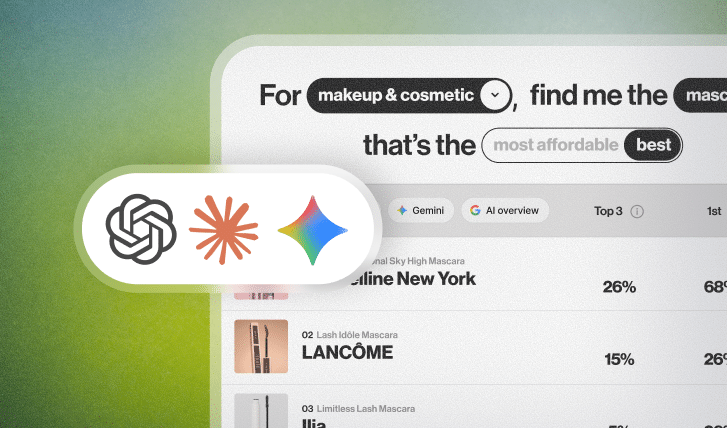










The way shoppers discover products online has shifted in ways most dashboards haven’t caught up to yet. Organic search used to be a straightforward race for blue links. Today, AI search engines synthesize answers on the fly, pulling from dozens of sources to recommend specific brands inside conversational interfaces — before a shopper ever clicks a single result.
If you want to stay visible where your customers are actually searching, you need to understand exactly how these engines perceive your brand and your catalog. A manual AI visibility audit is the clearest first move you can make toward earning your place in that new discovery layer.
Key Takeaways
- Only 16.7% of sources cited in Google AI Overviews overlap with the first page of organic search results, meaning strong keyword rankings don’t guarantee AI visibility.
- Conversational engines are showing up at massive scale, with Google AI Overviews present on 48% of all tracked search queries.
- Consumer habits are shifting fast, with shoppers increasingly planning to use AI-powered interfaces for product discovery and online purchasing.
- These platforms have a real impact on purchasing speed, since many shoppers report that AI answers help them make buying decisions faster.
- Auditing is the starting point, but long-term success requires automated tools that continuously build and repair your citations as models update.
Why This Matters: The AI Visibility Gap in E-Commerce
Legacy SEO relied on predictable keyword volumes and linear ranking positions. Chat-based search doesn’t work that way. These engines synthesize answers from many unstructured sources, and the ranking signals they weight most — structured product data, authentic reviews, off-site citations — are fundamentally different from what keyword-based ranking optimizes for.
The commercial risk is real. Only 16.7% of sources cited in AI-generated summaries appear on the first page of organic results. Your brand could sit in position one on Google and still be completely invisible to a shopper using ChatGPT or Perplexity to narrow their options.
Traffic from generative engines to retail sites is already growing, and it’s not a future trend to plan for. Shoppers are actively buying through these channels today. When your brand isn’t mentioned in a synthesized answer, you’re left out of the consideration set entirely — not pushed down a page, just absent.
We see brands struggle here because they try to apply old tactics to a search model that works differently. The mechanics have changed, and your audit process needs to change with them.
The Framework: Four Stages of an AI Visibility Audit
To benchmark your current brand footprint across AI engines, you need a repeatable process — not a one-time spot check. This audit evaluates your presence across the major platforms that capture shopper intent and shape purchase decisions.
The four stages build on each other deliberately: you can’t map citation sources until you’ve run the prompts, and you can’t automate fixes until you know what’s broken. Work through them in order:
- Stage 1: Identifying target chat-based queries. Mapping user intent beyond simple keywords.
- Stage 2: Manual prompting and sentiment analysis. Probing engines directly to assess brand positioning.
- Stage 3: Mapping source citations. Tracking down the exact origins of what the models cite.
- Stage 4: Moving from audit to automated execution. Turning passive findings into continuous updates.
Stage 1: Identifying Target Chat-Based Queries
What This Step Is About
Short, transactional keywords are what old-school search optimization is built around. Chat-based queries are longer, more conversational, and shaped by the actual decisions shoppers are trying to make. This stage means rebuilding your keyword list from scratch around the way people actually phrase things when they talk to an AI engine.
Think about how a shopper at the consideration stage sounds when they type a question. They’re not searching “baby shampoo.” They’re asking, “What’s the safest organic baby shampoo for a newborn with eczema-prone skin?” That specificity is where AI engines thrive — and where your brand either appears or doesn’t.
How to Run It
Start with your ten highest-value transactional keywords. For each one, write three to five natural-language versions of the same question — comparative, problem-aware, and context-specific. If you sell a loyalty platform, don’t just test “loyalty program software.” Test “Which loyalty program works best for a DTC brand already on Shopify with repeat buyers?” That’s the kind of prompt a VP of eCommerce actually types.
Group your prompts across three intent categories: informational queries where the shopper is learning, comparative prompts where they’re weighing options head-to-head, and direct brand questions where they already know your name and want specifics. Covering all three keeps you honest about the full shopping funnel — and surfaces gaps at different decision stages.
Next, pressure-test your list for diversity. If all your prompts live in one category, you’ll only see one slice of your visibility picture. Aim for a roughly even split across the three intent types, and include at least two prompts where a competitor is named directly alongside your brand.
Common Pitfalls
The most consistent mistake is keeping queries too short. Typing “best loyalty app” into ChatGPT and noting whether you appear is not an AI visibility audit — it’s a quick gut check. Chat engines thrive on specificity. Short queries often trigger generic answers that don’t recommend any specific brand at all, which tells you nothing about your actual citation strength.
Also watch for over-indexing on branded prompts. If you only test queries that include your company name, you’re missing the whole discovery problem. Shoppers who haven’t heard of you yet are the audience that AI visibility most affects (and that’s the part most teams miss).
Stage 2: Manual Prompting and Sentiment Analysis
What You’re Actually Measuring
This is the hands-on diagnostic stage. You run your curated prompts through each major engine, document what comes back, and evaluate not just whether your brand appears — but how it’s described, which attributes are tied to your name, and whether the tone is positive, neutral, or quietly dismissive.
Sentiment matters more than most teams realize. An engine that mentions your brand but pairs it with “limited integrations” or “best for small stores” is actively shaping shopper perception against you. You need to catch that before your prospects do.
How to Run It
Open ChatGPT, Claude, Gemini, and Perplexity. These four engines collectively hold a majority of AI referral traffic, so they’re the right starting point. Always run each prompt in a fresh incognito session with no prior context — logged-in sessions with search history can skew results in ways that don’t reflect what a new shopper sees.
For every prompt, document five things: whether your brand appeared, the position in the response, the specific attributes the engine tied to your products, the overall sentiment (positive, neutral, or negative), and which sources were cited to back up the recommendation. A structured spreadsheet with one row per prompt per engine keeps this manageable. Use consistent column names from day one — you’ll want to compare across audit cycles later.
Imagine a merchandising manager at a mid-market apparel brand running this audit for the first time. She tests 30 prompts across four engines and finds her brand appears in 40% of relevant queries on Perplexity but barely registers on Gemini.
The Perplexity answers consistently tie her brand to “fast shipping” but never mention the sustainability certification her team worked months to earn. That’s two separate action items from a single audit pass — and she’d never have found either by looking at organic rankings alone.
Common Pitfalls
Manual prompting is slow and easy to do sloppily. These engines are dynamic — they can return different answers to the exact same query minutes apart. Relying on a single pass gives you a snapshot, not a pattern. Repeat your most important prompts at different times of day to catch variance, and note it when results differ significantly.
The second common mistake is only recording whether your brand appeared and skipping the sentiment and attribute columns. A brand appearing in a negative context is often worse than not appearing at all — but you won’t catch that if you’re only tracking presence.
Stage 3: Mapping Source Citations
Where AI Recommendations Actually Come From
AI engines don’t invent their recommendations. They pull from real web sources — blog posts, review platforms, Reddit threads, editorial roundups — and cite them inline. Stage 3 is about tracing those citations back to their origins so you understand which content sources are shaping your AI visibility.
This step surprises most teams. They expect to see their own site dominating the citation list. In practice, third-party sources — comparison sites, community forums, niche review publications — often carry more weight than owned content.
How to Run It
Go back through the responses you captured in Stage 2 and pull out every URL cited as a source. List them in a separate tab and categorize each one:
- Owned content — your own site, blog, or press releases
- Third-party review platforms — G2, Trustpilot, Capterra, Amazon reviews
- Editorial and media coverage — industry publications, roundup posts
- Community and forum content — Reddit, Quora, niche Facebook groups
- Competitor-owned content — competitor blogs or comparison pages that mention you
Once you’ve categorized the list, look for patterns by citation type. If a specific Reddit thread keeps appearing across multiple queries, that thread is actively shaping how AI engines describe your category — and you need your brand represented positively on that exact page. If a competitor’s comparison blog is cited repeatedly, that’s a content gap worth addressing.
Pay close attention to sources that rank on page two or three of Google but appear frequently in AI citations. AI crawlers weight structured, authentic content differently than link-based algorithms do, and they’ll surface a well-written Reddit comment over a weakly optimized first-page result. Understanding that divergence is half the battle.
Common Pitfalls
Teams that skip the citation-mapping step tend to focus all their repair effort on owned content — rewriting product pages, improving structured data — while ignoring the third-party sources that are actually driving AI recommendations. If an engine keeps citing a forum thread where your product is described as overpriced, no amount of schema cleanup will fix that perception. You need to address the source directly.
The other gap is competitor content. If a rival’s comparison page is being cited to describe your product, you want to know that — and you probably want your own version of that comparison.
Stage 4: Moving From Audit to Automated Execution
Why a Spreadsheet Isn’t Enough
A well-run audit gives you a real picture of your AI visibility. But a static spreadsheet doesn’t fix anything — it just tells you where the problems are. To win in this search environment, you need to turn those findings into continuous updates that directly influence what the engines recommend.
The core challenge is speed. AI models update their indexes frequently, and manual optimization can’t keep pace. By the time a team manually rewrites schema, builds review outreach, and refreshes their citation sources, the model has already moved on to a newer training cycle.
The team built Yotpo Discover specifically to close this gap. Discover is the first AI visibility platform designed for the complex reality of commerce — SKU-level data, regional inventory, margin profiles, and authentic shopper language all feed directly into the citation-building process.
How to Execute
For an immediate baseline, you can use the free AI visibility score tool to see where you stand across the major engines right now. It takes a few minutes and gives you a concrete starting point — citation share, sentiment scores, technical health — before you commit to a deeper workflow.
To move from audit to continuous optimization, Yotpo Discover deploys three automated agents that work in parallel:
- The Onsite Agent scans your site for technical issues that block AI crawlers — invalid schema markup, broken internal links, missing product attributes — and flags or repairs them continuously as your catalog changes.
- The Content Agent pulls from real customer reviews and order history to build review-backed blog articles and outreach briefs. That’s the kind of authentic, specific content AI engines weight most heavily when deciding what to cite.
- The Activation Agent maps the exact third-party forums and review sites that engines currently cite in your category, then routes your real customers to leave positive reviews on those specific pages — targeting the off-site sources that actually move your citation share.
Beekman 1802 and David Protein use Yotpo Discover to maintain consistent visibility across chat-based search networks as those networks evolve. The advantage isn’t a one-time optimization — it’s the ability to stay current as indexes shift.
Common Pitfalls
Generic AI visibility tools often miss the nuances that make commerce data complex — out-of-stock SKUs, regional variants, margin differences between product lines. A tool that doesn’t understand those dimensions will optimize for the wrong signals or surface inaccurate data to the engines. You need a platform built for retail, not repurposed from a general SEO use case.
Brands that sell primarily through wholesale or third-party marketplace channels may also want to pair Discover with a marketplace-specific tool, since some citation paths run through the retailer’s product page rather than your owned site.
Measuring Success: KPIs for AI Visibility
Running the audit once isn’t enough. You need a consistent set of metrics to track whether your optimization efforts are moving the needle over time. These four KPIs give you a clear read on where you stand:
- Citation Share of Voice — the percentage of queries where your brand is cited compared to key competitors. This is the headline metric, and it tells you whether you’re gaining or losing ground in the AI conversation.
- Sentiment Alignment — the ratio of positive to negative brand attributes in engine responses. A brand that’s mentioned frequently but described in unflattering terms has a different problem than one that’s simply absent.
- Technical Schema Health — the completeness and accuracy of your product catalog’s structured data. If your price, availability, and attribute fields are inconsistent or missing, engines are less likely to trust your data enough to cite it.
- Off-site Citation Presence — your brand’s representation on the external domains that AI models cite most often in your category. This is the metric most teams undertrack, and it’s often the most telling.
“Manual auditing is a useful diagnostic starting point, but it quickly becomes unmanageable at scale. Brands that win in the AI search era are moving from passive monitoring to automated execution systems that update structured commerce data in real time.”
Ben Salomon, Growth Marketing Manager at Yotpo
Frequently Asked Questions
How often should we run an AI visibility audit?
A full manual audit once a month gives you a solid baseline. But because AI models update their indexes and citation patterns frequently, automated tracking is what lets you catch sudden visibility shifts between those monthly passes — not just see them in hindsight.
What’s the difference between SEO and AEO?
SEO focuses on optimizing web pages to rank in search engine results pages. AEO — Answer Engine Optimization — focuses on structuring your data so that chat-based models can synthesize and cite your brand in the direct answers they generate, often before a shopper ever scrolls to a traditional result.
Do traditional backlinks help with AI search citations?
Backlinks contribute to domain authority, which has some indirect effect. But AI models weight structured product data and authentic shopper voices much more heavily. Clean schema and real product reviews tend to move the needle faster for AI citations than a link-building campaign designed for traditional search.
Why is my brand ranked first on Google but ignored by ChatGPT?
ChatGPT and other answer engines don’t use traditional ranking algorithms. They crawl the web looking for structured product data, detailed reviews, and authentic conversations to build their recommendations. A first-page Google ranking doesn’t translate automatically into AI citation.
How does structured data affect AI visibility?
Structured data — product schema with accurate price, availability, and attributes — makes it straightforward for AI crawlers to read your catalog details. When those fields are clean and complete, engines are much more likely to pull from your data and cite your brand confidently.
What role do customer reviews play in AI recommendations?
Reviews give AI engines the authentic, natural-language signal they’re looking for. When shoppers run conversational queries, engines match against real customer experiences and specific product feedback — not marketing copy. Volume and specificity of reviews both matter for citation strength.
Can we pay to be cited in chat-based search results?
Not within the answer itself. Some engines — ChatGPT, for example — now run labeled sponsored placements that appear below a response, but the providers state those ads don’t influence the organic answer. The citations these engines make inside their recommendations are still earned through structured onsite data and genuine off-site discussion. There is no paid shortcut to the organic citation layer.
What’s the fastest way to get an AI visibility score?
You can use the free AI visibility audit tool to check your presence immediately. It gives you a quick read on how major chat-based engines currently describe your catalog — a good starting point before you commit to a full manual audit.
Ready to move beyond the spreadsheet? Visit the Yotpo Discover page and request a demo of the automated execution agents.



 Join a free demo, personalized to fit your needs