



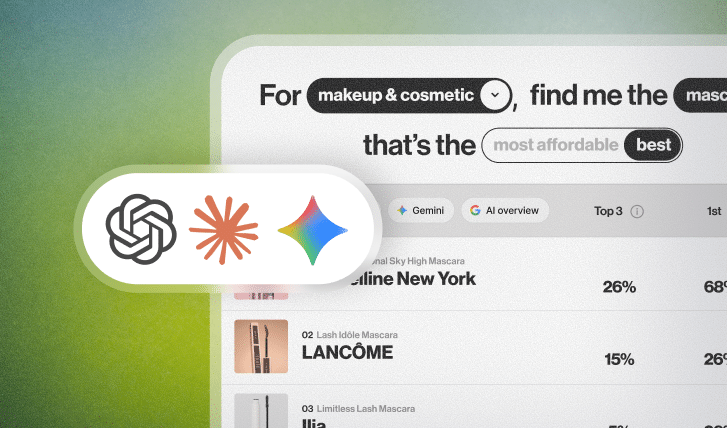










AI search has quietly rewritten the rules of visibility, and most ecommerce brands have no real picture of how they show up when a shopper asks ChatGPT or Google for a recommendation. An AI SEO audit gives you that picture. This guide walks through what to check, how to score it, and where to focus first.
E-commerce teams are facing a new challenge: making sure their products show up in AI-powered search and chat tools. Your website may rank well on traditional search engines, but if AI systems can’t understand your product data, your visibility could be much lower than you think. An AI SEO audit helps identify these gaps so you can protect traffic, reach more customers, and stay competitive.
Key Takeaways
- Google AI Overviews appear on 48% of tracked queries across high-intent search terms.
- Only 16.7% of sources cited in AI Overviews overlap with the top ten standard organic listings.
- A growing share of shoppers expect to rely less on traditional search engines as chat tools improve.
- Traffic from generative AI sources to US retail sites grew notably in early 2026.
- Many consumers now consult AI platforms while making a buy decision.
Why This Matters: The Shift to AI Search Visibility
The old search playbook is losing ground on conversational traffic, and the gap between where you rank and where you actually get cited is wider than most dashboards will tell you. Understanding why that’s happening, and what to do about it, is what a real AI search audit is for.
This isn’t a temporary trend. It’s a structural change in how search engines work. Classic SEO matched keywords to pages; generative engines crawl, synthesize, and rewrite answers on the fly. A site ranking first in standard organic results might be completely absent from a conversational AI response, not because the content is bad, but because the machine can’t read the data clearly enough to trust it. That distinction matters enormously for anyone managing e-commerce traffic at scale.
Picture an SEO director at a growing footwear brand reviewing analytics at the end of a long day. Her keyword rankings look solid. But she pulls up ChatGPT and types her most profitable category query. Three competitors appear in the answer while her brand isn’t mentioned once. What had felt like an abstract “AI search trend” suddenly shows up as a concrete daily revenue problem.
Many consumers now consult AI platforms while making a buy decision. If your technical structure is invisible to these engines, you’re absent from the channels where modern shoppers form their preferences before they ever visit a product page.
The Framework: Four Stages to Auditing AI Search Visibility
A useful audit doesn’t just measure keyword positions. It checks how machines read, interpret, and trust your brand data across the web. The four stages below move your e-commerce site from basic crawlability to continuous, automated optimization. Each stage builds on the one before it, so the sequence matters.
Teams that run these stages out of order often do significant work and see little citation lift. You can’t audit share of voice accurately if your schema is broken, and continuous optimization won’t move the needle if the off-site context layer is thin. Starting with the foundation is what makes the later stages work.
Stage 1: Crawlability and Schema Audit
What This Stage Covers
AI engines don’t browse websites the way shoppers do. They parse raw code, relying on structured schema, semantic JSON-LD feeds, and accessible catalog data to understand your inventory. Stage one verifies that AI scrapers can reach your product catalog cleanly, without hitting technical roadblocks or data gaps that cause them to skip your listings entirely.
It’s worth being specific about what “data gaps” actually means here. An AI engine parsing your product detail page is looking for a complete, non-null set of attributes: product name, price, availability, brand, and aggregate review ratings at minimum. When any of those fields are missing or malformed, the engine can’t confidently place your product in a comparison grid, so it simply doesn’t.
How to Execute
Start with your robots.txt file. Confirm you’re not blocking major AI crawler agents like GPTBot, ClaudeBot, and PerplexityBot. A surprising number of brands do this unintentionally through legacy firewall rules built to stop scraper bots.
Next, run your PDP schema through a structured data validation tool. Verify that your JSON-LD contains complete, non-null attributes for every critical field. Pay particular attention to GTIN and MPN identifiers. AI search models frequently bypass product listings that lack these because they can’t verify product authenticity or stock status without them. A missing GTIN isn’t just a schema gap; from the engine’s perspective, it’s an unverifiable listing it won’t risk recommending.
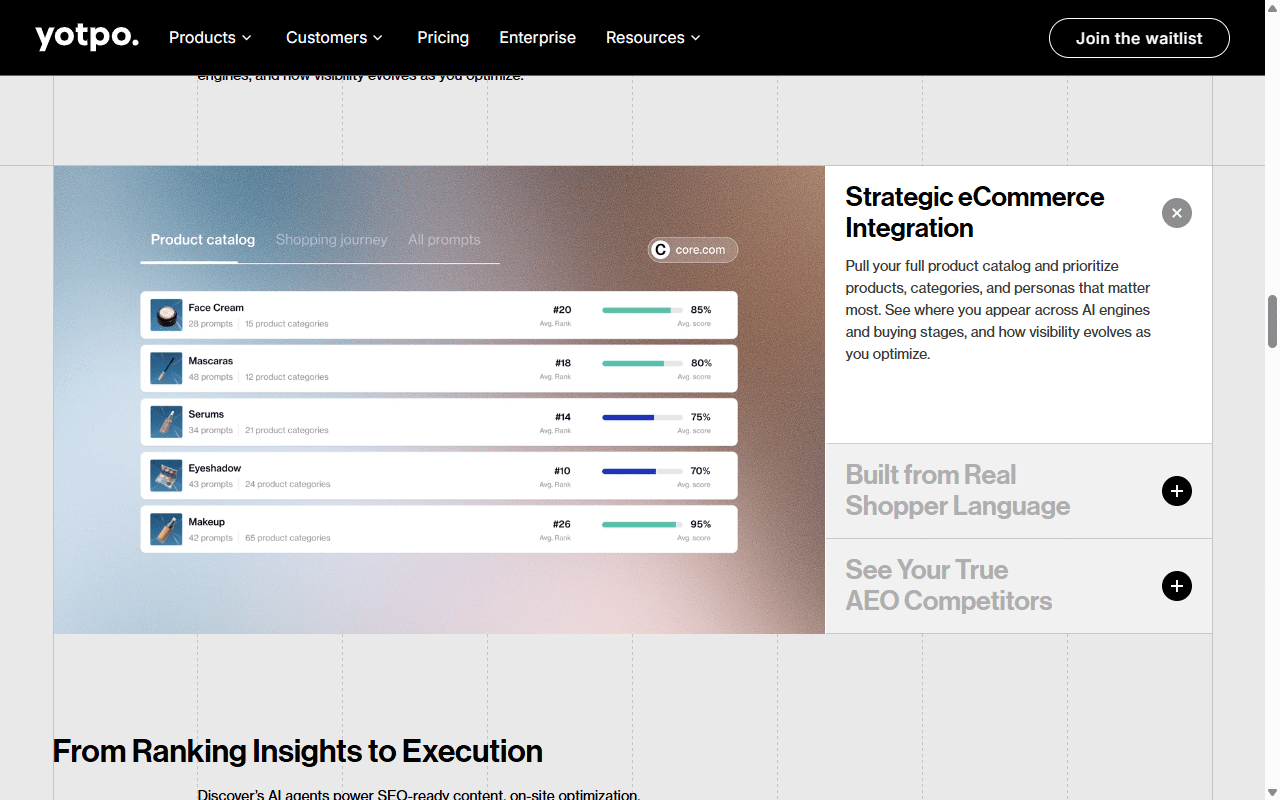
To stay on top of this across a growing catalog, Yotpo Discover includes an Onsite Agent that continuously scans your store to find and fix structural issues. It flags missing structured data, weak internal linking patterns, and unclear product detail pages that hurt machine comprehension, keeping your catalog legible to crawlers as your inventory evolves.
Common Pitfalls
Many brands assume their standard schema is sufficient, only to discover they’ve left critical identifiers like GTIN, MPN, or live inventory status blank. Legacy firewall configurations also sometimes flag rapid AI crawler requests as bad-bot traffic, accidentally blocking the very engines trying to index the store’s products. Both mistakes are easy to miss and worth checking proactively.
Stage 2: SKU-Level Commerce Data and LLM Context Audit
What This Stage Covers
AI models build recommendations by synthesizing third-party validation, customer reviews, and editorial coverage. They construct a contextual map of your brand’s reputation and product performance across the web before deciding whether to cite you. This stage checks how your brand is represented in the datasets that answer engines use when constructing their responses, not just on your own domain, but everywhere these engines look.
Your user-generated content and authentic customer voices matter more here than most teams expect. AI engines prioritize objective, third-party sentiment. They cross-reference your on-site claims with review platforms and forum discussions to verify quality before making a recommendation.
If your owned site praises a product but external platforms show thin or negative sentiment, the engine senses the contradiction and moves on. The fix isn’t to manufacture reviews; it’s to make sure the genuine experiences your customers have actually shared are visible on the platforms these engines crawl.
How to Execute
Run manual query tests inside the major chat-based assistants. ChatGPT, Perplexity, and Claude are the three worth covering first. Use natural, non-branded queries that mirror real shopper language: “What’s the best organic skincare product for sensitive skin?” or “Which running shoes offer the most arch support?” Track whether your brand appears, note the sentiment, and record the exact URLs cited as sources. Cover at least 20 to 30 queries to spot patterns, not just one-off results.
To scale these efforts, Yotpo Discover deploys three automated agents: the Onsite Agent, the Content Agent, and the Activation Agent. The Content Agent builds search-optimized blog content using real customer reviews and past order history (that’s the kind of proof AI search engines weight most), while compiling outreach briefs to secure coverage on external publisher sites.
The Activation Agent identifies the specific Reddit threads, retail marketplaces, and digital platforms that AI engines actively cite, then prompts your verified reviewers and loyalty members to share genuine experiences on those exact platforms. That’s how you build the off-site signal layer that answer engines actually trust.
Common Pitfalls
The most common mistake is focusing entirely on owned blog content while ignoring off-site forums and review platforms. AI engines look for a consensus of authentic voices across multiple independent domains before recommending a brand. Strong on-site content alone won’t close that gap if the third-party signal is thin or absent.
Stage 3: AI Overviews Share of Voice Audit
What This Stage Covers
Google AI Overviews sit at the top of the search results page, capturing a disproportionate share of user attention before a single organic listing is visible. This stage measures your actual brand footprint inside those generated modules for your highest-value commercial queries. Because AI Overview results differ so sharply from standard organic blue links (only 16.7% of cited sources overlap with the top ten organic listings), you need to audit them as a distinct performance metric.
How to Execute
Compile your top 100 revenue-driving queries. Run them through a search session with AI features enabled, and record whether an AI Overview appears. For every overview that shows up, document whether your brand is cited, which specific SKUs appear, and which external sources Google links to within the response block. That last detail often reveals which third-party publishers the engine trusts most for your category, which is useful intelligence for your outreach strategy.
A pattern shows up repeatedly across mid-market brands: the team celebrates ranking in the top three organic listings, unaware that an AI Overview has pushed those listings further down the page while naming three competitors by name in the generated answer. Tracking this manually is slow. Visibility dashboards that monitor citation shifts across ChatGPT, Gemini, and Google AI Overviews simultaneously are worth building into your reporting stack.
For broader context on AI search trends, the Yotpo blog regularly publishes research on e-commerce visibility metrics. Comparing your manual audit results with industry benchmarks helps you tell the difference between a site-specific problem and a category-wide shift.
Common Pitfalls
Many SEO managers skip segmenting their share of voice by device type or geography. Google AI Overviews populate dynamically based on searcher location and device. Desktop results in one region might feature your products prominently, while mobile queries in another omit them entirely. Always run audits across multiple simulated user profiles to keep your data representative.
Stage 4: Continuous Optimization and Automated Execution
What This Stage Covers
An audit gives you a diagnostic snapshot of your current performance, useful but limited. The real value lies in translating those findings into ongoing optimization workflows that keep pace with how AI engines evolve. This stage is about building a continuous improvement cadence that keeps your metadata, content assets, and external authority signals current as models update their retrieval logic.
AI engines update their parameters and datasets constantly. A technical fix that secures citations this week can lose effectiveness next month when an engine refreshes its parser. That’s not a hypothetical edge case; it’s the normal operating rhythm of these systems. Brands that treat AI optimization as a one-time project consistently find themselves recovering citation share after the fact rather than protecting it.
How to Execute
Once you’ve identified your visibility gaps, rank your improvement efforts by SKU revenue contribution. For products with high search volume but low citation rates, update page-level copy to answer the specific comparison and use-case questions buyers actually search. Make sure your product description pages address queries like “Product A vs Product B” using structured subheadings. Those are the patterns AI engines scan when building comparison responses.
Rather than managing updates manually, Yotpo Discover’s automated agents handle continuous optimization in the background. Brands like Beekman 1802 and David Protein use Yotpo Discover to maintain strong AI search visibility without taxing their internal marketing teams. To see where your store stands today, you can get a free audit that reviews your current performance baseline across the major engines.
Measuring Success: KPIs for AI Search Visibility
Measuring AI search performance calls for a different set of metrics than traditional organic reporting. Standard SEO success centers on click-through rates from specific keyword positions. AI success is defined by citation frequency: how often and how accurately engines pull your brand and products into generated answers as a trusted source.
Tracking domain-level visibility alone won’t tell you whether your hero SKUs are appearing in product recommendations, and that’s usually the number the business cares most about. Marketing teams need to establish clear baselines for share of voice and citation rates before they can measure return on investment from their AI search efforts. A brand can have strong aggregate AI visibility and still find its highest-margin products almost never cited. SKU-level detail is where the useful work happens.
The goal is to become the primary source of truth in your category. These five metrics tell you how close you are:
- Citation Share of Voice: The percentage of generated product recommendations within your category that feature your brand.
- Engine Citation Rate: How often AI engines link directly to your PDPs as reference materials within a generated response.
- Entity Attribute Association: How consistently AI models connect your brand to the descriptive keywords you want to own, like “durable” or “eco-friendly.”
- SKU-Level Visibility Score: Individual visibility rankings for your top products across ChatGPT, Perplexity, Gemini, and Google AI Overviews.
- Referral Traffic Conversion Rate: The transaction rate of traffic arriving from chat-based search engines, tracked separately from standard organic to reflect genuine buyer intent.
“AI engines don’t crawl websites the same way human shoppers browse. They look for highly structured, authoritative, and verified customer data to validate their choices. If your technical structure and customer reviews aren’t structured for machines to read, your brand simply doesn’t exist in their index.”
Ben Salomon, Growth Marketing Manager at Yotpo
Frequently Asked Questions
What is the difference between traditional SEO and AI SEO (AEO)?
Traditional SEO focuses on keyword rankings, page speed, and backlinks to drive users to your website. AI SEO, or Answer Engine Optimization (AEO), focuses on structuring your content so that AI models understand and cite your brand as a primary source in generated answers.
Will optimizing for AI search hurt my traditional SEO rankings?
Not at all. AEO works as a complementary layer that strengthens your existing SEO work. Clean technical schema, solid crawlability, and clear product descriptions benefit both traditional search crawlers and AI search agents — the two reinforce each other more than they conflict.
How often should we conduct an AI SEO audit for our store?
Because AI models update frequently and change how they fetch results, a full technical audit every quarter is a good baseline. That said, track share of voice and citation rates on an ongoing basis using automated platforms. Quarterly audits catch structural gaps, but continuous monitoring catches the week-to-week citation shifts that matter most for revenue.
Why do search engines ignore my high organic rankings in their AI answers?
AI engines prioritize informational synthesis and credibility over legacy search metrics. If your content lacks structured schema, or your brand lacks verified shopper feedback on third-party sites, an AI model will choose a competitor with stronger answer-engine authority, even if your organic ranking is higher.
Does Yotpo Discover help with standard keyword research?
No, Yotpo Discover is built specifically to address the complex reality of commerce and track your brand’s AI search visibility. It analyzes where your products rank across ChatGPT, Gemini, and Google AI Overviews, then deploys active agents to resolve technical and content gaps that keep you from being cited.
What role do customer reviews play in AI search visibility?
Customer reviews supply the authentic shopper voices that AI engines rely on to validate their recommendations. Answer engines seek out verified, unstructured product sentiment from real buyers to make confident suggestions — owned marketing copy alone doesn’t carry the same weight as genuine reviews on independent platforms, so the signal mix matters.
How do AI engines find SKU-level information on my e-commerce site?
They parse your site’s structured schema, product catalogs, and raw text. If your product detail pages lack complete JSON-LD markup or clear attribute lists, AI engines can’t extract your product details reliably and will omit them from citations.
Is Yotpo Discover designed only for enterprise-level retail brands?
No, Yotpo Discover is for serious retail brands of all sizes that prioritize AI search visibility. Whether you run a growing direct-to-consumer brand or a large enterprise, the platform helps you protect and grow your share of voice in AI results.
To stay ahead of the shift in how shoppers discover products, you need to actively track and optimize your search footprint across both traditional and AI-driven channels. Visit the Yotpo Discover page and request a demo. You can also get your current AI visibility score with a free audit today.



 Join a free demo, personalized to fit your needs