



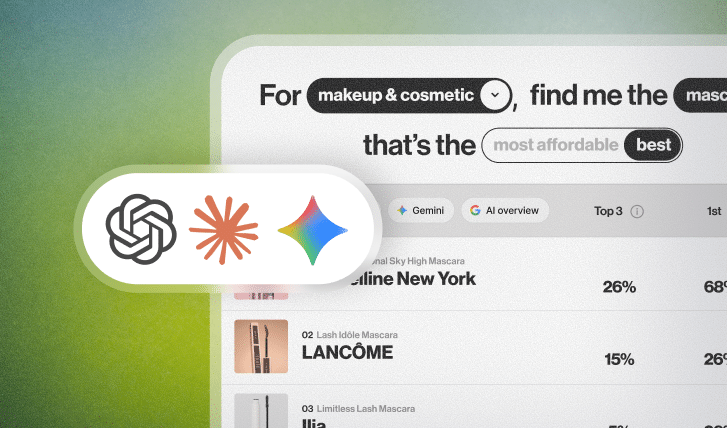










Online search is shifting from traditional index-based results to conversational answer engines, and that shift is moving faster than most teams expected. For digital marketing and SEO leaders at ecommerce brands, understanding how products appear in AI-driven search is no longer something you can defer to next quarter. This checklist walks you through a complete AI audit for ecommerce: measure your actual visibility, catch catalog optimization errors early, and correct them before they cost you meaningful traffic.
Key Takeaways
- Shoppers are adopting conversational search fast, with 89% of retailers implementing AI tools to meet that demand.
- AI search traffic is growing steadily and is projected to reach 40% of total search traffic by 2027.
- AI engines shape buy decisions directly — about half of consumers consult AI platforms at the exact moment they’re making purchasing decisions.
- Strong organic rankings don’t guarantee AI visibility, which is why a dedicated audit process has become essential for modern SEO heads.
- Successful retail brands use automated execution agents rather than static trackers to fix catalog issues at scale and keep high-performing content current.
Why This Matters: The Shift in E-Commerce Product Discovery
Picture a director of SEO at a growing direct-to-consumer brand staring at a spreadsheet of keyword rankings late at night, realizing that Google AI Overviews have quietly stopped citing their primary collection pages. It’s a disorienting moment, because the organic rankings still look fine. The old playbook (keyword tracking, backlink accumulation, metadata tuning) didn’t disappear, but it’s no longer sufficient on its own. Chat-based models now answer buyer questions directly, often bypassing the traditional list of blue links entirely.
To stay competitive, brands need to treat Answer Engine Optimization (AEO) as a genuine layer on top of their existing SEO work, not a side project. Traditional search engines rewarded keyword density and link authority. Chat engines read, summarize, and recommend based on context and structured data signals, so the optimization targets are different. You’re no longer writing only for crawl bots; you’re writing for language models that synthesize dozens of data sources before generating a single answer.
Generative engine optimization (GEO) isn’t just a new acronym for the same work. It requires a real rethink of how technical search marketing gets done. Brands that spent years tuning for specific keyword clusters now need to make sure their SKU-level commerce data is cleanly formatted, their product catalogs carry explicit structured data, and their pages are written in a way that language models can parse with confidence.
If those conditions aren’t met, the engine skips over your products entirely, and strong organic rankings offer no protection against that. We’ve seen this pattern across categories: organic success and AI citation success don’t always travel together (and that’s the part most teams miss until the audit reveals it).
Brands that ignore chat-based visibility risk quietly losing their share of voice for their highest-margin products. Running a thorough audit is the first step toward understanding exactly where you stand across these new discovery paths.
The Framework: Four Stages to a Complete AI Audit
A useful AI audit can’t rely on manual one-off queries or guesswork. Chat-based engines draw from dozens of distinct data points to build their answers: technical product data, customer reviews, off-site community mentions, structured schema, and more. To measure and improve your brand presence, you need a structured approach that covers all those layers at once.
This four-stage framework was designed around how major engines actually parse and recommend retail products. The stages move in logical order: measure your current footprint, check your technical product data, analyze shopper feedback patterns, and map your citation sources. Following this sequence lets your team pinpoint visibility gaps and prioritize fixes that match the complex reality of commerce.
Stage 1: Measuring LLM Share of Voice and Citations
What This Stage Covers
Stage one is about establishing your baseline. You’re measuring how often your brand and specific product SKUs appear in chat-based recommendations when shoppers search for relevant categories. This isn’t about brand name searches; it’s about the category-level and intent-driven queries that your actual buyers use during discovery.
A common assumption is that strong organic keyword rankings translate cleanly into chat-based citations. They often don’t. The correlation between “ranking well in Google” and “getting cited by ChatGPT or Gemini” is weaker than most teams expect, so the first step is to measure what’s actually happening. The goal here is an AI Visibility Score that reflects your true share of voice across ChatGPT, Gemini, and Google AI Overviews.
How to Execute It
Start by identifying fifty high-value queries that your target shoppers use during early discovery, phrased as they’d actually ask a chat engine, not as keyword-optimized strings. Run those queries across the major chat-based systems and record three things for each: whether your brand was cited, which source URLs the engine used, and which competitors were recommended instead of you.
Manual testing works fine for a small product catalog, but growing retail brands should use an automated platform like Yotpo Discover to run these checks continuously. The platform’s real-time visibility dashboard lets you track changes in citation frequency and respond quickly, without your team spending hours copying prompts across tabs.
Pitfalls to Watch For
The most common mistake here is monitoring only one engine, usually ChatGPT. Traffic share shifts regularly across models, so a narrow dataset leaves major blind spots. If ChatGPT is your only data source, you’re missing a significant portion of actual buyer behavior.
The other mistake is running queries only on your brand name. Shoppers in the research phase rarely use exact brand terms. Category-level queries like “best loyalty program for Shopify brands” or “which platform has the most verified reviews” are where real visibility is won or lost, and those are the ones you need to be tracking.
Stage 2: Auditing SKU-Level Commerce Data and Product Attribute Accuracy
What This Stage Covers
AI engines sometimes hallucinate product details or pull outdated information from old cached pages, which leads to incorrect recommendations that quietly damage your conversion rates. Stage two inspects how accurately engines describe your products, including their pricing, dimensions, specifications, and stock status. For an engine to confidently recommend your catalog, that data needs to be highly accessible and correctly structured.
This stage evaluates whether crawlers can correctly parse your product attributes: dimensions, ingredients, material specs, pricing variations, and live stock status. Even one misconfigured schema field on a top SKU can cause an engine to skip that product for comparative queries where you’d otherwise be recommended.
How to Execute It
Ask specific product questions for your top thirty SKUs across major chat engines, the kind of questions a shopper with clear intent would ask. Then compare the engine’s answer against your live store data. Note every discrepancy in product naming, specifications, or pricing. That gap list becomes your immediate fix queue.
To scale this check, you can deploy the Onsite Agent within Yotpo Discover. It continuously scans your store to catch and flag technical issues (missing structured data, weak internal linking, outdated schema) that prevent AI engines from parsing your catalog correctly. It turns what would otherwise be a quarterly manual project into a continuous background process.
Pitfalls to Watch For
Many brands assume their standard SEO schema handles AI crawlers just fine. It usually doesn’t. SEO schema was built for index bots; AI crawlers need catalog attributes presented in a way that language models can extract and reason about. A crawler that can’t pull your product specs with confidence will skip your brand for a competitor whose data is cleaner.
Failing to update structured data dynamically as inventory or pricing changes is another common gap. Static schema templates that were accurate six months ago create broken citations. When a shopper clicks through to find different pricing than the engine quoted, that trust problem compounds over time.
Stage 3: Sentiment Analysis and Chat-Based Context
What This Stage Covers
AI engines don’t just recommend the best-structured product; they recommend the product that buyers seem to trust most. Sentiment signals like customer reviews, forum discussions, and community mentions play a significant role in which brands get cited for comparison queries. Stage three audits how your customer sentiment is being summarized by chat-based systems and whether it’s working for or against you.
The key questions: Are models framing your brand positively? What specific product benefits do they highlight? Are they citing real customer experiences, or pulling from older forum threads with outdated complaints? Engines actively look for authentic shopper voices to validate their recommendations, which means your review ecosystem is effectively part of your search infrastructure.
How to Execute It
Prompt major engines to compare your top products against your main competitors. Pay close attention to the adjectives used to describe your brand. Note whether the engine references specific customer reviews or surfaces common complaints from older sources. Both tell you something important about how your brand is perceived in the AI layer, including where the gaps are.
To feed authentic shopper voices into these models at scale, you can use the Content Agent in Yotpo Discover. It builds high-performing, review-backed buying guides from real customer reviews and past order data. That kind of proof is what AI engines weight most when deciding which brand to cite. Real customer language beats polished marketing copy every time.
Brands like Beekman 1802 and David Protein use Yotpo Discover to keep their customer review data well-structured and current, so chat-based systems consistently find accurate, fresh shopper feedback when building their recommendations.
Pitfalls to Watch For
Relying on generic marketing copy is a real problem here. Modern AI models are trained to deprioritize polished brand language in favor of genuine customer opinions. If the only content your brand surfaces at scale is your own campaign copy, the engine will look elsewhere for social proof, and it’ll usually find your competitors’ reviews instead.
Ignoring negative sentiment trends also hurts you. If an engine repeatedly detects unresolved complaints about a specific product attribute, it will quietly stop recommending that SKU for positive comparison queries. Staying on top of negative review patterns isn’t just a customer service practice; it’s a search strategy.
Stage 4: Tracking and Mapping Citation Sources
What This Stage Covers
AI engines rarely generate recommendations from scratch; they pull facts from third-party sites, forums, and publisher blogs they’ve identified as trusted sources for your category. Stage four maps exactly where search models find their supporting evidence, then helps you decide where to build more presence.
By identifying these citation sources, your team can see which off-site channels have the greatest impact on your chat-based visibility. That lets you shift from passive tracking to deliberate outreach on the platforms that actually matter for your category.
How to Execute It
Start with the source links in Google AI Overviews and Perplexity recommendations for your category. Build a master list of the publisher sites, online forums, and community channels cited most frequently by these engines. That list tells you where authority currently lives in your space, and where yours is absent.
To scale this off-site influence, you can use the Activation Agent within Yotpo Discover. It identifies the specific Reddit threads, retail marketplaces, and community spaces that engines are actively citing, then helps you turn your existing customer base into an active community sharing authentic reviews on those exact channels.
Pitfalls to Watch For
Focusing entirely on traditional PR and high-authority blog links misses a large part of how AI engines build their citations. These engines frequently cite community platforms and informal discussion threads, which means standard media outreach lists leave meaningful gaps in your chat-based visibility strategy.
The other common error is running your off-site outreach separately from your on-page content strategy. Your owned blog and your off-site community mentions need to reinforce the same product attributes. When they contradict each other, or simply don’t connect, engines struggle to build a confident picture of your brand, and that uncertainty usually resolves in your competitor’s favor.
Measuring Success: KPIs for E-Commerce AI Audits
Tracking progress in AI search requires moving past vanity metrics like simple keyword ranks. Because AI engines refresh their data and retrieve live information dynamically, a single query can yield different citation sources from one session to the next. That variability makes consistent testing methodology more important than any individual data point.
Marketing teams need standardized testing baselines across ChatGPT, Gemini, and Google AI Overviews to capture a true average share of voice. Without a baseline, you can’t tell whether a content update or a schema fix actually moved your citations. You’re just watching numbers that may be shifting for unrelated reasons.
The financial case for getting this right is clear. 69% of retailers using AI report measurable revenue increases directly tied to those investments. And because many US shoppers now use chat-based tools to research purchases, securing these citations connects directly to stronger on-site conversion rates, not just traffic numbers.
Keep your team focused on outcomes that reflect actual system performance. Track these metrics through every audit cycle:
- AI Share of Voice: the percentage of chat-based answers in your product category that recommend your brand.
- Citation Frequency: the average number of source citations your domain earns per hundred transactional queries.
- Catalog Attribute Match Rate: how accurately chat-based engines report your product details, pricing, and dimensions.
- Sentiment Alignment Score: the ratio of positive to negative customer adjectives engines use when summarizing your brand in comparison queries.
- Off-Site Citation Coverage: the number of active community threads and publisher pages citing your products that get picked up by chat-based crawlers.
“Conducting an AI audit is step one, but manual tracking alone isn’t enough. To actually win share of voice, marketing teams need active systems that connect catalog data directly to automated execution agents.”
Ben Salomon, Growth Marketing Manager at Yotpo
Frequently Asked Questions
What is the difference between SEO and AEO?
AEO is a complementary layer, not a replacement for traditional SEO. SEO focuses on rankings within index-based search results; AEO optimizes your content to be cited as a direct answer by chat-based language models. You need both.
How often should we conduct an AI audit?
Run a basic audit monthly to track your baseline visibility score. Technical catalog audits should be automated with continuous scanning tools to catch dynamic inventory and pricing changes as they happen.
Do we need a large review base to get cited in AI search?
A large review volume helps, but catalog structure and review quality matter more. Crawlers prioritize well-structured, descriptive customer feedback that directly addresses specific product attributes. Ten detailed, specific reviews often outperform a hundred generic ones.
What are automated execution agents?
They’re automated systems that take direct action to resolve visibility issues rather than just reporting them. In Yotpo Discover, this includes the Onsite, Content, and Activation agents working together to close content and structural gaps without requiring a manual fix queue.
Why does SKU-level commerce data matter for AI?
Chat-based engines don’t browse websites the way humans do; they parse raw data attributes. Accurate, detailed SKU data lets language models confidently recommend your products for specific technical queries, where incomplete data leads to being skipped entirely.
Can we pay to be cited in AI search engines?
Not within the answer itself. Some engines — ChatGPT, for example — now run labeled sponsored placements that appear below a response, but the providers state those ads don’t influence the organic answer. The citations these engines make inside their recommendations are still earned through structured onsite data and genuine off-site discussion. There is no paid shortcut to the organic citation layer.
What role do community platforms like Reddit play in AI search?
AI engines prioritize third-party social proof and frequently scan forums for authentic customer opinions. Building real presence on these platforms, through genuine reviews and community engagement, is essential for securing organic citations.
How does Yotpo Discover work with our existing reviews?
The platform connects with your reviews to feed authentic customer feedback directly into the chat-based citation layer. That makes sure search engines have access to the genuine trust signals they need to recommend your brand consistently.
To start optimizing your catalog and scaling your chat-based presence, request a demo of Yotpo Discover. You can also analyze your current search footprint right now and get your free AI visibility score today.



 Join a free demo, personalized to fit your needs