














“Yotpo is a fundamental part of our recommended tech stack.”
 Laura Doonin, Commercial Director

Get a data-driven look at how online shoppers make confident purchase decisions. Uncover what resonates, what builds trust, and what sends them running, and how reviews and AI reduce uncertainty and drive smarter buys.
Before AI, before reviews, even before the internet, shoppers have always depended on one thing: asking someone else. In the 1950s, it was checking with the neighbor about that commercial you saw. In the ’70s, flipping through catalogs and calling your cousin for advice. By the ’90s, it was all about mall trips and friend group opinions. And in the 2000s? You trusted total strangers online who left way-too-honest reviews. No matter the decade, people have always craved reassurance from others before making a purchase.
Today, that instinct hasn’t changed, but the channels have. In an era shaped by algorithms, AI assistants, and a constant scroll of options, one thing remains true: people still want trusted opinions before they commit. From star ratings and unfiltered user photos to personalized AI suggestions, this report uncovers how the modern path to purchase is powered by feedback. We conducted this research to uncover what today’s shoppers truly want from reviews, how AI is transforming the way they discover and trust feedback, and what brands must do to stay ahead in this rapidly changing landscape.
This report is based on extensive research into the behaviors of modern online shoppers. We analyzed a group of shoppers who purchase online more than once a month.
We gathered over 50,000 survey points, conducted in-depth interviews, and analyzed open-ended feedback to explore how shoppers interact with reviews and AI.
The study covers a diverse demographic, spanning ages 18 to 65 across Gen Z, Millennials, and Gen X, and includes participants from the US, UK, and APAC regions.
Research was conducted between April and May 2025.

The rise of AI isn’t just changing how brands operate, it’s creating a new kind of shopper. One that’s curious, fast-moving, and AI-assisted. Early adopters are already using AI not just to browse, but to decide. They’re asking smarter questions, seeking personalized recommendations, and expecting streamlined answers that cut through the noise.
From discovering new products to evaluating reviews, AI is becoming a trusted co-pilot in the purchase journey. But AI isn’t replacing the shopper’s voice, it’s elevating it. These tools pull from real customer reviews, ratings, and experiences to surface insights that feel tailored and trustworthy. It analyzes patterns, highlights themes, and personalizes results to help shoppers feel more confident, informed, and in control. That means the value of a brand’s content, especially user generated content like reviews, has never been higher. In this new era of product discovery, a brand’s success depends on how well it feeds the machine. Rich, authentic content isn’t just influencing individual shoppers, it’s powering the engines that influence millions more.
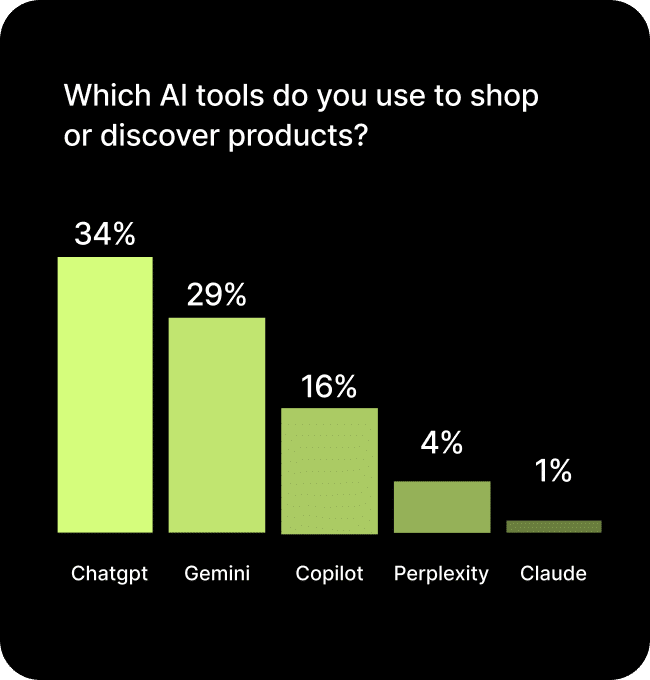
Nowhere is this shift more important than among frequent online shoppers, people who are shopping online multiple times a month. These power buyers are already leaning into AI to help them do it smarter and faster.
34% of frequent AI users are specifically using ChatGPT for product discovery.
And those who haven’t tried it yet? They’re curious. As AI becomes more integrated into everyday shopping experiences, this curiosity is likely to turn into action, accelerating adoption.

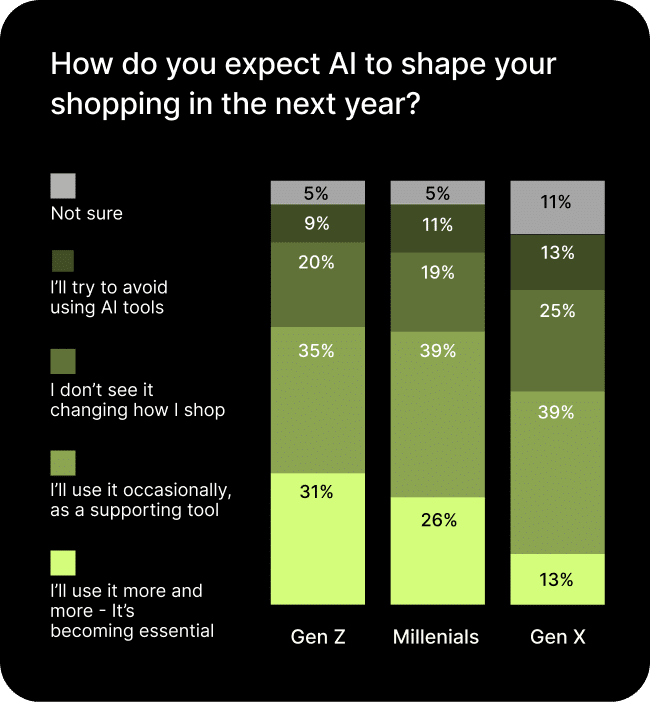
As with any emerging tech, adoption patterns reveal clear generational and demographic divides, and AI is no exception. Trust and openness toward AI specifically vary across age and gender. Gen Z leads the way in embracing AI for shopping and discovery, followed closely by Millennials. Gen X however, shows much more hesitation.
The most telling insight? A clear majority across all generations, not just Gen Z, see AI as a helpful tool they expect to use in the future.
52% to 66% of each age group expressed interest in using AI for product discovery in the future.
This early-stage curiosity signals more than just hype. What’s a “maybe” now is well on its way to becoming part of the everyday shopping routine of every generation.

Gender differences stand out too. Men tend to lean in and trust AI tools more readily, while women take a more cautious approach, waiting to see clear value before fully embracing the shift.
57% of men say they currently use AI tools for shopping, compared to 39% of women who say the same.
But of these women, more than half of them (41%) say they’re interested in trying tools like ChatGPT for shopping.
This gap between current usage and future intent signals strong growth potential, especially among less tech-savvy or more hesitant shoppers. Brands that invest in education and user-friendly experiences will be well-positioned to lead this shift and turn that interest into action.
While full adoption is still unfolding, the data points to a promising future for AI-driven shopping across all demographics.

Once shoppers start using AI tools, they don’t just scroll, they strategize, compare and evaluate. They’re asking smart questions, comparing products, and weighing pros and cons. These tools are helping people shop with intention. For brands, this means PDP content needs to do more than inform. It has to support side-by-side evaluation, highlight differentiators, and reflect real customer experiences. To stay competitive, product pages need to be rich in reviews, detailed in data, and structured for comparison.

Here’s how shoppers are putting AI to work, starting with the most popular:
Compare specs, prices, and features to find the best choice: Shoppers use AI to line up similar products side by side, break down technical specifications, evaluate pros and cons, and identify the best deals. It’s a smarter, faster way to zero in on the right choice.
“I ask Gemini to compare a product that different companies produce and tell me which is the best one.” Jack, 30, Washington, US
Get personalized recommendations and find best-fit products: Shoppers use AI to find items that match their unique needs and preferences, whether that’s budget, skin type, lifestyle, or specific use cases. It’s a tailored path to smarter, more relevant shopping.
“I use it to find certain products that will work for my skin that are the best for the price.” Olivia, 23, London, UK
Build and organize shopping lists: Ai is being used to streamline planning by creating smart shopping lists, grouping items by category or store, and ensuring nothing gets forgotten. Its convenience meets efficiency.
“I give a budget and stores I want to shop at and they provide a detailed list to shop for along with meals for the week.” Lily, 20, New York, US
Health, food, and skincare guidance: Users frequently consult AI for wellness-related purchases, from choosing healthy foods and supplements to building skincare routines or finding products that fit specific dietary needs.
“I use AI to find what skincare works best for my type of skin and how gentle it can be.” Ava, 34, Philadelphia, US
Gift ideas and occasion shopping: Shoppers use AI as a creative assistant for gift-giving. Using it to help brainstorm thoughtful gift ideas tailored to specific people, events, or occasions.
“I ask them for information about the product if I’m having trouble finding it. I’ll also ask if gift ideas are reasonable.” Michael, 28, Melbourne, Australia
The shift is here, a foundational change in how product discovery works. AI assistants rely on rich, structured, and relevant reviews as essential content assets that drive both discovery and trust. Brands that embrace this change and use reviews strategically will unlock growth and position themselves to lead the next wave of eCommerce.

Since reviews first started appearing online in the 90s, shoppers have relied on them to guide their decisions. But for years, that meant sifting through pages of conflicting opinions, scattered details, and endless scrolling just to find the truth. Now, AI is changing the game.
By instantly analyzing and summarizing thousands of real customer voices, AI transforms raw feedback into razor-sharp insight. It pulls out patterns, highlights pros and cons, and delivers the context shoppers need fast. No more digging. No more guesswork. What was once buried is now front and center. Reviews aren’t just post-purchase reflections, they’re fast, trusted, and decision-driving from the very first click. AI isn’t replacing human feedback, it’s amplifying its impact. In seconds, shoppers can feel smarter and more confident making reviews more powerful than ever.
That means the vast majority of shoppers aren’t casually browsing for social proof, they’re actively relying on reviews to guide their decisions. This signals that reviews are not just supporting content, they’re critical decision-making tools, as essential as price, product specs, or brand reputation.

In crowded marketplaces, product specs aren’t enough. Reviews are the real differentiator. They surface what makes your product unique through the lens of real-world use. They reveal unexpected benefits, provide clarity around key concerns, and tell a story your product description alone can’t.
“I purchase a lot of products and I compare a lot of products, and if a product doesn’t have any customer reviews that’s a big red flag for me.” Alex, 38, Cleveland, US
“If a product only has 2 or 3 reviews, it’s hard to put much credibility behind those.” Simone, 29, Brighton, UK
This is why review content needs to be treated like the performance asset it is. A rich, transparent review ecosystem doesn’t just reassure, it differentiates. And in competitive verticals like fashion, beauty and electronics, that edge is everything.
Electronics and tech gadget shoppers are the most review-reliant audience across all categories, with 85.5% of frequent review readers stating they always check reviews before purchasing. Clothing and beauty shoppers are in second place, with nearly 7 in 10 frequently checking reviews.
Another area where reviews become crucial? High-ticket items.
73% of shoppers said they are more likely to read reviews when making a high-ticket purchase.
High prices trigger higher expectations, not just of product quality, but of review transparency. Making reviews a critical driver of trust and conversion for high-ticket items. Shoppers want to know: Is this really worth it? So, they dig deeper, scroll longer, and investigate with intent.
“If I’m going to spend that much, I need to be sure.” Jacob, 40, San Francisco, US
“I check reviews carefully when it’s a bigger investment, even looking at how recent the reviews are.” Matthew, 25, Sydney, Australia

But simply having reviews isn’t necessarily the competitive edge brands are looking for. What matters to shoppers now is that they feel real. Shoppers don’t just want proof that others bought, they want proof they can trust.
The modern shopper isn’t just browsing reviews, they’re investigating them. Shoppers now scan for patterns, seek nuance, and assess credibility based on authenticity, not just positivity. They have a built-in filter for anything that feels overly polished or staged. What they’re really looking for isn’t perfection, it’s honesty.
That means a lack of negative reviews doesn’t build confidence, it actually raises red flags. Negative reviews, once feared by brands, are now viewed by consumers as signs of legitimacy. Shoppers expect to see some critique, it’s how they know the brand isn’t hiding something.
Brands must move beyond the idea that only positive reviews are good reviews. Real trust is built in the grey areas: when brands allow imperfection to show and respond with transparency, empathy, and action.
More than half of shoppers (53%) say a negative review about product quality or performance has made them reconsider a purchase. But of these shoppers, over half (56%) say their decision ultimately depends on how the brand responds.
“The response and how quickly they respond are important. If I see a few bad reviews and no response from the brand at all, I think this product is bad.” Kim, 28 years old, Los Angeles, US
“Show that you are genuinely replying to them and are taking steps to improve rather than just doing generic copy and paste responses.” Daniel, 36, Seattle, US
This means that brands should not just respond to negative reviews, but do it with intention. Avoid templated replies and canned apologies. Instead, acknowledge the issue, offer a solution or next step, and show that feedback leads to real improvements.
This means that brands should not just respond to negative reviews, but do it with intention. Avoid templated replies and canned apologies. Instead, acknowledge the issue, offer a solution or next step, and show that feedback leads to real improvements.
When it comes to reviews, brands must meet this new shopper standard: not just by collecting more reviews, but by collecting useful reviews and presenting them in ways that feel honest, accessible, and tailored to the buyer’s mindset.
Reviews influence doesn’t stop at shopper confidence, they shape hard business metrics that have an impact up and down the funnel.
At the top of the funnel, reviews act as trust accelerators. When shoppers see authentic voices vouching for a product, they’re more likely to enter the consideration set, making paid media more efficient and driving CAC down.
In the middle of the funnel, reviews reduce hesitation. They answer the quiet doubts: Will this fit? Is it worth the price? Will it last? That reduction in friction translates into measurable improvements in conversion rate.
At the bottom of the funnel and beyond, reviews help retain customers and drive loyalty. When customers feel their expectations were matched (or even better, exceeded), they’re more likely to return.
Reviews are the trust layer that keeps shoppers moving forward, the social proof that makes brands feel credible, and the real-world insight that turns browsers into buyers.
In the endless aisle of online shopping, star ratings are the first impression; fast, familiar, and surprisingly powerful. Before a single word of a review is read or a photo is swiped through, that compact row of yellow stars makes a silent but powerful first impression.
34% of shoppers say the star rating is the first thing they look at when evaluating a product. It acts as a credibility shortcut, a filter for whether something is worth their time. But while stars may open the door, they rarely close the deal.

Today’s consumers are savvier than ever. They know a 5.0-star rating may not mean perfection, it might just mean low volume. They understand that the true value of a product lies not just in the average score, but in the story behind the stars: the quantity of reviews, the authenticity of language, the presence of user-generated visuals, and the freshness of the feedback. This is especially true for Millennials.
90% of Millennials told us they use star ratings as an initial filter, but don’t stop there. They move beyond that first impression to examine the narrative. For them, volume enhances trust.
70% of them said they trust a high volume of reviews paired with a solid rating over the rating alone.
“There’s a difference between if it is 4.4 and it’s 18 reviews, and it is 4.3, but there are 1,800 reviews.” Noah, 38, Manchester, UK
That same trend carries over to Gen Z, who tend to be even more skeptical of ratings in isolation.
90% of Gen Z shoppers report to scan the star rating first, but then immediately look to visuals, review content, and recent posts to get a better sense of real-world use.
By contrast, Gen X shoppers were somewhat more reliant on star ratings. 34.5% saying they rely on them to inform purchase decisions, compared to just 26.4% of Gen Z.
This generational difference suggests brands should be thoughtful about how they present reviews to different audiences, older generations may respond better to high, prominently displayed ratings, while younger consumers expect deeper transparency and richer detail.
Our research also uncovered a key insight that disrupts the assumption that higher is always better. A perfect 5.0 rating, especially when backed by a small number of reviews, can spark suspicion rather than trust. Shoppers today are aware of fake reviews, curated feedback, and inflated scores.
Imperfection, especially when explained in context, can actually build credibility. A few 3-star reviews that include constructive feedback or specific user expectations help create a balanced picture that shoppers are more likely to believe. For most shoppers, a rating between 4.3 and 4.4 hits the sweet spot, high enough to inspire confidence, but low enough to feel believable.
“For me, star ratings are very important… I would like to see at least 4.3 or 4.4.” Jennifer, 40, Chicago, US
The modern shopper’s path to purchase is less about snap decisions and more about progressive trust-building. Yes, the star rating is the spark, but what fans the flame is storytelling: the volume of voices sharing real experiences, the images that show products in everyday use, and the words that reflect genuine emotion, both positive and negative.
Shoppers are increasingly cross-referencing these cues. They look for consistency in language. They examine timestamps. They compare pros and cons across reviews. In this landscape, brands that lean too heavily on the metric without offering context miss the opportunity to connect more deeply.
Star ratings are no longer the final word, they’re the starting point. The most trusted brands recognize that shoppers crave context and social proof, not just numbers. A high score may get you the click, but it’s the richness of the review ecosystem that earns the purchase.
Not all shoppers scroll the same. And when it comes to reading reviews, generational context matters more than ever. While Gen Z and Millennials are often lumped together as digital natives, their approach to online reviews reveals major differences and meaningful opportunities for brands that pay attention.
For Gen Z, skepticism is the starting point. No generation is better at spotting fake or manipulated reviews. An instinct shaped by growing up in the age of photoshop, influencers, paid partnerships, and algorithm-driven content. They’ve got a built-in radar for inauthentic content and they’re not afraid to use it. As a result, they value raw, unfiltered feedback that feels real, not polished. A perfect five-star rating with no critical comments? That’s a major red flag. Authenticity and credibility aren’t just preferences for Gen Z, they’re expectations.
70% of Gen Z are more trusting when products have a natural mix of positive and critical feedback.
“It actually makes me feel a little bit more skeptical if there are no negative reviews.” Lauren, 25, San Diego, US
“A full 5.0 without critiques suggests paid reviews or manipulation.” Liv, 24, New York, US
Because of this need for authenticity, they gravitate toward user-generated content that’s visual, recent, and easy to navigate. Star ratings and real customer photos are their entry point, but they’ll dig into detailed feedback before making a decision. Visuals get their attention, but control keeps them engaged. The ability to filter by things like height, fit, review recency or experience type isn’t a nice-to-have, it’s essential.
70% of Gen Z shoppers filter for or prioritize recent reviews when making purchase decisions.
“For clothing, I do look at the reviews just to see the pictures of the size or how it looks on.” Anita, 27, Melbourne, Australia
Gen Z also pays close attention to how brands respond to issues, and generic replies won’t cut it.
They value realness and transparency, so they are looking for thoughtful, solution-oriented responses that show the brand is listening and actually cares. A real answer builds trust. A copy-paste response does the opposite.
Millennials, on the other hand, are patient investigators. They are methodical. They read to avoid regret. They’re not just checking if a product works, they want to know how, why, and what happens when it doesn’t. They read deeper, compare more, and look to volume and detailed context to feel confident. Star ratings and high review counts carry more weight for them than Gen Z but detailed, written experiences help them connect the dots. And while images still matter heavily, Millennials are more willing than Gen Z to invest time in reading thoughtful narratives.
Millennials value brand responses too, but they’re looking for accountability and follow-through. A good reply doesn’t just acknowledge the issue; it offers a clear, helpful solution. Millennials read brand responses as part of their decision-making process, looking for signs of integrity and customer care. A thoughtful, specific response builds confidence. A vague or dismissive one raises red flags.
“I like to see how the company responds back, if they reimburse, if they even care.” David, 42, San Francisco, US
“It’s not just enough to say ‘we’re always here to help’, instead, say something like ‘we are happy to help you find a better fit.’ That energy is more important.” Liz, 35, Portland, US
Despite their differences, Gen Z and Millennials align on a few key review must-haves:
When it comes to AI-generated review summaries, it’s no surprise that Millennials are more skeptical than Gen Z.
While Gen Z gravitates toward quick, easy-to-read snapshots, Millennials prefer to dig into the full, unfiltered reviews placing more trust in real voices than in algorithmic summaries. That said, Millennials are cautiously warming up to AI. Curiosity is growing, but many still rely on traditional review formats to guide their decisions. For this generation, AI can be a helpful assist, but it’s no substitute for detailed, firsthand feedback from real people.

Understanding how each generation approaches reviews, what they scan for first, what builds trust, and what gets dismissed can make the difference between an “add to cart” and a “never mind”.
Online shopping has given us the gift of convenience, infinite options, and the joy of browsing in pajamas. But there’s a not-so-ideal side to this digital dream: returns. For retailers, they’re a logistical burden and a hit to margins. For shoppers, they’re a hassle and a friction point in the buying journey. But here’s the plot twist: the majority of returns aren’t due to defective products, they’re the result of unmet expectations. In many cases, the product isn’t faulty; it simply doesn’t match what the shopper thought they were getting.
This expectation gap stems from a breakdown in communication. When brands set clear, accurate expectations from the start, through product descriptions, accurate imagery, and customer education, they can significantly reduce this disconnect. One of the most effective tools for doing so is customer reviews. Authentic, detailed reviews provide real-world insights that help shoppers better understand what they’re buying, leading to fewer surprises and fewer returns.
Reviews act not just as feedback, but as pre-purchase lifelines. They’re like a friend whispering, “It runs small,” or “It’s softer than it looks.” In other words, reviews are a secret weapon hiding in plain sight, a high-impact fix for one of eCommerce’s biggest headaches.
When shoppers can’t touch, try, or test a product, they rely on reviews to fill in the blanks. What does it feel like? How true is the color to the photo? Is the fabric soft or scratchy? Does it wear well over time? Reviews have become the virtual version of picking up a product, feeling its weight, testing its texture, or seeing how it fits. They’re the digital stand-in for tactile trial, answering unspoken questions, easing hesitation, and reducing the risk of regret. And in a world where you can’t try before you buy, that’s powerful currency.
80% of shoppers actively use reviews as a substitute for “trying before buying”, particularly for fit- and feel-sensitive categories like apparel, home goods, and personal electronics.
“Reviews made me feel more confident about my purchase online, since I couldn’t obviously try it on in-store.” Zoe, 36, Nashville, US
“I go to the size guide, but the reviews give more information.” Lucas, 42, Manchester, UK
In this context, reviews do more than build trust, they reduce risk. They close the gap between what the product claims to be and how it actually shows up in someone’s life. And the more that gap narrows, the fewer items come back.

Review context is especially critical in high-return categories where touch, texture, and fit are key to satisfaction. Without the sensory cues of an in-store experience, shoppers lean on the real-world insights of others to make informed decisions.
Our research uncovered two key areas where negative review content had the greatest influence on shoppers choosing not to purchase a product:
#1: Quality and performance details (61%)
When shoppers can’t physically evaluate a product, they turn to reviews for sensory cues. When reviews include critical feedback about quality like cheap materials, uncomfortable textures, or misleading photos shoppers take notice. They want honesty, and when that honesty signals poor quality, they walk away.
#2: Product durability and longevity (36%)
Shoppers don’t just want to know how a product feels out of the box, they want to know how it holds up over time. Negative reviews that cite fast wear, breakage, or fading can quickly kill a purchase decision.

And when it comes to post-purchase experiences, 30% of shoppers who returned a product said better review content about quality could have helped them avoid the return in the first place. The takeaway? Reviews don’t just influence what gets bought, they also shape what stays kept. A well-written review that mentions how a fabric feels, how a product fits compared to sizing charts, or how it performs over time can be the difference between a confident purchase and a costly return.
One of the most powerful tools in preventing returns is authentic visuals in reviews. User-generated photos and videos bring products to life in a way polished product shots can’t. They show the real color, real scale, and real-life context, on real people, in real spaces. And that kind of transparency builds instant trust. When shoppers can see how that dress fits on someone with a similar body type, or how that couch looks in an actual living room (not a showroom), they feel more confident hitting “Add to Cart.” Adding these visuals directly to the product detail page (PDP) doesn’t just make the page more engaging, it helps shoppers set realistic expectations, leading to more accurate purchases and far fewer “this wasn’t what I thought it would be” returns.
It’s a fair question: Can we really draw a line between reviews and return rates? The data says yes, loud and clear. Reviews don’t just inform, they help shoppers make better decisions, which leads to fewer preventable returns.
But the solution isn’t just collecting more reviews, it’s collecting better ones. Specific, experience-rich feedback that covers the things shoppers can’t physically assess: texture, wear, quality, and accuracy.
Here’s where brands can take action. By being intentional about review collection and display, they can reduce uncertainty, guide purchase decisions, and lower their return rates.
Ultimately, this is more than a review strategy. It’s a CX optimization play. It’s how smart brands align expectations before the buy button is ever clicked and avoid the operational cost of misalignment later. When used strategically, reviews protect revenue, preserve customer satisfaction, and streamline operations. Returns may always be part of eCommerce, but many of them are avoidable. And the best prevention starts with better information, in the voices shoppers trust most: each other’s.
Shoppers don’t just consume reviews, they create them. And while it’s easy to assume that incentives like discounts or loyalty points are the primary drivers behind review submission, the real motivators go much deeper. The act of leaving a review is often personal, emotional, and rooted in a sense of purpose.
Understanding what motivates customers to leave reviews is essential for eCommerce brands looking to improve their review collection strategy. By understanding the why behind review behavior, brands can build smarter strategies that fuel trust, improve content quality, and make the most of every customer voice.

The impulse to write a review often starts with emotion. Whether it’s delight, frustration, or the simple satisfaction of getting what was promised. But what turns that feeling into action? For many shoppers, writing a review is a form of contribution. It’s about helping others make smarter decisions, sharing firsthand insights that can’t be found in a product description, or giving credit where it’s due. In fact, a positive experience often outweighs the desire for incentives when leaving reviews. A product that exceeded expectations, arrived early, or solved a real problem is enough on its own.
64% of shoppers say a positive experience is what motivates them to leave a review.
50% say they do it specifically to help others.

But not all reviews are born from satisfaction. Negative experiences are a powerful trigger, too. When something goes wrong reviews become a public record of disappointment. A late delivery, a product that doesn’t live up to the hype, a customer service failure, shoppers turn to reviews as a way to hold the brand accountable.
51% of shoppers say a bad or negative experience is what led them to leaving a review. Yet, here’s the surprising part: the review isn’t always final.
Understanding why people leave reviews is crucial to the next step: figuring out when and how to ask for reviews. Timing and framing can make all the difference between a glowing five-star review and no response at all.
Timing Is Everything
Few things spark joy like a package on your doorstep, especially when it arrives early or solves a problem fast. But that review-worthy glow fades fast if you don’t capture it in the moment. Even if the arrival of your product sparks disappointment instead of delight, post-delivery emotions run high and that’s exactly when you want to strike. While exact timing can vary between industries, the sweet spot for review requests is within 2 weeks of delivery: the product’s fresh, the opinion is formed, and the feelings (good or bad) are still vivid. Wait too long, and that moment fades along with your chance to collect a review that’s either glowing with praise or ripe with feedback you can act on.
If the customer’s first experience didn’t go perfectly, that doesn’t mean the chance for a positive review is lost. In fact, resolving an issue quickly and thoughtfully can trigger even stronger loyalty. Once a problem has been resolved, a refund issued, a replacement sent, or a service problem addressed, that is a brand’s chance to seek feedback. It is important however, that brands don’t rush the ask. Let the resolution land first. Then invite the customer to “share their story,” highlighting how the brand made things right.
That said, not all value comes in the first impression. For products where longevity, durability, or extended use matters, consider a second check-in weeks or even months later. These follow-ups capture the “how’s it holding up?” insights that other shoppers crave when deciding if a product is truly worth it. Early reviews speak to excitement. Late reviews speak to durability and results. Brands need both in order to have reviews that are truly helpful and drive conversions.
It’s not just when you ask for a review, it’s how. The way you frame your review request can make the difference between silence and a thoughtful response. Shoppers aren’t leaving reviews to do your brand a favor, they’re doing it to help others, share their experience, or call out where a brand went wrong. That’s why your request should feel less like you’re asking for praise, and more like an invitation to contribute. Frame it as an opportunity to pay it forward: “Share your experience to help other shoppers!” When you position review writing as an act of guidance, not obligation, you tap into shoppers’ intrinsic motivation to help, inform, and connect.
Most customers are willing to leave a review to help others, but willingness doesn’t always lead to action. That’s where incentives can play a role. Used strategically and not transactionally, they can boost volume and encourage follow-through. The goal isn’t to buy praise, it’s to encourage richer, more thoughtful feedback. Position incentives as a thank you for contributing, not as a bribe for positivity.
Reducing friction wherever you can will not only make it easier for your customers to leave reviews, it can help brands get more thoughtful complete reviews. Even the most motivated customer won’t leave a review if the process is clunky. Make it easy. Mobile-first design, in-email forms, one-click star ratings, and pre-filled product details can significantly improve completion rates. Don’t forget to make the process feel personal. Include the customer’s name, the product they bought, and a prompt relevant to that item (e.g., “How did the sizing work out for you?”).
It is also crucial to identify and address unhappy customers quickly. Not every customer is ready to leave a review, and that’s okay. If someone had a bad experience, the first step isn’t a review request. It’s a resolution. Use post-purchase surveys or satisfaction check-ins to identify unhappy customers early and guide them to customer service before they go public. A simple “Did everything meet your expectations?” with two buttons, “Yes” (triggers a review request) and “No” (routes to support) can catch negative sentiment before it spreads.
By aligning your review request strategy with the real emotions and motivations behind reviews, you’ll collect not just more but better, more believable, and more influential feedback. When the ask feels timely, authentic, and effortless, shoppers are far more likely to answer the call.
Reviews aren’t just feedback, they are the modern version of asking someone else. Whether it was knocking on a neighbor’s door, calling a friend, or posting in a forum to ask, “Should I buy this?” shoppers have always craved reassurance before they commit. While the tools evolve with time, the behavior remains the same.
Reviews are the voices shoppers trust, the signals AI amplifies, and the content that turns a maybe into an add to cart. As shopper expectations and behaviors evolve, so must the way brands collect, display, and learn from reviews. The opportunity is clear: understand what today’s consumers trust, meet them with the content they’re searching for, and use reviews not just as social proof but as a strategic advantage.
“Yotpo is a fundamental part of our recommended tech stack.”
Laura Doonin, Commercial Director


 Join a free demo, personalized to fit your needs