






“Yotpo is a fundamental part of our recommended tech stack.”
 Laura Doonin, Commercial Director


Shoppers are skipping the search results and asking AI what to buy, and the brands it recommends get the sale. Getting on that list isn’t luck. AI pulls from signals you can shape. This playbook walks you through how those recommendations work, how to see where you stand and what to tackle first.

Suddenly, AEO is everywhere, and everyone already sounds like an expert.
And if you’re a brand just trying to keep up with how shoppers are discovering products these days, it can feel like you missed a briefing everyone else got invited to.
The good news is you didn’t. This is a genuinely new field, and most of those confident voices learned it pretty recently too.
What we do have is a couple of decades spent studying the part that hasn’t actually changed: how shoppers decide who to trust. Long before AI entered the picture, Yotpo was in the business of understanding what makes a shopper choose one brand over another, reviews, reputation, brand loyalty, the signals that build real trust. AEO didn’t invent that question. It just added a new place where the answer gets decided.
What you can be behind on is starting, and that’s the part this guide fixes. By the end, you’ll know:
You won’t be an “AEO expert” (honestly, very few people legitimately are yet) but you will know exactly what to do next. And you don’t have to do it alone. This playbook comes with a free downloadable Claude skill that turns everything in these pages into a working session.

Let’s start with the acronym, since it gets thrown around a lot without much explanation.
AEO stands for Answer Engine Optimization.
It means optimizing for the engines that give people answers, ChatGPT, Perplexity, Google’s AI Mode, instead of the engines that give people a list of links to click through themselves.
You’ve probably also seen it called GEO (Generative Engine Optimization). Different people use different terms, and it’s not worth getting hung up on which one is “correct.” For this guide, we’re calling it AEO.
So how is this different from SEO? Here’s a simple way to think about it:
SEO was always a game of rank. You wanted to be the best of ten options on a page, because a shopper was going to scroll through those ten and pick one.
AEO is a game of citation. There isn’t a page of ten options anymore and there definitely isn’t a page 2. A shopper asks a question, and the engine gives one answer, sometimes with a few options folded in, but rarely with ten.

That means you’re not trying to simply rank higher than the brand next to you, instead you’re trying to be the brand that gets mentioned at all.
That’s a real shift, not just a rebrand of the same old job. Ranking third on a Google results page still puts you in front of a shopper. Being the fourth brand an AI engine could have mentioned, but didn’t, means you’re invisible to that shopper completely. There’s no scrolling past you to find you anyway, you’re just not part of the conversation.
That word, cited, is worth circling back to for a second. AI engines aren’t ranking your webpage the way Google used to. They’re deciding whether to mention your brand by name when someone asks a relevant question, the same way a person decides whether to bring you up when a friend asks for a recommendation. Would you get name-dropped, or would you not come to mind at all?
That’s really the question AEO is trying to answer. Not “how do I rank higher.” But “how do I become the answer someone gives.”
We’ll get into exactly how that decision gets made soon. For now, the important thing is just this: AEO isn’t a new flavor of SEO with extra steps. It’s a different goal, and once that clicks, everything else in this guide will make a lot more sense.

For a long time, shopping online started with a search bar and ended with a scroll. You typed something short and generic, “best running shoes,” and did the comparing yourself, tab after tab, review after review.
That’s not really how it works anymore, at least not for a growing number of shoppers. Now the question goes straight into an AI tool, and it’s rarely short or generic. It sounds more like something you’d ask a friend: “what running shoes are good for wide feet and don’t feel stiff out of the box.” The engine does the comparing, and hands back an answer.
And people are trusting those answers. Not blindly, but enough to act on them. Nearly half of consumers now say they’re using AI for product discovery, and last year, AI referral traffic to ecommerce brands didn’t creep up the way most new channels do, it spiked dramatically.
These shoppers aren’t just showing up in bigger numbers. They’re showing up more valuable.
That’s not a coincidence, it’s what happens when someone arrives having already asked a specific question and gotten a specific answer.
They’re not browsing. They’re most of the way to a decision already.

So brands aren’t chasing AEO because it’s trendy. They’re chasing it because the traffic behind it is quietly becoming some of the best traffic they’ll ever get. The brands who figure out how to earn it are seeing that show up directly in conversion, not just in a report nobody reads past the summary line.
Part of why this is moving so fast is that the tools got good quickly, and the habit was easy to form. Asking a question and getting a direct answer is just a nicer experience than sifting through search results, once people try it a few times, a lot of them don’t go back.
It also helps that the biggest player in search isn’t sitting this one out. Google has been actively building AI-generated answers into its own results, for a lot of comparison and recommendation searches, an AI summary shows up before the traditional list of links even loads. When the company that basically built the search-results era starts leaning into answers over links, that tells you where things are headed.

In short, you can have a great website, solid SEO, all the traditional boxes checked, and still be functionally invisible to a shopper who skips search entirely and just asks an AI tool instead.
Want to go deeper on what we’ve covered so far? Check out these additional Yotpo resources:

When an AI engine answers a shopper’s question, where does it actually get that answer from?
To understand that, it helps to understand what an AI engine is actually doing when it answers a question. It isn’t looking something up in one fixed database the way a search engine looks up an index. It’s reading across a massive number of sources, weighing which of them seem trustworthy on this particular topic, and then generating an answer based on what it finds, citing the sources it used along the way.
You have probably heard the word “trustworthy” a lot when it comes to AEO, and it’s worth unpacking why. Trust is not a vague concept, it’s something these engines are functionally scoring.
If a brand says its own product is great, that’s a claim with an obvious motive behind it. If a stranger on Reddit or in a product review says the same thing, unprompted, with no reason to lie, that carries more weight. AI engines have essentially learned to apply the same skepticism a person already brings to modern advertising.
Most citations in top AI tools come from these kinds of high-authority, independent sources, not from brand-owned pages.
That’s a real shift from how search used to work. Google, for most of its history, was largely evaluating your own website, how it was built, how it was linked to, and how fast it loaded. AI engines are evaluating something closer to your reputation, what other people, independent of you, are saying about you across the internet.

A five-star review that just says “love it” is worth almost nothing to an AI engine. It’s sentiment with no substance behind it.
A review that says “this hairspray held up through 90-degree humidity at an outdoor wedding and my curls didn’t budge” is a different thing entirely, it answers a real question a future shopper might actually ask. AI engines are essentially trying to match a shopper’s specific question to the most specific, relevant evidence available. Vague praise, even glowing praise, is less useful to them than detailed, honest description.
Beyond what people say about you, AI engines also read the actual data on your product pages, price, materials, dimensions, availability, and so on.
This isn’t about trust the way reviews are, it’s about whether the engine can even understand what your product is and does in the first place.
A page full of well-written but unstructured prose can be harder for an engine to parse cleanly than a page with the same information laid out in clear, labeled fields.
We’ll get into why that matters more later, but it’s worth knowing now: trust gets you considered, structure gets you understood.

So when an AI engine decides what to cite, it’s really running through a version of this logic:

A brand with glowing but generic marketing copy and no outside conversation about it has very little for an engine to work with. A brand with detailed, honest reviews scattered across its own site and a few retailer pages has quite a lot.
AEO IS closer to how word-of-mouth trust has always worked, just read by a machine instead of passed between people at dinner. And for brands, that’s actually good news. It means the fundamentals here aren’t some brand-new skill to learn from scratch. They’re the same fundamentals of earning genuine trust that have always mattered, just with a new audience reading the signals.

It’s tempting to think of “AI search” as one thing, a single new channel to figure out, but it’s not that simple.
ChatGPT, Perplexity, and Google’s AI Mode are built differently, trained on different data, and designed with different priorities. That means they don’t necessarily trust the same sources, or weigh them the same way, even when answering the exact same question.
Each engine has its own sense of what counts as a reliable source, shaped by how it was built and what data it was trained on. Some engines lean more heavily on community platforms like Reddit, where real, unfiltered conversation happens. Others lean more on a broader mix of retailer sites, review platforms, and editorial content.
Neither approach is wrong, they’re just different philosophies about where trustworthy information tends to live.
That means in reality the overlap between what different engines cite is often surprisingly low. A source that shows up constantly in one engine’s answers might barely register in another’s.
For example less than 7% of cited sources overlap between ChatGPT and either of Google’s AI engines.
That means a brand’s visibility can look completely different depending on which engine a shopper happens to be using, even though the shopper is asking the exact same question.
This isn’t a flaw or an inconsistency to be annoyed by. Different engines are, in a real sense, different audiences, the same way a print magazine and a Reddit forum are different audiences even when covering the same topic. What earns trust with one doesn’t automatically earn trust with the other.
For example Google AI Mode leans on Reddit and social platforms more than 3x as often as ChatGPT or Gemini does.
That means a brand that’s built a strong presence in detailed community discussion might do well on Google AI, since it leans on that kind of content, while a brand with strong retailer and review site coverage might do better with an engine, like ChatGPT, that leans there instead.
It gets more specific than just “which engine,” too. Even within a single engine, what gets cited shifts depending on where a shopper is in their decision. A broad, early “what should I look for in X” question pulls from different kinds of sources than a specific “is this brand any good” question asked right before checkout.

Visibility earned at one stage doesn’t automatically carry to the other.
For example social and community content on Google AI Mode jumps from 9.5% of citations at the awareness stage to 25% once a shopper is comparing options and entering the consideration stage.
And if your brand sells internationally, there’s a geographic version of this same problem.
Even the most globally consistent engine shares only around a fifth of its citations across markets. The rest is built locally, market by market.
Strong AI visibility in the US doesn’t reliably carry over to the rest of the world, even for English-language content in English-speaking markets.
The upshot is that “are we visible in AI search” isn’t really a yes-or-no question. It’s closer to “are we visible, and where, and to whom, and at what stage.” A brand can be genuinely well-positioned on one engine and nearly invisible on another, strong at answering early research questions and weak at closing the sale, visible in the US and invisible in the UK, and several of those things can be true about the exact same brand at the exact same time. Understanding that split is the first step toward actually being able to measure and improve it, which is exactly where we’re headed next.
Want to go deeper on what we’ve covered so far? Check out these additional Yotpo resources:

Before you can improve your AI visibility, you need to know where you’re starting from. That sounds obvious. It’s actually the part most brands get stuck on, and not because it’s hard to understand, but because the tool they’re used to reaching for doesn’t exist here.
A quick reality check, and a bit of lingo:
If you wanted to check your website’s search performance, you’d open Google Search Console, plug in your domain, and get a number. Rankings, impressions, click-through rate, all sitting there waiting for you.
There’s no equivalent for AI search. No dashboard you log into. No score Google (or ChatGPT, or anyone else) hands you. This is worth saying plainly, because it trips people up constantly: AI visibility isn’t something you look up. It’s something you have to measure yourself.
A few terms worth knowing before we go further, since you’ll see them a lot in this chapter and the next:
With traditional SEO, there’s an entire industry of third-party tools built around one central, knowable thing: Google’s index.
Google publishes some of the rules, other people reverse-engineer the rest, and you end up with a reasonably reliable way to check your position.
AI engines don’t work like a public index you can query the same way. What ChatGPT decides to say about your brand today can depend on the exact phrasing of the question, which sources it’s currently weighting, and factors that aren’t published anywhere.
There’s no equivalent of typing your domain into a tool and getting an authoritative score back.

That’s not a gap in the tooling that will get fixed soon. It’s closer to a structural fact about how these engines work. Which means the responsibility shifts. Instead of looking up your position, you have to go create the data that tells you your position.
This isn’t as intimidating as it sounds. In practice, it comes down to three things, which we’ll walk through properly in the next chapter:
Pick a real set of questions. Not guesses, actual questions a shopper in your category would ask an AI engine, at different points in their decision. Your own reviews are a great place to start, customers already ask and answer these questions in their own words, in the reviews and Q&A you’ve already collected.

Ask those questions across the major engines. Write down, honestly, whether you show up, and where.
Do it again, regularly. This isn’t a nice-to-have. AI citations are genuinely unstable, week to week, roughly 70 to 80% of what gets cited changes, and a source cited today has only about a 15% chance of still showing up three weeks from now.
A one-time check tells you where you stood on the day you looked. It says almost nothing about tomorrow. Building a benchmark means checking on a real cadence, not collecting one data point and calling it done.
Having an honest, current answer to “where do we actually stand” puts you ahead of a lot of brands who are still assuming their SEO reputation carries over automatically.
That’s exactly what the next chapter walks you through building.

Building your own benchmark starts with something simple: asking the questions your shoppers are already asking, and paying attention to what comes back.
There are three types of questions worth testing. Each one tells you something different, and a brand can do well on one while being nearly invisible on another, which is exactly the kind of gap you can’t see without testing all three.
1. Category-level, no brand names at all: This is the hardest, most honest test, it tells you whether you show up when nobody’s thought of you yet. Ex: “best gifts for someone who loves cooking”
2. Product-specific, using real details: This tells you whether a specific product of yours surfaces based on what actually makes it right for someone, not just the broad category it sits in. Ex: “running shoe with a wide toe box and firm arch support for overpronation”
3. Comparison, brands included: This tells you how you hold up once you’re already in the conversation. Ex: “brand X vs. brand Y for sensitive skin”
Pick four or five of your most important products, the ones that actually drive revenue, or the ones you most want to be known for. Resist the urge to test everything at once. A handful done properly tells you more than twenty done sloppily.
For each one, think like the shopper who’s about to buy it, not like the brand that sells it. What would that person actually type into an AI tool?
Something closer to what they’d ask a friend: “what’s a good running shoe for wide feet,” “best moisturizer for sensitive skin that won’t break the bank,” “is [a category, not your brand] worth it for someone who travels a lot.”
Your own reviews and Q&A are a great place to pull these from. Customers have already asked and answered these questions in their own words, you just have to go find them.

Want help running this part?
The /aeo-fundamentals Claude skill does the setup for you. Share your website and a few priority products, and it writes your test prompts in all three types, builds your scorecard and analyzes the results once you’ve run them.

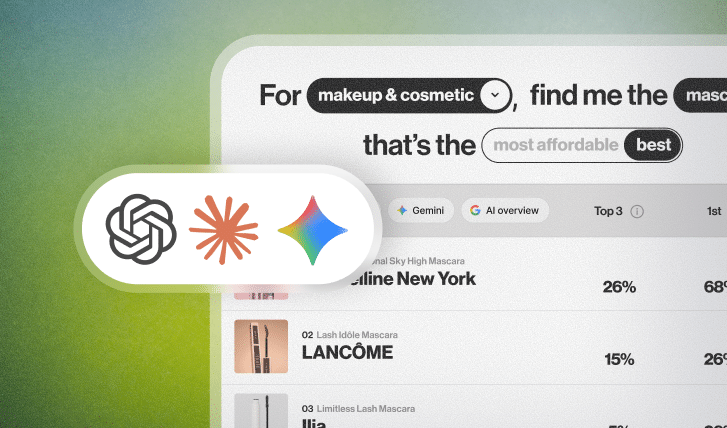
To give you a head start, Yotpo built The Discoverable Index, a free weekly leaderboard that shows which products ChatGPT, Gemini, and Google’s AI answers recommend first in a given category. Look up your industry and category before you run your own questions. It gives you a first read on who you’re really up against, so you know which names to watch for in your own results. It shows who’s winning your category, and your own score still comes from the questions below.

Open a few incognito or private browser windows (this stops your own search history and preferences from skewing the results), and ask the same set of questions across a couple of different AI tools, ChatGPT, Perplexity, Google’s AI Mode or AI Overviews. Not the same window with three tabs. Actually separate, private sessions.
Don’t forget to write down what actually happens.
For each question, note three things: whether you got mentioned at all, where in the answer (first thing mentioned, buried at the end, not there), and who else got mentioned instead. That last one matters as much as the first two, the answer isn’t just “are we visible,” it’s “who’s winning the spot we want.”
Then look closer at what the AI engine actually said about whoever it did mention, what reasons or details did it cite? That’s often the most useful piece of the whole exercise, it’s not just who won, it’s what they had that made them the answer.

You’ve got a page of notes now, questions, answers, who showed up and who didn’t. Here’s how to actually make sense of it.
Look at the pattern, not any single result: AI citations turn over week to week. A single result could just be that week’s volatility, not a real signal. What matters is the pattern across all the questions you tested: consistent, occasional, or basically absent.
Separate brand-level results from product-level results: These aren’t the same thing. A brand can score well on one and poorly on the other.
Break your results out by engine, not just by question: Don’t average your results across ChatGPT, Perplexity, and Google’s AI Mode, look at each one separately.
Strong results on one tell you almost nothing about the others. Showing up on two out of three isn’t “mostly visible,” it’s visible on one engine and invisible on another, which is a different problem with a different fix.
Note who showed up instead of you: For every miss, write down who got mentioned. Then check what they have that you don’t: more detailed reviews, more complete product information, a blog post that directly answers the question you tested, structured content an AI engine could actually read. This is where you find specific, fixable gaps instead of a general sense of being behind.
Turn it into a simple scorecard: A basic spreadsheet works: products down one side, the three question types across the top, one column per engine. Mark whether you showed up for each, and note who showed up instead when you didn’t. That’s your first real benchmark, something to compare future checks against.
Want to go deeper on what we’ve covered so far? Check out these additional Yotpo resources:

You’ve got a baseline now, and probably a list of gaps. Here’s where to actually put the effort.
AI engines cite third-party, independent-sounding sources over brand copy, that’s the mechanism from Chapter 3. Reviews are the most direct lever you have on that. A brand that grows from 0 to 100 reviews sees a 106.5% lift in conversion, and that same specific, detailed language, how something fit, how it performed, what it was used for, is exactly what gets cited.
A few things matter here, and they’re worth treating as separate action items, not one vague “get more reviews” goal:
Review Collection: The fix isn’t just more reviews, it’s better questions. A star rating and one line doesn’t give an AI engine much to work with.
A prompt like “how did it fit, what did you use it for, would you buy it again” does.
Specificity is what actually gets cited: authenticity, recency, specific detail and natural language all matter more than star rating alone.
This is a big part of what a tool like Yotpo Reviews is built for, making it easy to ask the right questions at the right moment, so you’re actually collecting the detailed language AI engines are looking for, not just a number of stars.

Review Structure: Detailed reviews only help if the actual content, the sentence underneath the star rating, is present and readable on the page, not buried or summarized away.
Review Syndication: Reviews sitting only on your own site are good for shoppers who land there, but AI engines weight third-party content more heavily than anything on your own domain. Syndicating reviews to retailer sites can put that same content somewhere AI engines already trust, and can produce significantly more reviews live within a month than organic collection alone.
AI shopping agents read structured data, not just well-written prose. “Lightweight and responsive” doesn’t help an agent evaluating a specific query. Weight, dimensions, materials, specified clearly, does.
Two things worth checking specifically:
Is the information actually there in text, or only in an image, a banner, or something rendered through JavaScript? If a page’s content only loads dynamically, it may be effectively invisible to an AI engine, even if a person can see it perfectly fine. This trips up more brands than you’d expect, including promotions and sale pricing built as a banner graphic instead of real text on the page.
Is your Q&A section actually being used, or just answering the same handful of shipping questions? AI engines read Q&A as structured, comparative content, exactly the kind of source they’re looking for. A thin Q&A section is a fixable, specific gap.

This is the one that’s easy to treat as optional. It isn’t. Citations turn over week to week, so a strategy built on a single check, fixed once, and left alone will look stale within weeks.
Running the exercise from Chapter 6 by hand, regularly, across multiple engines and products, is real, recurring work. That’s exactly the gap Yotpo Discover is built to close, continuously tracking your visibility and share of voice across engines, so you’re not relying on memory or a spreadsheet to catch a new competitor showing up, or a gap quietly reopening after you thought it was fixed.

Before you build out a full strategy, it’s worth knowing where beginners typically go wrong, because most of these mistakes come from good intentions.
Mistake 1: Treating this as a one-time project
This is the big one, and it’s already come up twice in this guide because it matters that much. Citations are constantly being updated. A brand that runs the check from Chapter 6 once, fixes a few things, and moves on will look outdated within a month, not because the fixes didn’t work, but because the whole landscape keeps shifting underneath them. AEO isn’t a project with an end date. It’s closer to an ongoing habit, like checking analytics, not a redesign you finish and walk away from.
Mistake 2: Chasing every engine at once
It’s tempting to try to win on ChatGPT, Perplexity, and Google’s AI Mode simultaneously, especially once you realize from Chapter 4 how differently they behave. In practice, spreading thin effort across all three usually means being mediocre everywhere instead of strong somewhere. It’s more effective to figure out which engine your shoppers actually use most, focus there first, and expand once you’ve got real traction.
Mistake 3: Obsessing over the wrong number
A single citation feels like a win, and it’s worth noting when it happens. But one citation on one question, on one day, isn’t a strategy working, it might just be that week’s volatility. Watch the pattern over time, not any individual result. A brand that swings from celebrating one good check to panicking over the next bad one is reacting to noise, not signal.
Mistake 4: Fixing the visible stuff and skipping the technical layer
Reviews and content are the part that feels most within reach, so that’s often where all the effort goes. But a beautifully written page with JavaScript-rendered pricing or a promo banner with no underlying text can be invisible to an AI engine no matter how good the content on it is. The unglamorous technical check, is this actually readable, matters as much as anything you write.

Here’s the whole guide compressed into something you can actually act on, week by week.
Week 1: Get your baseline
Run the check from Chapter 6. Four or five products, three question types each, a few AI tools, incognito windows. By the end of the week you should have real notes, not guesses, on where you show up and who shows up instead of you.
Then read those results the way Chapter 7 laid out: separate brand-level from product-level, break it out by engine, and write down what the brands beating you actually had going for them. Turn it into the simple scorecard. This is your day-one number.
Week 2: Find the technical blind spots
Before touching content, check whether your site is even readable. Open your key product pages and ask: is the pricing, availability, and product detail sitting in real text, or is it loading through JavaScript, banners, or pop-ups? Check your Q&A section too, is it actually answering real comparison questions, or just shipping FAQs?
Fix what you can here first. Fast, structural fixes, unlike content, don’t take months to matter, but they do need to happen before you invest real effort in reviews and content that an engine still can’t read.
Week 3: Start closing the content gap
Look back at your Week 1 notes. Where were competitors winning with something specific, detailed reviews, a comparison page, better answers to a real question? Pick one or two of your weakest products from that list and start there.
Update how you’re asking for reviews, specific prompts instead of a star rating and a line. If you have reviews sitting only on your own site, look into syndication so that content reaches the third-party pages AI engines already trust.
Week 4: Set your cadence, and go again
This is the step most guides skip, and Chapter 5 already told you why it matters: citations shift 70-80% week to week. A one-time fix goes stale fast.
Put a recurring check on the calendar, monthly is a reasonable starting cadence for most brands. Re-run the same core questions from Week 1 against your new baseline. That comparison, this month against last month, is the only way to know whether anything you did actually worked.
Where to go from here
Thirty days in, you should have: a real baseline, your worst technical gaps fixed, a first round of stronger content live, and a recurring check scheduled. That’s not the finish line, there isn’t one, but it’s genuinely further than most brands have gotten, and it’s enough to walk into your next leadership conversation with a real number instead of a guess.
Want to go deeper? Check out these additional Yotpo resources:
And if you’d rather see how much of this Yotpo Discover can do for you automatically, from the audit and competitive tracking through real-time monitoring, take a look at Discover or book a demo with our team.

Don’t forget the Claude skill.
If you haven’t tried it yet, the /aeo-fundamentals skill is the fastest way to put this playbook to work. It builds your baseline, checks your product pages and turns your results into a 30-day plan for your brand, so you can start today instead of starting from a blank page.
How to get started:

AEO (Answer Engine Optimization): The practice of optimizing for AI tools that give people direct answers, like ChatGPT, Perplexity, and Google’s AI Mode, instead of a page of links to click through.
GEO (Generative Engine Optimization): Another name for the same general discipline as AEO. Different people use different terms; this guide uses AEO throughout.
Citation: When an AI engine mentions your brand or product by name, or pulls from something on your site, in its answer to a shopper’s question.
Prompt: The actual question a shopper types or speaks to an AI tool. AEO work is built around real prompts, not keywords.
Share of voice: How often you get cited compared to your competitors, across a set of relevant prompts. Not just whether you show up, but how often relative to everyone else.
Brand-level visibility: Whether an AI engine recognizes and mentions your brand generally, separate from any specific product (“is [brand] good?”).
Product-level visibility: Whether an AI engine recommends a specific product of yours in response to a specific need, without necessarily naming your brand. A brand can score well on one and poorly on the other.
Category-level prompt: A broad question with no brand in mind (“best gifts for someone who loves cooking”). Tests whether you show up before a shopper has thought of you.
Comparison prompt: A question pitting two or more named options against each other (“brand X vs. brand Y”). Tests how you hold up once you’re already part of the conversation.
Product-specific prompt: A question built around real product details or use case, without naming a brand (“running shoe with a wide toe box for overpronation”). Tests whether a product surfaces on merit.
“Yotpo is a fundamental part of our recommended tech stack.”
Laura Doonin, Commercial Director


 Join a free demo, personalized to fit your needs
