














In the competitive landscape of e-commerce, the distinction between a one-time buyer and a lifelong advocate often depends on a well-executed loyalty incentive program. These programs are far more than a simple rewards mechanic; they represent a powerful strategy for building lasting customer relationships. They establish a compelling reason for shoppers to return to your brand, fostering a cycle of repeat business.
This guide serves as a definitive resource for e-commerce managers and marketers, providing the insights needed to build, manage, and optimize a program that drives retention, increases revenue, and cultivates true brand advocacy.
The Indisputable Value of Customer Loyalty in E-commerce
Before detailing implementation, it is essential to understand the strategic importance of loyalty. Focusing on customer retention is not just an abstract goal; it is a financial imperative. The data is clear: acquiring a new customer can cost five times more than retaining an existing one. By shifting resources toward building loyalty, you are making a direct investment in your brand’s profitability and long-term stability.
Why Focus on Retention? The Financial Imperative
A successful loyalty program directly and positively impacts your most critical financial metrics. It functions as a growth engine by nurturing the customers you have already acquired.
- Customer Lifetime Value (LTV): This metric represents the total revenue a business can anticipate from a single customer account over its entire relationship with the brand. Loyalty programs are specifically designed to increase LTV by encouraging repeat business. When a customer feels valued and rewarded, they are significantly more likely to make future purchases, which boosts their lifetime spend.
- Repeat Purchase Rate: This metric tracks the percentage of your customers who return for subsequent purchases. Loyalty incentives, such as points earned on transactions or exclusive member discounts, provide a tangible reason for shoppers to choose your brand over a competitor for their next purchase.
- Average Order Value (AOV): Loyal customers consistently demonstrate a higher AOV. A tiered loyalty program, for example, can encourage a customer to add another item to their cart to reach the next reward level. Similarly, incentives like “earn double points on orders over $75” can effectively increase the average transaction size.
Beyond Transactions: Building Brand Advocates
The most effective loyalty programs do more than simply encourage spending; they transform satisfied customers into enthusiastic brand ambassadors. When customers feel they are part of an exclusive group, they are more inclined to discuss your brand with their personal and professional networks. This word-of-mouth marketing is exceptionally potent because it originates from a trusted source.
Furthermore, these programs can be structured to reward customers for creating user-generated content (UGC), such as writing product reviews or posting photos on social media. This authentic content builds social proof and is often more persuasive than traditional advertising.
Gaining a Competitive Edge with Valuable Data
In today’s data-centric marketplace, a deep understanding of your customers is a significant competitive advantage. Loyalty programs are an excellent channel for collecting zero-party and first-party data. Zero-party data is information a customer intentionally shares, such as their style preferences, while first-party data is collected from their direct interactions with your brand, such as their purchase history.
This information is invaluable for advanced segmentation and personalization. It allows you to tailor marketing communications, product recommendations, and special offers with a high degree of precision. This level of personalized engagement is what sets market-leading brands apart.
In summary, a loyalty program is a core business strategy. It directly improves your bottom line, cultivates a community of advocates, and provides the customer insights necessary to maintain a competitive advantage.
Deconstructing Loyalty: Core Program Models
The structure of your loyalty program must be carefully selected to align with your brand identity, customer motivations, and business objectives. A variety of established models exist, each with unique strengths.
The Classic: Points-Based Programs
This is the most prevalent type of loyalty program, largely due to its simplicity and effectiveness.
How They Work
Customers earn a predetermined number of points for completing specific actions. The most common action is making a purchase (e.g., “Earn 1 point for every $1 spent”), but points can also be awarded for non-transactional engagements. These might include creating an account, following a social media channel, or for a birthday. Once a customer accumulates a sufficient number of points, they can redeem them for rewards such as discount codes, free shipping, or exclusive products.
Pros & Cons
- Pros: The primary advantage of a points-based system is its simplicity and flexibility. Customers can easily grasp the relationship between their actions and the rewards they earn. It also provides the flexibility to incentivize a wide range of behaviors that build a more engaged community.
- Cons: If not managed with strong branding and communication, a points program can feel purely transactional. The objective is to make customers feel like valued members, not just point collectors.
The Motivator: Tiered Programs
Tiered programs introduce gamification elements to the loyalty experience, encouraging customers to increase their engagement to unlock elevated status and benefits.
How They Work
Customers are segmented into different tiers based on their spend or points accumulated over a defined period. As they ascend through the tiers (e.g., from Silver to Gold to Platinum), they unlock progressively more valuable and exclusive rewards. A base tier might offer standard benefits, while a top tier could grant perks like complimentary expedited shipping, early access to new collections, and dedicated customer support.
Pros & Cons
- Pros: Tiered programs are exceptionally effective at motivating customers to increase their spending and long-term engagement. The aspiration to reach the next level creates a powerful psychological incentive. They also foster a sense of exclusivity and community, which makes your most valuable customers feel recognized.
- Cons: The main challenge is designing the tiers with a clear and compelling value proposition. The benefits of each successive tier must be substantially better than the previous one to provide adequate motivation for customers to advance.
The Exclusive Club: VIP & Paid Programs
This model elevates the concept of exclusivity by requiring a higher level of customer commitment in exchange for premium, always-on benefits.
How They Work
There are two primary approaches. The first involves a high spending threshold, where customers who meet a certain annual spend are automatically granted VIP status. The second, and increasingly common, model is a paid program where customers pay a recurring fee for membership. A well-known example is Amazon Prime, where members pay for a suite of benefits, including expedited shipping.
Pros & Cons
- Pros: Paid programs cultivate a highly committed customer base. When customers make a financial investment in a membership, they are strongly incentivized to shop with that brand to maximize the return on their investment. This model also generates a predictable, recurring revenue stream.
- Cons: The value proposition must be extremely compelling to convince customers to pay for a membership. The benefits must be significant, relevant, and consistently delivered to justify the cost.
The Emotional Connection: Value-Based & Hybrid Programs
These modern approaches focus on building a deeper bond with customers by aligning with their personal values or by combining the best features of other models.
How They Work
A value-based program connects rewards to a purpose beyond the transaction. For example, a customer might have the option to redeem their points for a charitable donation made by the brand on their behalf. This demonstrates that the brand stands for more than just profit. A hybrid program combines elements from different models, such as a tiered structure that uses points as its foundational currency.
Pros & Cons
- Pros: Value-based programs can forge a powerful emotional connection with customers and are an excellent way to differentiate your brand. Hybrid models offer maximum flexibility to design a program that is perfectly suited to your specific needs.
- Cons: To be effective, the cause promoted in a value-based program must be authentic to your brand’s core identity. If it is perceived as an insincere marketing tactic, it can negatively impact brand perception.
In summary, understanding these core models is the first step. The optimal choice will depend on your specific business goals, brand identity, and what truly resonates with your customers.
A Practical Framework for Designing Your Loyalty Program
A successful loyalty program is the result of a deliberate, strategic process. Following this framework will help you design a program that delivers measurable results.
Step 1: Define Your Strategic Goals
Before considering program mechanics, you must define what success looks like. What do you want your loyalty program to achieve for your business? Your goals should be specific, measurable, achievable, relevant, and time-bound (SMART).
Begin by asking critical questions:
- Is the primary objective to increase customer retention?
- Do we aim to increase purchase frequency?
- Is the main goal to increase the Average Order Value (AOV)?
- Are we focused on reducing churn among high-value customer segments?
Once you have identified your primary goal, establish the Key Performance Indicators (KPIs) you will use to measure it. For example, a clear KPI would be: “Increase the repeat purchase rate from 25% to 35% within the first 12 months of the program’s launch.”
Step 2: Understand Your Customer Segments
You are not building a program for a generic audience; you are designing it for your specific customer base. The better you understand them, the more effective your program will be. Conduct a thorough analysis of your customer data.
- Analyze Purchase Behavior: Identify your most valuable customer segments. What products do they purchase? How frequently do they shop? What is their average spend? This analysis helps you understand the behaviors you wish to reinforce.
- Gather Direct Feedback: Do not assume what motivates your customers. Ask them directly. Use tools like customer surveys and polls to discover what rewards and experiences they would find most valuable. This zero-party data is crucial for designing a program that resonates.
Step 3: Architecting Your Program’s Structure
With clear goals and customer insights, you can begin to construct the mechanics of your program.
Choosing Your Earning Mechanisms
This defines how customers will earn rewards. While purchasing is the most common action, a sophisticated program encourages a wider range of brand interactions. Consider rewarding customers for:
- Making a purchase
- Creating a store account
- Celebrating a birthday
- Following your brand on social media
- Writing a product review
- Referring a friend
- Subscribing to a newsletter
Designing Your Redemption & Reward System
This step defines the tangible value for the customer. A balance must be struck: rewards should be attainable enough to maintain engagement but valuable enough to be desirable.
Popular reward types include:
- Fixed Amount Discounts: $10 off a future purchase.
- Percentage Discounts: 15% off the next order.
- Free Shipping Vouchers: A consistently high-value incentive.
- Exclusive Products: The ability to redeem points for a specific item.
- Early Access: The opportunity to shop sales or new collections before the general public.
Step 4: Branding and Naming Your Program
Your loyalty program should be treated as a distinct product with a strong brand identity. A generic name like “Rewards Program” is insufficient.
Brainstorm a name that is:
- Memorable: Easy to recall and pronounce.
- On-Brand: Reflects the personality of your business.
- Value-Driven: Communicates a clear benefit, such as “The Insider’s Club.”
The program’s branding must be consistent across your website, emails, and all marketing materials to create a cohesive and professional customer experience.
In summary, a well-designed program is the product of clear objectives, a deep understanding of customer behavior, and a carefully constructed system of earning and redemption.
Selecting the Right Technology: The Engine of Your Loyalty Program
An excellent strategy cannot be executed without the right technology to power it. A dedicated platform is essential for managing members, tracking points, automating rewards, and analyzing performance at scale.
Why a Dedicated Platform is Non-Negotiable
Attempting to manage a loyalty program with manual processes or homegrown systems is inefficient and limits potential. Such methods are prone to errors, are extremely time-consuming, and lack the sophisticated features required to deliver a seamless customer experience. A dedicated loyalty platform automates these complex tasks and provides the tools necessary to optimize your program for success, allowing your team to focus on strategy.
Introducing Yotpo Loyalty: Your Strategic Partner
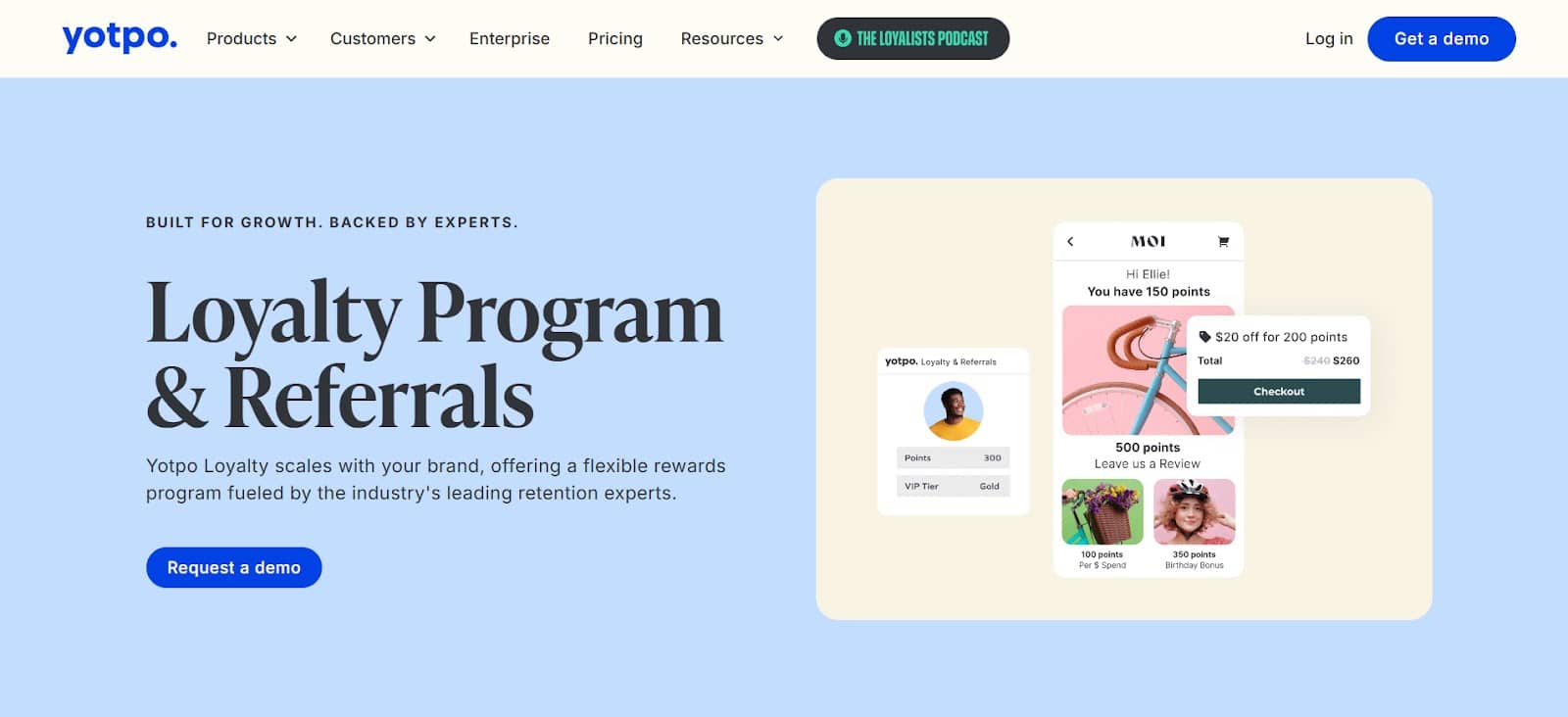
When evaluating technology, you are choosing a partner to help drive your retention strategy. This is where a platform like Yotpo Loyalty excels. It is engineered to be a complete solution that helps e-commerce brands develop and execute winning retention strategies.
Built on a Foundation of Market Experience and Expertise
Choosing a loyalty provider is a strategic decision that relies on their expertise. Yotpo provides a significant history and a strategic approach to customer retention.
- Partnership Approach: Yotpo’s model extends beyond providing software; it establishes a strategic partnership. Clients receive guidance from dedicated Customer Success Managers (CSMs) and eCommerce loyalty experts who help design and refine a program that aligns with specific business goals. This hands-on, strategic support is critical for navigating the complexities of loyalty marketing and implementing best practices.
- Market Maturity and Experience: Yotpo has been a leader in the loyalty space since 2016, providing a mature, reliable platform built on a deep understanding of e-commerce dynamics. Clients benefit from years of data and insights gathered from thousands of successful brands.
- Unmatched Flexibility and Customization: A loyalty program should feel like a natural extension of your brand, not a generic third-party application. Yotpo Loyalty offers extensive customization capabilities, enabling brands to create unique, on-brand experiences. From the visual design of the loyalty interface to the specific rules for earning and redemption, you have the flexibility to build your ideal program. This includes advanced features like dynamic segmentation for tailored offers and flexible point expiration methods to drive urgency.
- Robust and Accurate Reporting: Effective management requires accurate measurement. Yotpo provides a comprehensive analytics suite with robust, precise reporting. This allows you to easily track key metrics, understand member behavior, and calculate program ROI, enabling data-driven decisions for continuous optimization.
How Yotpo Compares in the Loyalty Landscape
The market for loyalty solutions includes various platforms, such as Loyalty Lion, Smile, Okendo, Stamped, and Rivo. Many of these platforms provide the necessary tools to create a standard points-based or tiered program and can be effective for brands seeking a straightforward, out-of-the-box solution.
However, Yotpo differentiates itself through its deep focus on a strategic partnership model. While some platforms may provide the software and leave the strategy to the user, Yotpo’s inclusion of dedicated CSMs and access to loyalty experts provides a significant advantage. This emphasis on strategic support, combined with powerful customization and analytics capabilities, empowers brands to build sophisticated, high-performing retention engines precisely tailored to their business needs.
Launching and Promoting Your Loyalty Program for Maximum Impact
An excellent loyalty program cannot deliver value if customers are unaware of its existence. A strategic launch and consistent, ongoing promotion are essential for driving enrollment and ensuring the program becomes a core element of the customer experience.
The Pre-Launch: Building Anticipation
Begin marketing activities before the official launch to build excitement and an initial list of interested customers.
- Create a “Coming Soon” Page: Deploy a simple landing page on your website that teases the new program. Announce that a new benefit is coming for your best customers and include an email capture form for early notification.
- Use Teaser Campaigns: Leverage your existing marketing channels. Distribute teaser emails and social media posts that hint at a new way to receive rewards. This can generate significant interest before the launch.
The Launch: A Coordinated Rollout
On launch day, your objective is to make every website visitor and existing customer aware of your new program. A coordinated, multi-channel effort is required for maximum impact.
- Multi-Channel Announcement: Your launch strategy should include:
- A prominent banner on your homepage.
- A dedicated email blast to your entire subscriber list.
- Announcements across all active social media profiles.
- A detailed blog post explaining the program’s mechanics and value proposition.
- Offer a Sign-Up Bonus: Encourage immediate enrollment by offering a compelling bonus for anyone who joins during the launch period. This could be a significant allotment of points or an exclusive first-purchase discount. This initial incentive can create the momentum needed for long-term success.
Ongoing Promotion: Maintaining Momentum
A loyalty program is not a single campaign; it must be integrated into your ongoing marketing activities to remain top-of-mind.
- On-Site Promotion: Ensure the program is highly visible throughout your website. This includes a dedicated, easy-to-navigate landing page that explains all benefits, as well as reminders on product pages and within the checkout process.
- Email & SMS Marketing: These channels are ideal for nurturing members. Send regular, personalized updates regarding their point balances, tier status, and available rewards. Create segmented campaigns targeting different loyalty tiers with exclusive offers to reinforce their value.
- Post-Purchase Communication: The customer journey continues after checkout. Include loyalty program information in order confirmation and shipping notification emails. Consider adding printed inserts into your packages that remind customers to sign up to earn points on their next purchase.
In summary, a strong promotional strategy is as vital as the program’s design. Build anticipation, launch with a coordinated plan, and integrate program messaging across all customer touchpoints to drive continuous enrollment and engagement.
Measuring and Optimizing for Long-Term Success
Launching your program is only the first step. The most successful brands treat their loyalty programs as dynamic initiatives that require continuous monitoring, analysis, and optimization. To do this effectively, you must track the right metrics and use that data to make informed decisions.
Key Loyalty Metrics You Must Track
While high-level metrics like total sign-ups are encouraging, they do not provide a complete picture of performance. Focus on the KPIs that demonstrate the program’s tangible impact on your business.
- Program ROI: This is the ultimate measure of success. Is the program generating more profit from its members than the total cost of rewards and platform fees? A positive ROI validates the program’s financial contribution.
- Customer Retention Rate (CRR): This is a critical indicator. Compare the retention rate of your loyalty program members to that of non-members. A significantly higher CRR for members is a clear signal of your program’s effectiveness.
- Repeat Purchase Rate (RPR): Are your members purchasing more frequently than non-members? This metric directly shows the program’s ability to drive repeat business.
- Participation Rate: What percentage of your active customer base is enrolled in the program? A low participation rate may indicate a need to improve promotional efforts or clarify the program’s value proposition.
- Redemption Rate: This metric tracks the percentage of earned points that are being redeemed for rewards. A low redemption rate could suggest that your rewards are not compelling enough or that the redemption process is too complex.
Leveraging Analytics for Continuous Improvement
A platform with strong analytics, such as Yotpo Loyalty, is indispensable for optimization. The data it provides allows you to move beyond simple tracking to ask strategic questions.
- Which rewards are most popular among members?
- Which customer segments exhibit the highest engagement?
- At what point in their journey do customers typically redeem rewards?
The Power of A/B Testing
A culture of testing is essential for optimization. Continuous improvement is often the result of experimenting with different approaches to determine what resonates most with your audience. You can A/B test nearly any element of your program, including:
- Reward types and values.
- Promotional messaging in email and SMS.
- Website calls-to-action (CTAs).
In summary, a loyalty program must evolve. Through consistent measurement, rigorous analysis, and methodical testing, you can ensure your program remains a powerful and profitable driver of growth.
Navigating Common Challenges in Loyalty Marketing
Even well-designed loyalty programs can encounter challenges. By anticipating these common issues, you can develop proactive strategies to overcome them, ensuring your program remains healthy and effective.
Challenge: Low Member Engagement
After an initial launch spike, you observe that members are not actively earning or redeeming points. This is a frequent challenge.
- Strategic Response: First, evaluate the program’s structure for any unnecessary friction. If earning a meaningful reward is too difficult, customers will disengage. Second, increase the visibility of the program through personalized communication. Remind members of their point balances and the specific rewards they can unlock. A relevant, timely notification is often sufficient to re-engage a customer.
Challenge: The Program Feels Too Complicated
If customers must decipher complex terms to understand how the program works, they will abandon it. Complexity is a barrier to participation.
- Strategic Response: Simplicity is paramount. The rules for earning and redemption must be communicated with absolute clarity. Employ clean design and an intuitive user interface for your program’s landing page. The value proposition should be immediately understandable.
Challenge: Demonstrating Clear ROI
Your team may feel the program is successful, but key stakeholders require quantitative proof of its value. Demonstrating the financial impact of a loyalty program is crucial for securing long-term internal support.
- Strategic Response: This highlights the importance of selecting a platform with robust analytics. You must be able to track and compare the spending behavior of members versus non-members. By presenting a data-backed analysis of metrics like AOV, purchase frequency, and LTV between these two groups, you can build a clear business case for your program’s ROI.
In summary, anticipating potential pitfalls is the first step to avoiding them. By focusing on simplicity, consistent communication, and data-driven validation, you can effectively navigate these common challenges.
Conclusion: Your Journey to Building Lasting Customer Relationships
In today’s e-commerce environment, a loyalty incentive program is a strategic asset. It is one of the most effective tools for converting casual shoppers into devoted brand advocates. As this guide has detailed, a successful program is more than a system for discounts; it is a sophisticated engine for driving customer retention, increasing lifetime value, and building a thriving community.
Success requires a foundation of clear strategic goals, a deep understanding of your customers, and the selection of the right technology partner. By investing in a flexible, data-driven platform and committing to a strategy of continuous measurement and optimization, you can create a program that delivers measurable returns. Ultimately, by investing in your customer relationships, you are making the most critical investment in the sustainable, profitable growth of your business.
FAQs
What is the first step to creating a loyalty program?
The foundational step is to define your strategic goals. Before considering points, rewards, or branding, you must decide what you want the program to achieve for your business. Are you focused on increasing purchase frequency, boosting average order value, or improving overall customer retention? Setting clear, measurable goals will inform every subsequent decision.
How do I know which type of loyalty program is right for my business?
The optimal program type depends on your brand identity and customer behavior. A points-based program is a versatile and effective starting point for many businesses. If your goal is to encourage higher spending and cultivate a sense of exclusivity, a tiered program is an excellent choice. The key is to analyze your customer data to understand what rewards and experiences will be most motivational.
How long does it take to see results from a loyalty incentive program?
Initial results, such as an increase in sign-ups and engagement, can be seen immediately following a well-executed launch. However, the program’s significant, long-term impact on metrics like Customer Lifetime Value (LTV) and customer retention rate typically becomes evident within 6 to 12 months. It is a long-term strategy, and consistent measurement is essential for tracking its cumulative effect.
What is a common pitfall brands encounter with their loyalty programs?
A common pitfall is making the program overly complicated. If customers cannot easily understand how to earn rewards and what those rewards are worth, they will quickly disengage. Another frequent mistake is a “set it and forget it” approach. The most successful loyalty programs are treated as dynamic products that are constantly being tested, analyzed, and optimized based on performance data and customer feedback.
Can a loyalty program be effective for a small or new e-commerce store?
Yes, a loyalty program can be an exceptionally powerful tool for a new or small e-commerce business. It helps establish a core group of repeat customers from the outset, which is fundamental for sustainable growth. It also provides invaluable data about your initial customer base, offering insights that can inform your broader marketing strategy for years to come.


 Join a free demo, personalized to fit your needs