



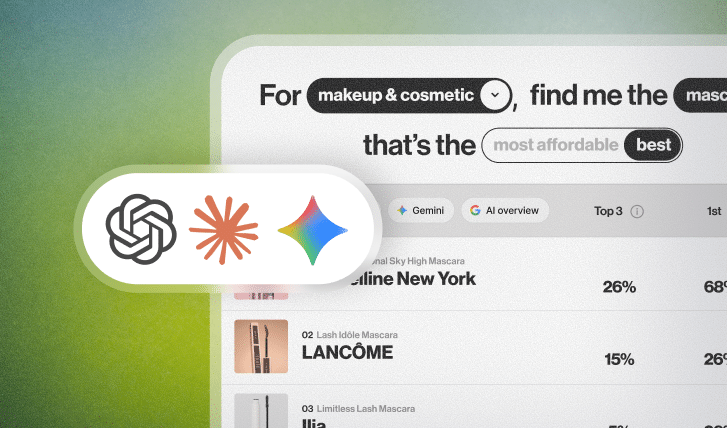










When a shopper googles a product question now, Google often answers it directly with an AI Overview, and the brands cited there win the attention. Getting your products into that answer takes more than traditional SEO. This guide breaks down how AI Overviews choose their sources and what you can do to become one of them.
Ask Google a question today and you’ll often get the answer before you ever reach a blue link. AI Overviews now sit at the top of nearly half of all tracked searches, summarizing products, comparing options, and naming recommendations right on the results page. For ecommerce brands, that’s a new front door, and the brands cited in those summaries are pulling ahead of the ones still optimizing only for the ten links underneath.
Showing up in an AI Overview isn’t the same as ranking. The engine reads your structured product data, weighs authentic customer reviews, and checks whether real shoppers vouch for you off-site before it decides what to cite. This guide lays out a four-stage framework — technical schema, conversational content, off-site shopper signals, and automated execution — to make your catalog the source AI Overviews reach for. It builds on your existing SEO rather than replacing it.
Key Takeaways
- AI-driven channels are growing fast, with projections showing AI search traffic could reach 40% of total search traffic by 2027.
- Consumer confidence is shifting toward generative answers: a growing share of US shoppers now use AI tools when making purchase decisions.
- Optimizing for AI Overviews means structured schemas and clear, Q&A-style formatting so crawlers can extract catalog attributes cleanly.
- Off-site citations lean heavily on authentic shopper voices from community platforms, because AI engines prioritize those to keep their recommendations credible and unbiased.
- Scaling AEO requires automated execution, not just passive tracking, making platforms like Yotpo Discover central to closing visibility gaps at speed.
The Shift From Keyword Indexes to Generative Answers
The change happening in ecommerce search isn’t a minor update. It’s a structural shift in how engines process intent. Traditional search indexed keywords and served lists of blue links, leaving shoppers to click and parse multiple pages. Google AI Overviews and similar platforms do the parsing themselves — synthesizing SKU-level commerce data and web content into a single direct answer.
To win here, brands need to move from standard SEO to Answer Engine Optimization (AEO). AEO works alongside traditional SEO as a complementary layer, not a replacement for it.
Where SEO operated on intent expressed in keywords, AI search works on intent expressed in conversational context. That means the surface area for influence has grown considerably. Brands built on keyword-density optimization face a real question: how do you optimize for an engine that paraphrases rather than retrieves? The honest answer is that the old playbook doesn’t transfer cleanly. New tools, new measurement, and a new content surface are all required. (And that’s the part most teams are still figuring out.)
This shift is already visible in consumer data. Half of consumers in 2026 turn to AI engines at the exact moment of a purchase decision. While roughly 80% of retailers have adopted AI in some capacity, only a fraction have scaled their strategy to capture this shifting traffic.
The Framework: Four Stages to AI Overview Visibility
Building sustainable visibility in AI search means moving from manual effort to automated execution. Brands that are winning this transition tend to follow a specific four-stage approach — one that shapes their digital footprint to fit how AI crawlers actually work.
Stage 1 focuses on technical content structures, so search bots can parse product attributes without friction. Stage 2 addresses conversational question mapping, connecting product pages to the real queries shoppers type. Stage 3 builds authentic shopper voices — the social proof AI engines trust most. Stage 4 moves everything into automated tracking and execution to keep closing visibility gaps over time.
Stage 1: Technical Content Structures and Schema Markup
What It Takes
AI engines don’t browse websites the way shoppers do. They run deep crawlers that scan raw code to extract SKU-level commerce data. If your product catalog lacks explicit, machine-readable metadata, those models can’t categorize your inventory correctly — and that’s a structural problem, not a copy problem.
Standard on-page copy isn’t enough to win citations. Crawlers need to find product specifications, pricing, stock levels, and unique identifiers like GTINs quickly and cleanly. Without that structural clarity, your brand simply doesn’t show up in AI-generated answers.
How to Execute
Build a full Product Schema layout across your entire catalog using JSON-LD formatting. Declare every attribute explicitly — materials, dimensions, pricing, availability. This gives Google AI Overviews exactly what they need to answer detailed shopper queries on your behalf.
Format physical product specifications into clean, native HTML tables rather than burying them inside text blocks. Structured product tables consistently improve the likelihood that AI crawlers extract your data cleanly, rather than skipping past it. Wherever you can make information machine-readable rather than design-dependent, do it.
You can automate this ongoing maintenance with the Onsite Agent in Yotpo Discover. It continuously scans your store to detect and fix weak internal linking, missing structured schemas, and underoptimized product pages — all running quietly in the background while your team focuses elsewhere.
Where Brands Go Wrong
The most common mistake is storing critical product details inside design assets — images, interactive JavaScript, or CSS-rendered text. If it’s not directly readable in the raw HTML, search engines will bypass your page. Keep your technical foundations visible and accessible at all times.
Stage 2: Conversational Content and Question Mapping
What It Takes
AI search runs on natural language, not isolated keywords. Shoppers don’t just search for short phrases anymore — they ask full questions like “what’s the best loyalty program for a mid-sized Shopify brand?” or “how do I choose a reviews platform that works with Klaviyo?” Your content needs to match those conversations directly.
That means structuring your pages to answer specific, multi-clause queries in plain language. The goal is to show up not just as a search result but as the source the AI chooses to quote.
How to Execute
Start by analyzing your customer search queries to map out the most common questions people ask before they buy. Then design your blog posts and landing pages to answer those questions explicitly — ideally within the first paragraph, before any context-setting or brand positioning.
Use clear question-based headings followed by short, factual answers. Write detailed buying guides that compare options objectively, with real pros and cons rather than promotional language. AI engines pick up on promotional copy quickly and tend to prefer sources that present balanced, factual information.
The Content Agent inside Yotpo Discover takes much of this off your team’s plate. It builds SEO and AEO-ready content for your brand blog using real customer reviews and historical order data — the kind of review-backed, authoritative buying guides that AI platforms cite consistently. (Real proof beats invented copy, and the engines can tell the difference.)
Where Brands Go Wrong
Long, promotional copy that takes several paragraphs to reach the actual answer doesn’t perform well in AI search. Engines look for immediate factual density. If a page requires too much parsing to find the answer, they’ll skip it and cite something faster.
Stage 3: Authentic Shopper Voices and Off-Site Citations
What It Takes
Search platforms don’t rely solely on your brand’s owned content to form recommendations. They actively scan third-party websites, social platforms, and community spaces to gauge genuine customer opinion. If your brand has strong reviews on your own site but almost no presence on community forums, AI engines will struggle to confirm your product quality — and will often default to a competitor that does have that off-site presence.
How to Execute
Building a consistent stream of user-generated content across your full digital footprint is the foundation here. Authentic shopper voices on your store are a vital starting point, but the work doesn’t stop there. You also need to extend that feedback to third-party platforms where AI engines actually look.
Share structured review highlights on social media and publisher websites. Consistent review volume correlates directly with stronger organic search performance — this isn’t a soft brand play, it’s a citation-driving strategy. Research on the Yotpo blog shows this relationship clearly across ecommerce categories.
With Yotpo Discover, the Activation Agent identifies the exact community platforms and forums that AI models cite most for your category. It then prompts your verified customers and loyalty program members to share their experiences on those specific off-site spaces — turning passive reviewers into active citation sources.
Where Brands Go Wrong
Many brands put all their energy into on-site reviews and ignore off-site spaces entirely. But if your product is highly rated on your own website with zero presence on community forums or third-party publications, AI engines will frequently leave you out of their answers. The citation ecosystem extends well beyond your own domain.
Stage 4: Automated Execution and Continuous Improvement
What It Takes
The AI search landscape updates constantly. New models are released, algorithms shift, and competitor content gets cited in places yours used to appear. A static strategy built on manual audits can’t keep pace with that kind of environment.
Staying competitive means moving from monitoring to execution. You need systems that track your visibility in real time and fix gaps automatically — because the window to act on a citation loss is narrow, and manually chasing every change at scale isn’t realistic.
How to Execute
Build an automated workflow that connects tracking directly to updates. When a competitor earns a citation you don’t have, your team should understand why — and have the ability to deploy content or schema changes quickly in response.
This is especially important in competitive niches where visibility shifts daily. Beekman 1802 and David Protein use Yotpo Discover to track and act on their chat-based search visibility, keeping their teams in a proactive position rather than a reactive one.
By deploying Yotpo Discover, you activate three specialized agents that handle this workflow together: the Onsite Agent, the Content Agent, and the Activation Agent. Each handles a distinct piece — technical schema, content creation, and off-site activation — so the full cycle runs continuously without requiring manual input at every step. Brands that sell primarily through wholesale or third-party marketplace channels may want to pair Discover with a marketplace-specific tool, but for direct-to-consumer ecommerce, the three-agent model covers the full loop.
Where Brands Go Wrong
Relying on tracking alone — without the execution layer to act on what you find — leaves your team in a loop of observation without improvement. Your visibility score tells you where you stand. The agents are what change it.
Measuring Success: KPIs for AI Overview Visibility
Measuring an AI visibility strategy well requires a departure from traditional SEO metrics. Organic clicks and keyword rankings still matter, but they don’t tell the full story when AI engines are synthesizing answers on-screen rather than sending shoppers to your pages. The metrics that matter most now are built around citations — how often your products actually appear in AI-generated recommendations.
Citation rate is the most direct signal: the percentage of target queries where your brand or SKUs show up in AI answers. Share of voice across individual engines — Gemini, ChatGPT, Claude, AI Overviews — tells you where you’re strong and where a competitor is eating your lunch.
Tracking these at the SKU level keeps the focus on your highest-value products, not just brand-level visibility. And referral traffic conversion from AI platforms, compared to traditional search, shows whether the visibility you’re building actually converts.
Keep a close eye on these core performance indicators:
- AI Citation Rate — The percentage of target queries where your brand or SKUs appear in AI-generated answers.
- Engine Share of Voice — Your share of recommendations across the major engines: ChatGPT, Claude, Gemini, and AI Overviews.
- SKU-Level Visibility — How often your hero products appear for high-intent shopping queries, not just your brand name.
- Referral Traffic Conversion — The conversion rate of visitors coming from AI platforms, compared to traditional organic search.
“Optimizing for AI search isn’t about writing more text — it’s about presenting structured, review-backed data in a format that AI agents can trust and parse instantly. The brands that win this transition will be those that automate their on-site and off-site improvement cycles.”
Ben Salomon, Growth Marketing Manager at Yotpo
Frequently Asked Questions
What is Answer Engine Optimization (AEO)?
Answer Engine Optimization is the process of structuring your web content and product data so AI models can easily crawl, synthesize, and cite it. It works as a complementary layer to traditional SEO, focused on chat-based queries and SKU-level structured data rather than pure keyword matching.
How do Google AI Overviews decide which products to cite?
AI Overviews prioritize sources with well-structured product data, clear natural-language answers, and strong off-site social proof. They pull from both traditional organic results and specialized databases that index authentic shopper voices. The cleaner and more factual your content, the better positioned you are to be cited.
Does optimizing for AI Overviews mean we should stop traditional SEO?
No — AEO doesn’t replace traditional SEO. Traditional search signals still influence AI crawlers, and maintaining both keeps you visible across all search channels. Think of AEO as an additional layer on top of a healthy SEO foundation, not a fork in the road.
How does Yotpo Discover help with AI visibility?
Yotpo Discover is the AI visibility platform built specifically for the complex reality of ecommerce. It tracks where your brand ranks across major AI models, analyzes why competitors win citations, and deploys automated agents to close the gaps — all in one connected system.
What are the three automated agents in Yotpo Discover?
Discover deploys three specialized agents: the Onsite Agent fixes technical schema and site structure issues; the Content Agent writes high-performing buying guides built from real review data; and the Activation Agent drives authentic customer reviews on the external forums that AI engines actually cite.
Why are reviews so important for AI search performance?
AI models weight authentic shopper voices and third-party feedback heavily because it signals credibility and impartiality. Review-backed content gives the models the kind of external validation they’re looking for when deciding which brand to recommend. Your own marketing copy can’t substitute for it.
Can we track AI visibility across multiple search engines?
Yes. Yotpo Discover tracks your brand and SKU-level appearance rate across all major AI platforms — including ChatGPT, Gemini, and Google AI Overviews — giving you a unified view of your chat-based search footprint in one place.
How does the Onsite Agent improve technical schema?
The Onsite Agent continuously scans your ecommerce store to detect missing structured data, weak internal links, and underoptimized product pages. It flags and fixes issues so search crawlers can extract your product attributes cleanly — without requiring manual audits from your team.
How do community platforms like Reddit affect AI Overviews?
Many AI engines cite Reddit and similar community forums because they contain real-world discussions and unfiltered shopper experiences. When your customers share authentic feedback on those platforms, it directly influences whether your brand gets cited in AI-generated answers. It’s one of the most underused citation levers in ecommerce.
How can I start measuring my brand’s AI visibility?
You can run a free readiness audit right now. Visit commerce-gpt.yotpo.com to get your initial AI visibility score and identify the first places to improve.
Protecting your search traffic in 2026 means moving from passive tracking to active, automated execution. Visit the Yotpo Discover page to request a demo — or generate your AI visibility score today for a free, immediate read on where your store stands.



 Join a free demo, personalized to fit your needs