














Building a successful eCommerce brand means going beyond the first sale. In a crowded market, your best chance for sustainable growth comes from earning long-term customer loyalty. But how do you know if your retention efforts are actually working? The answer is in the data. This guide provides a clear resource on the proven methods and key metrics for understanding customer loyalty and feedback, which is the essential first step toward building lasting customer relationships.
Key Takeaways
- Loyalty Drives Profit: Retaining customers is more cost-effective than acquiring new ones. Loyal customers spend more over time, directly boosting your Customer Lifetime Value (CLV) and creating predictable revenue.
- Use Quantitative Metrics: Track key metrics like Customer Lifetime Value (CLV), Repeat Purchase Rate (RPR), Purchase Frequency (PF), and Average Order Value (AOV) to get an objective view of customer behavior.
- Gather Qualitative Feedback: Use surveys (NPS, CSAT), product reviews, and user-generated content (UGC) to understand why customers act the way they do. This context is crucial for making meaningful improvements.
- Combine Data for a Full Picture: The most powerful insights come from integrating quantitative data (the “what”) with qualitative feedback (the “why”). This 360-degree view helps you create strategies that truly resonate with your customers.
- Leverage Specialized Tools: Use best-in-class solutions like Yotpo Loyalty to measure and act on retention metrics and Yotpo Reviews to collect and leverage customer feedback effectively.
Why Measuring Customer Loyalty is a Must for eCommerce Brands
Tracking customer loyalty isn’t just an optional task; it’s a core part of any modern eCommerce strategy. It gives you the insights needed to move from a simple transactional business to one built on strong, recurring customer relationships.
The Direct Link Between Loyalty and Profitability
At its heart, loyalty directly drives your bottom line. Your loyal, repeat customers are your most valuable audience. Industry data consistently shows that getting a new customer can cost up to five times more than keeping an existing one. On top of that, existing customers are much more likely to spend more over time.
This relationship is best measured by Customer Lifetime Value (CLV), which is the total profit you can expect from a single customer over their entire relationship with you. When you focus on loyalty, you actively work to increase your average CLV. This leads to more predictable revenue and a healthier business overall.
Loyalty as a Competitive Advantage
In today’s crowded digital marketplace, products and prices can be copied easily. The relationship and sense of community you build with your customers, however, cannot. A smart loyalty strategy, built on meaningful recognition and rewards, can become your biggest competitive edge.
When customers feel valued, they have a good reason to choose your brand over a competitor, even if they find a slightly lower price somewhere else. This builds a protective wall around your business, making it stronger against market pressures and price wars.
Gaining Actionable Insights from Your Best Customers
Your most loyal customers are often your best source of honest and helpful feedback. They have a real interest in your success and are usually happy to share their thoughts on your products, services, and overall experience.
By systematically measuring their behavior and analyzing their feedback, you can gain priceless insights to guide important business decisions. This feedback loop helps you improve products, fine-tune marketing messages, and enhance customer service. In short, it ensures you are always meeting the expectations of your best customers.
Key Metrics for Measuring Customer Loyalty: A Numbers-Based Approach
To really understand customer loyalty, you have to start with objective, measurable data. These metrics show you what your customers are doing and give you a clear, unbiased view of their buying habits. They are the foundation of any effective retention strategy.
Customer Lifetime Value (CLV)
What is CLV?
Customer Lifetime Value (CLV) is a metric that predicts the total net profit a business can expect from a single customer. It helps you shift your focus from short-term sales to the long-term value of customer relationships.
How to Calculate CLV
A simple formula for CLV is a great starting point for any eCommerce business:
CLV = (Average Purchase Value) × (Average Purchase Frequency) × (Average Customer Lifespan)
- Average Purchase Value (APV): If your total revenue is $500,000 from 10,000 orders, your APV is $50.
- Average Purchase Frequency (APF): If those 10,000 orders came from 4,000 unique customers, your APF is 2.5.
- Average Customer Lifespan (ACL): If a customer typically buys from you for three years, your ACL is 3.
In this case, the estimated CLV would be: $50 x 2.5 x 3 = $375.
A rising average CLV is one of the clearest signs that your loyalty efforts are working. It means customers are staying with you longer and buying more often.
Repeat Purchase Rate (RPR)
What is RPR?
Repeat Purchase Rate (RPR) measures the percentage of customers who have made more than one purchase. It’s a direct and powerful sign of customer satisfaction. A high RPR suggests that the first customer experience was good enough to bring them back.
How to Calculate RPR
The calculation is simple:
RPR = (Number of Customers with >1 Purchase / Total Number of Customers) × 100
For example, if you had 1,000 customers and 300 of them made a second purchase, your RPR would be 30%. The key is to track your RPR over time. A steady increase signals a healthy business with a growing base of loyal customers.
Purchase Frequency (PF)
What is PF?
Purchase Frequency (PF) shows how often an average customer buys from you in a set period. This metric helps you understand the natural buying cycle for your products.
How to Calculate PF
The formula is:
PF = Total Number of Orders / Total Number of Unique Customers
With 10,000 orders from 4,000 unique customers, the Purchase Frequency is 2.5. Understanding this is great for timing your marketing. If customers usually buy every 60 days, sending a promotional email around day 50 can be a great way to encourage their next order.
Average Order Value (AOV)
What is AOV?
Average Order Value (AOV) tracks the average amount spent each time a customer places an order. While it’s not a direct measure of loyalty on its own, it gives important context.
How to Calculate AOV
The calculation is straightforward:
AOV = Total Revenue / Number of Orders
Loyal customers often have a higher AOV because they trust your brand. This trust makes them more willing to buy higher-priced items or add more to their cart.
The RFM Model: A Complete View of Loyalty
The RFM model brings these metrics together into a single, powerful framework. RFM stands for:
- Recency: How recently did the customer buy?
- Frequency: How often do they buy?
- Monetary Value: How much have they spent?
By scoring customers on these three areas, you can create very specific segments like “Champions,” “Potential Loyalists,” or “At-Risk Customers.” This lets you move away from one-size-fits-all marketing and send the right message to the right customer at the right time.
How Yotpo Loyalty Helps You Measure and Act on These Metrics
Knowing the formulas for loyalty metrics is one thing. Tracking, analyzing, and acting on them in real-time is a much bigger challenge. This is where the right technology becomes essential.
The Challenge: Disconnected Data
For many eCommerce brands, the data needed to calculate CLV, RPR, and RFM is scattered across different systems. This makes it hard to get a clear, unified view of customer loyalty.
Furthermore, many loyalty solutions on the market are just basic point systems. While there are several options available, a truly strategic approach requires more than just tallying points.
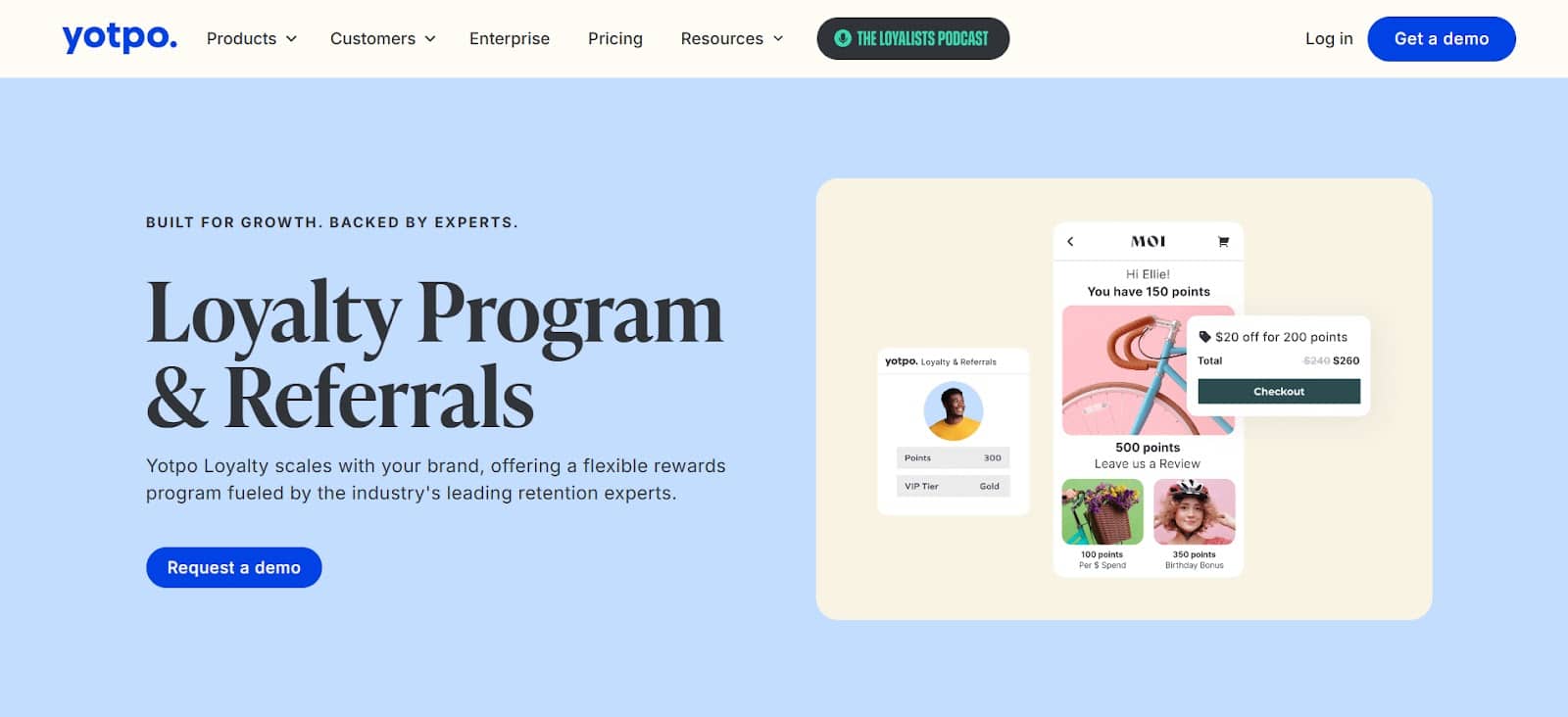
- Yotpo Loyalty is designed not just to run a program, but to function as a strategic engine for improving all key retention metrics. Its deep, actionable analytics and expert guidance set it apart.
The Solution: Yotpo Loyalty’s Strategic Approach
Yotpo Loyalty is built to solve these exact challenges.
Centralized, Robust Reporting
Yotpo centralizes all your loyalty data into a single, easy-to-use interface. The dashboard gives you robust reports that show your most important metrics in one place. Instead of doing manual calculations, you get clear, up-to-date insights. This lets you focus on making smart decisions instead of pulling data. The platform tracks how your loyalty program directly affects metrics like repeat purchase rate and average order value, giving you a clear view of your ROI.
Advanced Segmentation and Insights
Yotpo goes beyond basic reporting with flexible segmentation. You can easily group customers by their loyalty tier, point balance, or purchase behavior. This allows you to apply RFM-style segmentation automatically. For example, you can create a segment of “VIPs with points nearing expiration” and target them with a campaign to drive immediate sales.
Crucially, Yotpo combines these tools with a partnership approach. Brands get access to eCommerce loyalty experts and dedicated Customer Success Managers who provide strategic guidance. These experts help you understand data, find opportunities, and build effective campaigns that get real results.
Flexible Program Customization
With Yotpo, you can design a unique loyalty experience that fits your brand and encourages specific behaviors. You have complete control over how customers earn and redeem points, with options for creating custom rewards and engaging VIP tiers. This flexibility lets you directly influence metrics like purchase frequency and AOV. For instance, offering bonus points for orders above a certain amount can effectively boost your AOV.
Gathering Customer Feedback: The Qualitative Side of Loyalty
Quantitative data tells you what your customers are doing. Qualitative feedback explains why. While numbers like RPR and CLV are key for understanding behavior, they don’t capture the emotions and opinions that drive it. To get a complete picture of customer loyalty, you also have to listen to your customers.
Why Numbers Aren’t Enough
Imagine your Repeat Purchase Rate drops by 5%. The data shows a problem but doesn’t explain the cause. Is it a product quality issue? A frustrating shipping experience? Without qualitative feedback, you are left guessing. Understanding the “why” is the difference between treating a symptom and fixing the root cause.
Proven Methods for Collecting Quality Feedback
Customer Surveys
Surveys are a structured way to ask specific questions.
- Net Promoter Score (NPS): Asks, “How likely are you to recommend our brand?” This segments customers into Promoters, Passives, and Detractors.
- Customer Satisfaction (CSAT): Measures satisfaction with a specific interaction, like a purchase or support ticket.
- Customer Effort Score (CES): Asks how easy it was for a customer to get their issue resolved. A low-effort experience is a huge driver of loyalty.
Product and Site Reviews
Reviews are a rich source of detailed, unsolicited feedback. They provide real-world insights into product quality, sizing, and whether expectations were met. Positive reviews offer powerful social proof, while negative reviews highlight areas for improvement.
User-Generated Content (UGC): Photos and Videos
When customers share photos and videos of your products, they provide authentic social proof. This UGC helps potential buyers see how a product looks and works in the real world, building trust and helping them visualize it in their own lives.
How Yotpo Reviews Turns Customer Feedback into a Growth Engine
Collecting customer feedback is just the start. The next challenge is getting a high volume of quality responses, analyzing that data, and using it to build trust and drive sales.
The Challenge: Low Response Rates and Unstructured Feedback
Many brands find it hard to motivate customers to leave reviews. Their request emails might be generic or sent at the wrong time. Even when they do get feedback, it’s often difficult to analyze.
Several review platforms are on the market, each with a different focus. But Yotpo Reviews offers an end-to-end solution engineered to transform feedback into a powerful marketing asset through smart collection, strategic display, and deep analysis.
The Solution: Yotpo Reviews’ Comprehensive Toolkit
Yotpo Reviews is built to transform customer feedback into a powerful marketing asset.
Smart and Automated Review Collection
Yotpo makes the review process seamless. It automates review requests via email, using smart triggers to ask for feedback at the perfect moment after purchase. The mobile-friendly forms are embedded directly in the email, so customers can submit a review with a single click. This makes it incredibly easy for customers to share rich, visual UGC.
Strategic Display for Maximum Impact
Reviews don’t help if they aren’t displayed strategically. Yotpo provides a suite of customizable on-site widgets designed to showcase your feedback in a way that boosts conversions. These include review carousels, photo galleries, and star ratings on collection pages. The widgets have smart features like filtering and sorting to highlight the most helpful content first.
Deep Insights and Analysis
Yotpo helps you pull actionable intelligence from your feedback. The platform uses AI-powered tools like sentiment analysis to help you understand key topics and trends in your reviews at a glance. This focus on analysis helps turn customer feedback into strategic business intelligence.
Syndication for Broader Reach
One of Yotpo’s biggest advantages is its extensive syndication network. As an official partner with Google, Meta, and major retailers, Yotpo helps you automatically syndicate your reviews to appear in Google Shopping ads, on Facebook and Instagram, and on TikTok Shop. This puts your social proof in front of shoppers across many channels, boosting visibility and credibility.
Integrating Loyalty Metrics and Feedback for a 360-Degree Customer View
We’ve looked at two key parts of loyalty measurement: the quantitative data that shows what customers do, and the qualitative feedback that explains why. The goal is to bring these two streams of insight together. By connecting the “what” with the “why,” you unlock a true 360-degree customer view.
The Power of Connecting the “What” and the “Why”
Analyzing loyalty metrics and customer feedback separately only gives you a partial picture. Integrating them uncovers powerful insights.
- Quantitative data (CLV, RPR) tells you who your best customers are.
- Qualitative feedback (reviews, NPS) tells you what your best customers value.
By combining these, you can build a detailed persona of your ideal customer and create marketing strategies that truly connect with them. For example, you can create a segment of all customers who left a 5-star review and invite them to your loyalty or referral program.
Synergy Between Yotpo Products
Trying to connect data from separate reviews and loyalty providers is often a manual and messy process. This is where using solutions designed to work together can be a major advantage.
When you use both Yotpo Loyalty and Yotpo Reviews, the integration is native and seamless. For example, you can award loyalty points the moment a customer submits a review. You can also display a customer’s VIP tier right next to their on-site review, adding another layer of social proof. This synergy helps you create cohesive, personalized customer experiences that drive maximum impact.
Conclusion: From Measurement to Mastery
In the competitive world of eCommerce, understanding your customers is key to building a strong and profitable brand. We’ve explored the two sides of this understanding: the hard data of quantitative loyalty metrics and the rich context of qualitative customer feedback.
Measuring metrics like CLV and Repeat Purchase Rate gives you an objective foundation. Listening to feedback through reviews and surveys explains why customers behave the way they do.
The real advantage, however, comes from integrating these two perspectives. By combining behavioral data with customer feedback, you move beyond simple measurement to a true mastery of your audience. This 360-degree view allows you to anticipate needs, personalize experiences, and build genuine, lasting loyalty. Measurement is the foundation, but action based on those measurements is what drives results.
Frequently Asked Questions
What is a good Repeat Purchase Rate for an eCommerce store?
A “good” Repeat Purchase Rate (RPR) really depends on the industry. A brand selling coffee would expect a higher RPR than one selling furniture. A general benchmark for eCommerce is in the 20-40% range. The most important thing is to track your own RPR over time and work to improve it consistently.
How often should I send customer feedback surveys?
To avoid “survey fatigue,” it’s best to be strategic. Transactional surveys, like CSAT, should be sent right after an interaction (like a purchase). Relationship surveys, like NPS, are better sent less often, maybe quarterly or twice a year, to check on overall loyalty.
Can I use Yotpo to measure Net Promoter Score (NPS)?
While Yotpo’s primary focus is on collecting product and site reviews, you can use the custom questions feature within review request forms to ask an NPS-style question. This allows you to gather that sentiment in the same simple workflow as your product review collection.
What’s the biggest mistake brands make when trying to measure loyalty?
The biggest mistake is looking at data in isolation. Many brands focus only on quantitative metrics without collecting the qualitative “why” behind them, or vice-versa. True loyalty measurement requires a holistic view that combines behavioral data (like RPR) with direct feedback (like reviews).
What is the difference between Customer Lifetime Value (CLV) and Lifetime Value (LTV)?
Often, the terms CLV and LTV are used interchangeably. However, some marketers make a small distinction. LTV can sometimes refer to the total revenue from a customer, while CLV specifically refers to the total profit. For strategic planning, focusing on CLV (profit) is generally more useful.
How can I improve my Repeat Purchase Rate (RPR)?
Improving RPR involves enhancing the overall customer experience. Key strategies include launching a loyalty program to reward repeat business, sending personalized email and SMS campaigns based on past purchases, providing excellent customer service, and ensuring a fast and easy checkout process.
Why is qualitative feedback so important?
Qualitative feedback provides the context that numbers alone can’t. If your sales drop, quantitative data tells you that it happened, but qualitative feedback from reviews or surveys can tell you why it happened (e.g., poor product quality, slow shipping). This “why” is essential for making smart business decisions.
How does Yotpo Loyalty differ from other solutions?
Yotpo Loyalty stands out by combining a flexible, customizable platform with a dedicated team of eCommerce loyalty experts. While many tools are self-service, Yotpo provides strategic guidance from a Customer Success Manager to help you build, analyze, and optimize your program for tangible results like increased CLV and RPR.
How can I use negative reviews to my advantage?
Negative reviews are an opportunity. First, responding publicly and professionally to a negative review shows other shoppers that you care about customer satisfaction. Second, negative feedback is a valuable source of information, highlighting specific areas where you can improve your products or services.
What is the RFM model and why is it useful?
The RFM (Recency, Frequency, Monetary) model is a method for segmenting customers based on their purchasing behavior. It helps you identify your best customers (“Champions”), those who are at risk of leaving, and new customers with high potential. This allows for highly targeted and effective marketing campaigns.
Are customer loyalty programs still effective?
Absolutely. In a competitive market, a well-designed loyalty program gives customers a compelling reason to stick with your brand. It’s not just about discounts; modern loyalty programs build community and make customers feel valued, which are powerful drivers of long-term retention.
What are the main benefits of collecting user-generated content (UGC)?
UGC, like customer photos and videos, builds authenticity and trust. It acts as powerful social proof, showing potential buyers how your products look and function in the real world. This helps shoppers make confident purchase decisions and can significantly increase conversion rates.
How quickly should I see results from a new loyalty program?
While you can see immediate engagement like sign-ups and point redemptions, the true impact on core metrics like Repeat Purchase Rate and CLV typically becomes clear over a few purchasing cycles. For most eCommerce brands, you should start to see meaningful trends within 3 to 6 months.


 Join a free demo, personalized to fit your needs