













I needed a new refrigerator. But instead of reading reviews or walking into a store, I did what most shoppers will soon do – I asked six different AI assistants (ChatGPT, Gemini, Google AI Mode, Grok, Perplexity and Claude) the same question:
“What’s the best zero-clearance refrigerator around 90 cm wide?”
The results looked nothing alike. Each AI pulled from a different web, a different logic, and a different data ecosystem. Yet one name kept repeating, everywhere – LG Counter-Depth MAX. Another, Samsung Bespoke, appeared often but not universally.
Why “LG Counter-Depth MAX” Dominated Every LLM’s Results?
Across every model analyzed, it was surfaced at or near the top, not because of luck or because of brand size, but because its digital footprint is built for AEO (Answer Engine Optimization), not just traditional SEO.
Key Takeaways
- AI discovery rewards clarity, not noise: each LLM model works differently, but all of them look for the same things: structured information, matching facts, and reliable context. The clearer your product data, the easier it is for AI to understand and recommend.
- The prompt is now the starting point: shoppers no longer use keywords, they describe what they want. That means every attribute you publish online, from dimensions to use cases, helps AI connect your product to real questions.
- Consistency builds trust: LLMs cross-check product details across brand sites, retailers, and reviews. When information shows up consistently across trusted sources, the model gains confidence in your product and is more likely to recommend it.
- LG won because it built for the machine mind: its data was structured, its partners synchronized, and its story repeated, creating a digital footprint every model could verify. That’s the blueprint for AEO success.
In short: In the age of AI discovery, visibility doesn’t come from keywords, it comes from clarity. The better AI can understand you, the more likely shoppers will too.
The logic behind the answers
To answer that, I broke down what happens behind every AI product recommendation:
- The Question (or, it all starts with the prompt)
Most shoppers today don’t type short keywords like “refrigerator 90 cm.” They ask long, detailed questions: “What’s the best zero-clearance French-door refrigerator around 90 cm wide for a small kitchen?”
These long-tail, attribute-rich queries contain several hints about what the shopper really wants – the size, layout, hinge design, style, and even the use case (“small kitchen”). For an AI, the question itself becomes a structured data point, it decides which attributes to prioritize and how specific the results should be. - The Thinking
Before searching, the AI takes a moment to “think.” This is the chain of thought, the hidden reasoning, where the model breaks the question into parts that it can solve. It might interpret “zero-clearance” as “check hinge type,” link “90 cm” to “36 inches,” and infer that “best” means “compare top-rated options.”
Each LLM does this differently. Some “think out loud”, others keep it invisible. But all of them decide, in this step, what they believe the search intent is – research, comparison, or purchase. - The Search
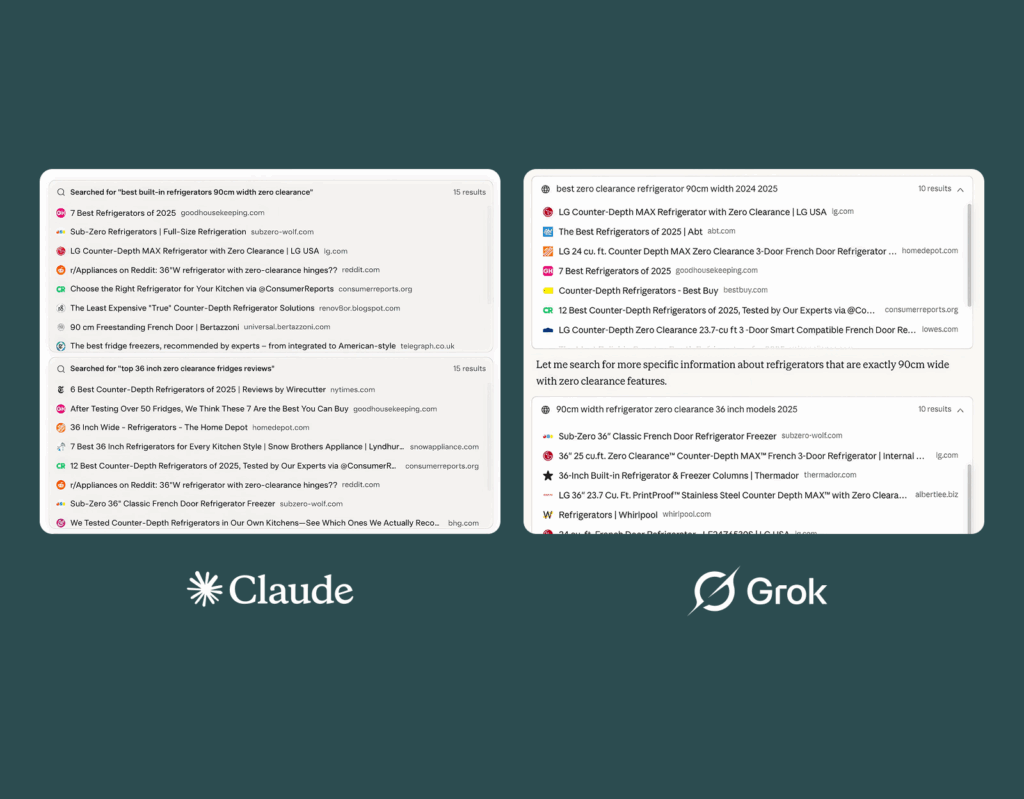
Once the intent is clear, the AI goes shopping online – literally. It sends web searches through different engines (Bing for ChatGPT, Brave for Claude, Google for Gemini and Google AI, Perplexity’s and Grok’s own crawlers).
Each uses its own phrasing style – some hunt for “best” or “top” lists, others look for brand specs like “zero-clearance hinge 90 cm.”
This is where SEO still plays a role: structured product data, up-to-date feeds, and rich snippets help the AI “see” a page faster and trust it more. - The Analysis
Now the AI acts like a comparison engine. It opens the pages it found, brand sites, retailer listings, and editorial reviews, and pulls structured facts (dimensions, price, features, ratings). It also checks for consistency across sources: if LG lists 90.8 cm width on its site and Home Depot lists the same, that’s a reliability signal. Inconsistent data, missing specs, or broken schema make products drop out of contention fast.
- The Recommendation
Finally, the model combines everything it’s gathered, facts, reviews, and perceived trust, to decide what to show first. It doesn’t just look at popularity; it weighs trustworthiness (who said it), structure (how clearly the data is presented), and consistency (do all sources agree?).
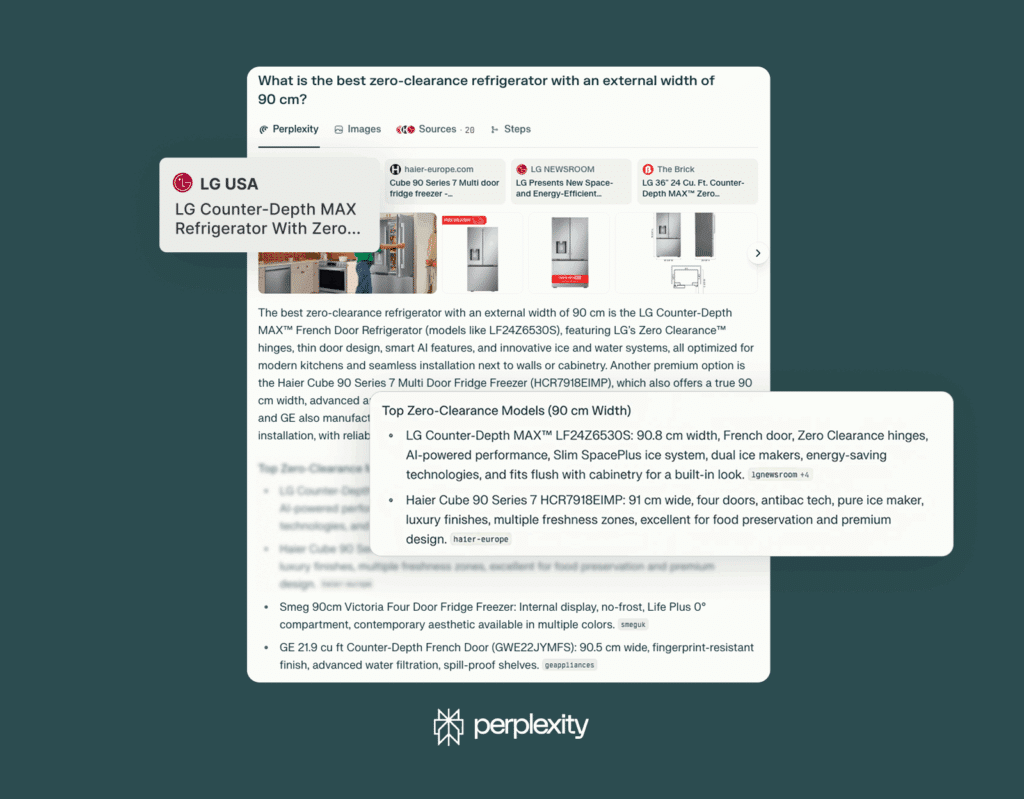
The result you see (in our case – “LG Counter-Depth MAX is the best zero-clearance refrigerator around 90 cm”), is the end of this pipeline.
- The Recommendation
For brands, every step in that chain is a chance to win or lose visibility. The clearer your data, the broader your distribution, and the more consistent your message, the more likely you are to be the answer every AI recommends.
How Different LLMs Think About Product Discovery
In the sections below, we’ll compare how each LLM thinks, searches, and sources, and reveal why LG Counter-Depth MAX managed to stand out across every one of them.
Each model follows a different mental “shopping journey.” ChatGPT behaves like a category curator, it starts wide, creating a longlist of potential refrigerators from brand and retailer sites, then narrows down by comparing features like hinge type and width.
Gemini takes a research-first approach, it begins by defining what “zero-clearance” means, then uses that definition to filter products, moving logically from concept → examples → comparison → recommendation.
Claude mirrors a sales associate mindset, searching broadly, confirming product equivalence (90 cm ≈ 36 in), and progressively refining to premium sub-brands like LG, Sub-Zero, and Thermador.
Perplexity and Grok act more like catalog scanners, running multiple variations of the same query to cover every possible phrasing (“best,” “top,” “recommendations,” “36-inch”) and then compiling extensive lists.
Google AI’s reasoning isn’t visible, but its output behavior shows that it performs structured aggregation behind the scenes, organizing brand, retail, and review data into an immediate ranked summary, suggesting it goes through similar internal discovery and filtering steps, even if the chain itself isn’t exposed.

Difference in Search Phrasing and Intent
The keyword patterns each LLM uses reflect its underlying search mindset. ChatGPT, acting as a category curator, structures its searches around feature- and specification-based terms like “90 cm refrigerators with zero-clearance hinge,” designed to gather a comprehensive product pool before filtering down. It’s particularly interesting to see how this stage may evolve following OpenAI’s recent announcement of the Agentic Commerce Protocol (ACP).
Gemini doesn’t reveal its exact keywords, but from its reasoning flow, it’s clear that its intent is conceptual learning before comparison, likely using broader topical searches to ground its understanding of “zero-clearance” before transitioning to products. Google AI also hides its actual phrasing, but its results show a transactional balance between brand, retailer, and review sites, implying commercially tuned product queries optimized for relevance rather than breadth. Perplexity, by contrast, fires multiple structured queries simultaneously using explicit modifiers such as “best,” “recommendations,” and “2025,” aiming for maximum coverage across media, retailer, and manufacturer content. Grok follows a similar pattern, emphasizing SEO-style list keywords like “top,” “reviews,” and “36-inch,” signaling intent to gather authority content and affiliate comparisons.
Claude mirrors its methodical research behavior through iterative refinement, starting with broad, intent-driven phrases like “best zero-clearance refrigerator 2025,” then narrowing with dimensional and model-specific filters such as “90 cm width” or “36 inch models,” aligning its phrasing closely with its progressive chain of thought.
Difference in Source Mix and Overlap
Each AI assistant builds its product answers from a different mix of online sources, from brand sites and retailers to editorial reviews and even Reddit threads. Across all six models I analyzed (ChatGPT, Gemini, Google AI Mode, Perplexity, Grok, and Claude), there were 46 unique domains, with each model citing between 11 and 23 sources on average.
When grouped by content type, the sources fell into six main categories:
- Retail and marketplaces (39%): Sites such as HomeDepot.com, BestBuy.com, Abt.com, Costco.com, and AppliancesDirect.co.uk, which confirm availability, pricing, and specifications.
- Brand and manufacturer (24%): Official product pages like LG.com, Samsung.com, Bosch-home.com, SubZero-Wolf.com, and Whirlpool.com that provide authoritative information and structured data.
- Editorial and review media (20%): Publications such as ConsumerReports.org, GoodHousekeeping.com, Wirecutter (NYTimes.com), BHG.com, and Forbes.com, offering expert evaluations and comparisons.
- Affiliate and local retailer blogs (11%): Hybrid or niche sources like YaleAppliance.com, AlbertLee.biz, and PowerReviews.com that blend product reviews with purchase intent.
- User-generated content (4%): Forums and community discussions on Reddit and Facebook that reflect authentic consumer sentiment.
- Video platforms (2%): YouTube, Vimeo, providing demonstrations and unfiltered reviews that enhance credibility.
The mix each model relies on reflects the search engines and retrieval methods behind them.
ChatGPT, which uses Bing Search, draws from every major content source, brand sites, retailer listings, editorial reviews, affiliate blogs, video platforms, and user-generated discussions. In this query, most of its citations (52%) came from retailers like Home Depot, Best Buy, and Costco, followed by 26% from brand pages such as LG and Samsung. Yet the presence of YouTube, Reddit, and other contextual sources shows that ChatGPT’s discovery process isn’t limited to transactional data. It integrates structured product facts, professional reviews, and community feedback.
Claude, powered by Brave Search, shows the most balanced distribution across all categories, roughly one-third retail (36%), one-quarter brand (27%), and a meaningful presence in both affiliate and editorial media (18% each). This balance gives its responses a broader contextual understanding and a tone closer to a human product advisor.
Gemini and Google AI Mode, both built on Google Search, concentrate heavily on retail and review content. Google AI Mode, in particular, draws 57% of its sources from retail and another 21% from editorial sites such as RTINGS.com and Better Homes & Gardens, reflecting Google’s commerce-first orientation and deep integration with structured product data.
Perplexity and Grok, which rely on their own multi-source crawlers, favor breadth and diversity. Perplexity references nearly 20 domains across multiple regions (US, UK, EU, AU) and extends into video-based reviews on YouTube. Grok, on the other hand, is the most editorially weighted, with nearly half of its citations coming from media and review publications such as Good Housekeeping, Wirecutter, and Reviewed.com. Its results resemble a “journalistic shopper’s guide” more than a commerce listing, leaning into opinion-led and recommendation-driven content.
Despite these differences, all six systems converged on a shared visibility core, the domains that appeared across nearly all models: LG.com, Samsung.com, HomeDepot.com, BestBuy.com and ConsumerReports.org.
For brands, this is the essence of Answer Engine Optimization: it’s no longer about winning a single ranking on one search engine, but about maintaining structured, consistent visibility across every surface that AI models read, brand pages for accuracy, retailer listings for validation, editorial reviews for authority, and user content for trust.
Why “LG Counter-Depth MAX” Dominated Every LLM’s Results
Circling back to my claim in the beginning of this article, LG’s Counter-Depth MAX refrigerator consistently surfaced at or near the top because its digital footprint is built for AEO (Answer Engine Optimization), not just traditional SEO. Classic SEO focuses on ranking a single webpage through backlinks, metadata, and keyword density. AEO, by contrast, rewards structured clarity, multi-surface distribution, and contextual consistency, the ability for an AI system to recognize, cross-reference, and verify a product across many types of digital touchpoints. For LLMs, this isn’t about who shouts loudest in search, it’s about who shows up everywhere, in the right formats, with matching facts.
And that’s precisely why LG Counter-Depth MAX wins. It’s the only model mentioned across all content ecosystems that LLMs rely on. In the brand layer, LG’s official site (lg.com) consistently ranked in ChatGPT, Claude, Grok, Perplexity, and Google AI, each detecting structured schema, product identifiers, and detailed technical attributes. In the retailer layer, LG dominated Home Depot, Best Buy, Lowe’s, The Brick, and Abt citations, retail partners whose structured product feeds mirror LG’s schema, allowing every LLM to validate the same entity independently. In the editorial and affiliate layer, LG appeared repeatedly in Consumer Reports, Good Housekeeping, Better Homes & Gardens, Wirecutter, and Yale Appliance, giving it credibility in the narrative-driven parts of search that LLMs pull from. Finally, in the UGC and community layer, LG surfaced in Reddit and YouTube via review discussions and recommendation videos, giving LLMs behavioral and trust context that pure product data lacks.
Put simply, LG achieved what most brands haven’t: presence across every content tier that LLMs use to build confidence. Its schema tells the model what it is, its retailers confirm availability, its media mentions validate authority, and its community content anchors trust. That multi-surface coherence makes it the “answerable” brand, one that every AI system, no matter its architecture, can safely and consistently recommend first.
By the way, after all that research, analysis, and a dozen LLMs agreeing that LG was the smart choice… I went and bought the Samsung. Because even in the age of AI-driven discovery, some decisions still come down to human bias, and, in my case, the color matched the kitchen.
FAQs: From SEO to AEO and the Rise of AI Discovery
- What is Answer Engine Optimization (AEO) and how is it different from SEO?
Answer Engine Optimization (AEO) focuses on making your brand and products understandable to AI systems that generate answers, not just search results. Unlike traditional SEO, which centers on ranking individual web pages, AEO rewards structured clarity, consistent data, and presence across multiple online surfaces – brand sites, retailers, reviews, and community content. It’s about being the verified answer, not just the top link. - How do large language models (LLMs) choose which products to recommend?
LLMs analyze a product through multiple layers – structured data, online sources, and consistency signals. They verify details like dimensions and features across brand, retailer, and review sites, rewarding products with matching facts and credible context. The clearer and more consistent a product’s data, the more confidently AI systems will recommend it. - What role does structured product data play in AI discovery?
Structured product data acts as the language AI systems read. Schema, attributes, and technical details help models quickly recognize, compare, and validate products. Without structure, even great products can be overlooked, since LLMs rely on verified data formats to surface confident answers. - How can brands optimize their product pages for AI assistants and LLMs?
Brands should ensure their product pages include detailed, structured data and consistent facts across all listings. Partnering with retailers to synchronize feeds, maintaining accurate schema, and reinforcing key specs in editorial and user-generated content all increase discoverability. In short, clarity and consistency are the new ranking factors. - What types of online sources do AI models rely on when recommending products?
LLMs pull from a mix of sources: retailer and marketplace sites for specs and availability, brand sites for authority, editorial reviews for credibility, affiliate blogs for purchase intent, and user-generated content for trust. Video reviews and forums add context, helping models gauge real-world sentiment. - Why is data consistency across retailers, brand sites, and reviews important for AEO?
AI systems cross-check facts across multiple sites to confirm accuracy. When dimensions, pricing, and features align across brand and retail listings, models view that product as reliable. Inconsistent or outdated data can break that trust and push a product out of AI-generated recommendations. - How does the shopper journey change when starting with an AI prompt instead of a keyword search?
Today’s shoppers describe what they want in detail – asking questions like “What’s the best zero-clearance refrigerator around 90 cm wide?” instead of typing short keywords. This shifts discovery from keyword matching to attribute matching, meaning brands must publish clear product attributes that help AI connect their items to real shopper intents. - In the age of AI-driven discovery, what does visibility really mean for brands?
Visibility is no longer about keyword rankings – it’s about clarity and verifiability. The better AI systems can understand and confirm your brand’s information, the more likely your products will appear as trusted answers. In this new landscape, structured data is the bridge between brands, AI, and shoppers.


 Join a free demo, personalized to fit your needs