











In the fast-paced world of eCommerce, it’s common to focus on chasing new customers. But what about the ones you already have? With rising acquisition costs and fierce competition, focusing on customer retention is not just a smart tactic. It is essential for sustainable growth.
This guide gives you a complete overview of ecommerce customer loyalty, from basic principles to advanced strategies. You will learn how to design, launch, and optimize a rewards program that builds lasting customer relationships and drives profitable growth for your brand in 2026 and beyond.
Key Takeaways
- Retention is the New Growth: Rising customer acquisition costs make retaining existing customers the most profitable strategy for sustainable eCommerce growth.
- Emotion Drives Loyalty: Successful loyalty programs build emotional connections that turn one-time buyers into brand advocates, going beyond simple transactional discounts.
- Data is a Competitive Advantage: Loyalty programs are a powerful source of first-party data that allows for deep customer understanding and personalized marketing.
- Structure is Key: The foundation of a strong program involves choosing the right model (points, tiers, or hybrid) and offering a compelling mix of rewards.
- Technology is a Partner, Not a Tool: Choosing the right loyalty platform involves finding a strategic partner that offers expert guidance, deep customization, and robust analytics, not just software.
Why Ecommerce Customer Loyalty is No Longer Optional
For years, the main growth plan for many online brands was customer acquisition. The model was simple: run ads, get new buyers, and repeat. That playbook, however, is becoming more expensive and less effective. Today, real growth comes from building genuine relationships with the customers you have already earned.
Ecommerce customer loyalty has shifted from a “nice-to-have” marketing idea into a core business strategy. It involves creating a system that recognizes and rewards repeat customers, encouraging them to choose your brand again and again. Let’s look at why this is so critical in today’s market.
The Shifting Economics: Acquisition Costs vs. Retention Value
The cost to acquire a new customer has been climbing in nearly every industry. This trend is driven by more competition on ad platforms and new data privacy rules that make reaching new audiences harder and pricier. Because of this, the clear difference between the cost of acquisition and the value of retention is now a central focus for smart eCommerce brands.
This is where the economics of retention show their power. The financial arguments are strong and based on core marketing principles:
- Acquisition vs. Retention Costs: It is a basic marketing principle that getting a new customer costs much more than keeping an existing one, often by a five-to-one ratio. When you focus on retention, you are working more cost-effectively right away.
- Impact on Profitability: The effect on your bottom line is huge. Famous research shows that increasing customer retention by just 5% can boost profits by 25% to 95%. This is because loyal customers buy more often over time, which means you spend less on costly marketing to replace them.
- Increased Spending Power: This profitability comes from the predictable actions of loyal customers. They not only make repeat purchases more often, but they also tend to spend more per order and are more open to trying new products. This behavior greatly increases their lifetime value (LTV).
When you invest in loyalty, you are not just keeping your current customers happy. You are making a strategic investment in your most profitable and stable source of income.
Beyond Transactions: Building Emotional Connections
A purchase is a transaction; loyalty is an emotional connection. In a market full of choices, customers want more than just a product. They want to feel a connection with the brands they support. A well-designed loyalty program is a great tool for building that connection.
It tells your customers that you see them as more than just an order number. It shows you value their business and want a long-term relationship. This approach turns casual shoppers into excited brand advocates who not only buy from you but also tell their friends about your brand. This word-of-mouth marketing is incredibly valuable because it comes from a trusted source, making it much more effective than traditional ads.
The Data Goldmine: Understanding Your Best Customers
With increasing data privacy rules, first-party data—information you collect directly from your customers with their permission—is more valuable than ever. A loyalty program is one of the best ways to ethically collect this data.
When customers join your program, they give you permission to track their behavior in return for value. This creates a wealth of insights:
- Purchase History: What products do they buy and how often?
- Engagement Patterns: Which rewards do they redeem? Which messages do they respond to?
- Customer Preferences: What are the most popular items among your best customers?
This data allows you to move past generic marketing. You can create very personal experiences, from targeted product recommendations to exclusive offers for your VIPs. This makes your marketing more relevant and efficient.
In short, a focus on ecommerce customer loyalty is a strategic must. It directly fights rising acquisition costs by boosting profitability, turns sales into emotional connections, and gives you the first-party data needed to win in a competitive market.
The Core Components of a High-Impact Loyalty Program
Now that we have covered the “why,” let’s explore the “what.” A successful loyalty program is more than just a discount machine. It is a carefully designed system with several key parts working together to motivate and reward your customers. Getting these foundational pieces right is the first step toward building a program that delivers a great return on investment.
Choosing Your Program Model: Points, Tiers, or Hybrid?
The structure of your program decides how customers interact with it. There is no single “best” model. The right choice depends on your brand, your products, and what your customers like.
Points-Based Programs
This is the most common type of loyalty program. The idea is simple: customers earn points for doing specific actions and can then trade those points for rewards.
- How it works: Customers might earn 1 point for every $1 spent, 50 points for creating an account, or 100 points for writing a product review. They could then exchange 500 points for a $5 discount.
- Pros: This model is easy for customers to understand. Its flexibility lets you give different values to different actions, encouraging behaviors beyond just buying.
- Cons: If not managed well, it can feel purely transactional and may not build a deep emotional connection with your brand.
Tiered Programs
Tiered programs create a feeling of exclusivity and status. Customers unlock new levels of benefits as their spending or engagement grows.
- How it works: A customer might start in a “Bronze” tier. After spending $250, they could move up to “Silver,” unlocking benefits like free shipping. At $1,000, they might reach “Gold,” getting early access to new products.
- Pros: Tiers are very aspirational. They add game-like elements to shopping and make customers feel like valued VIPs, which helps build a stronger emotional connection.
- Cons: These programs can be more complex to set up and manage. The benefits for each tier must be meaningful enough to motivate customers to move up.
Hybrid & Value-Based Programs
Many of the best modern programs use a hybrid model, mixing the best parts of both systems. In this model, customers earn points for purchases that can be redeemed for discounts, while their total spending also helps them reach a higher VIP tier.
Also, top programs are adding value-based rewards. This means offering rewards that match customer values, such as donating points to a charity or getting non-monetary perks like a personal shopping consultation. This approach deepens the relationship by showing that your brand shares their values.
Designing Rewards That Actually Motivate
The rewards you offer are the heart of your program. If your rewards are not appealing, your program will not engage customers. The key is to offer a mix of rewards that appeal to different motivations.
Transactional Rewards
These are the most direct rewards, offering a clear financial benefit.
- Percentage or fixed-amount discounts ($10 off, 20% off)
- Free shipping
- Free products or samples
These are great for encouraging quick action but should be balanced with other reward types. This avoids training customers to buy only when there is a discount.
Experiential Rewards
These rewards offer exclusivity and access that money can’t always buy, making your customers feel special.
- Early access to new products or sales
- Invitations to VIP-only events
- Exclusive content, like tutorials or behind-the-scenes videos
- Personalized styling or product consultations
Experiential rewards are very powerful for building a strong brand community and deep emotional loyalty.
Community & Recognition
Sometimes, simple recognition is the most effective reward. These rewards cost very little but can have a big impact.
- Featuring a customer’s photo or review on your social media
- Giving access to a private, members-only community
- Sending a “happy birthday” message with a small bonus
These simple acts of recognition show customers you appreciate them as people, not just as numbers.
Earning Actions: More Than Just Purchases
A smart loyalty program encourages a wide range of valuable behaviors, not just purchases. Rewarding these actions helps build a more engaged community around your brand.
Consider offering points for these activities:
- Creating a store account
- Subscribing to your newsletter
- Following your brand on social media
- Writing a product review
- Adding a photo or video to a review
- Referring a friend
- Celebrating a birthday
- Completing a quiz to gather product preference data
By rewarding engagement, you show customers that their relationship with your brand has value beyond what they spend.
Building Your Loyalty Program: A Step-by-Step Framework
Launching a loyalty program can seem like a big job, but you can make it manageable by breaking it down into logical steps. This framework will guide you from the first idea to a successful launch. It will help you build a program that matches your business goals and connects with your customers.
Step 1: Define Your Goals & KPIs
Before you design anything, you must define what you want to achieve. What does success look like for your brand? A loyalty program can affect many areas of your business, so be specific with your goals.
Common goals include:
- Increase Customer Lifetime Value (LTV): Encourage each customer to spend more with you over time.
- Boost Repeat Purchase Rate: Motivate first-time buyers to become second-time buyers.
- Raise Average Order Value (AOV): Motivate customers to add more items to their carts.
- Drive User-Generated Content (UGC): Increase the number of product reviews.
- Grow Your Contact List: Incentivize sign-ups as part of the loyalty program.
Once you set your goals, define the Key Performance Indicators (KPIs) you will use to measure them. This will let you track your progress and show the program’s ROI.
Step 2: Understand Your Audience and Define Segments
Your loyalty program should be designed for your customers, especially your most valuable ones. Do not guess what they want. Use data to find out.
Start by analyzing your customer data. An RFM (Recency, Frequency, Monetary) analysis is a great place to start. This method segments your customers based on:
- Recency: How recently did they buy?
- Frequency: How often do they buy?
- Monetary Value: How much do they spend?
This analysis will help you identify key groups like “Champions” (your best customers), “Potential Loyalists” (recent, frequent shoppers), and “At-Risk Customers” (those who haven’t bought in a while). Understanding these groups will help you tailor your program’s rewards and messages for the best results. You can also survey your customers directly to ask what kinds of rewards they find most appealing.
Step 3: Choose the Right Technology Partner
You cannot run a modern loyalty program with a spreadsheet. You need a strong technology platform to manage members, track points, automate rewards, and measure performance. Choosing the right partner is one of the most important decisions you will make.
Key Capabilities to Look For in a Loyalty Platform
As you evaluate your options, look for these essential capabilities:
- Strategic Support and Expertise: Does the provider act as a real partner? Look for a company that offers strategic guidance, dedicated support, and has deep expertise in eCommerce loyalty. You need a partner invested in your success.
- Flexibility and Customization: Your loyalty program should feel like a natural part of your brand, not a generic add-on. The platform must offer deep customization options for everything from the visual design to the earning rules.
- Robust Reporting and Analytics: You need clear, accurate data to understand what is working. The platform should provide easy-to-understand dashboards and detailed reports on your KPIs, allowing you to measure ROI and make data-driven decisions.
- Seamless Integrations: Your loyalty program needs to connect smoothly with your other marketing tools, especially your reviews provider and your eCommerce platform (like Shopify or BigCommerce).
How Yotpo Loyalty Delivers a Strategic Advantage
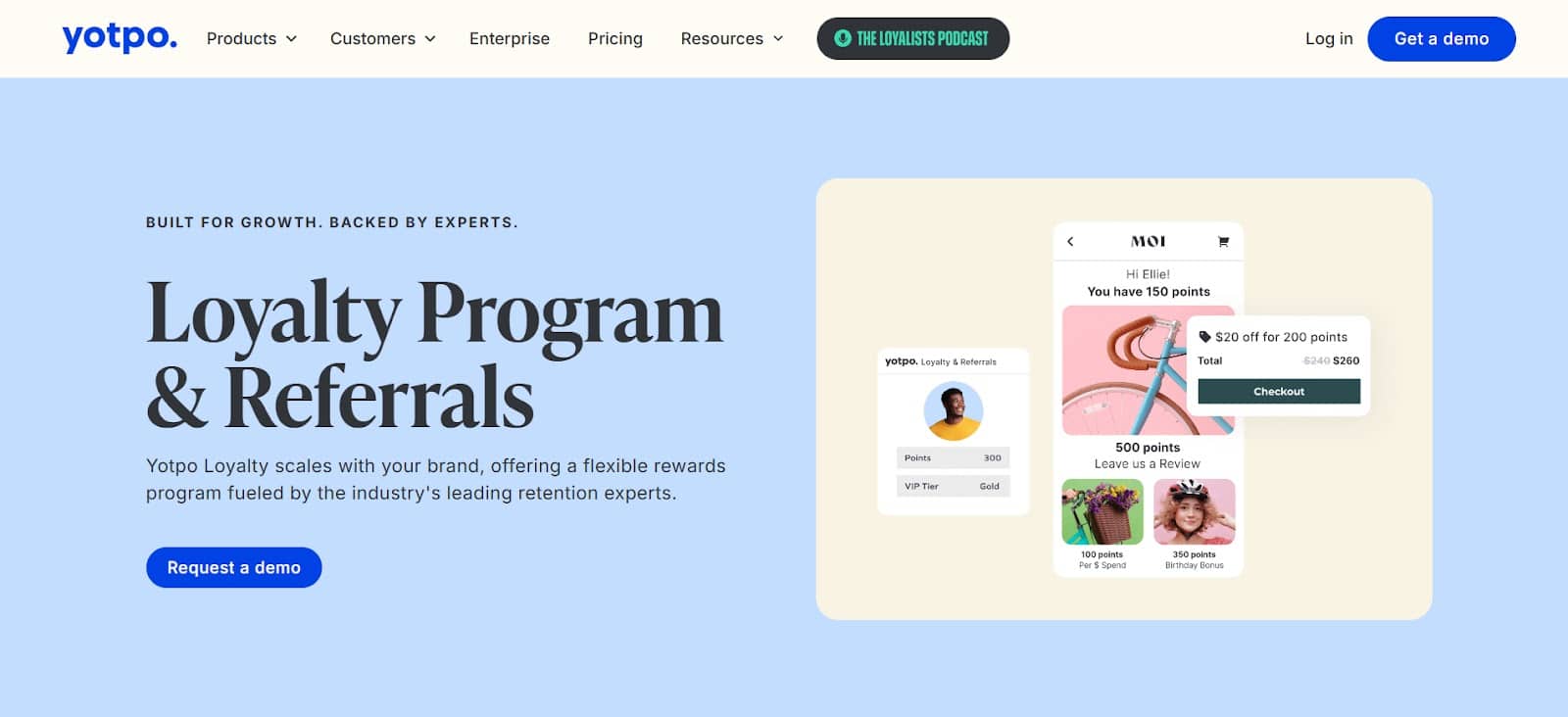
Yotpo Loyalty is designed to be a strategic growth engine for your brand. Here’s how it addresses the key capabilities:
- A True Partnership Approach: Yotpo stands out by providing a team of eCommerce loyalty experts and dedicated Customer Success Managers (CSMs). They work with you to design and optimize your program. This strategic guidance is key for maximizing ROI.
- Unmatched Flexibility and Customization: Yotpo Loyalty offers extensive customization options to create unique and on-brand experiences. You can design custom rewards, create dynamic VIP tiers, and set up flexible rules that match your business strategy.
- Actionable, Accurate Reporting: The platform provides robust and accurate reporting dashboards. This lets you easily track key metrics, understand member behavior, and prove the financial impact of your program.
- Deep eCommerce Integrations: Yotpo Loyalty is built to work smoothly within the eCommerce ecosystem. It integrates deeply with other key channels, such as a reviews solution, to improve their collective effectiveness.
This focus on strategic partnership and powerful technology empowers brands to build loyalty programs that drive real results.
Step 4: Design and Brand Your Program
With your goals set and your technology chosen, you can move to the creative stage.
- Give it a Name: Avoid generic names like “Rewards Program.” Brainstorm a creative, on-brand name that excites customers, like “The Insiders Club.”
- Create a Landing Page: Build a dedicated, easy-to-find landing page for your program. This page should clearly explain how the program works: Join, Earn, and Redeem. Use clear visuals and compelling copy to show the benefits of joining.
Step 5: Launch and Promote Your Program
Your program is built. Now you need to get people to sign up. A strong launch and ongoing promotion are key.
- Choose a Launch Strategy: You can do a “soft launch” by inviting your best customers first to get feedback. Or you can do a “big bang” launch with a major promotional campaign to build excitement.
- Promote It Everywhere: Do not keep your program a secret. Promote it across all your marketing channels:
- Add a banner to your website’s homepage.
- Send a dedicated email campaign to your contacts.
- Announce it on your social media channels.
- Include a call-to-action on your post-purchase thank-you page.
- Train your customer service team to mention it.
Building a loyalty program is a step-by-step process. By setting clear goals, understanding your audience, choosing a strategic partner, designing a great brand experience, and running a strong launch, you set the stage for success.
Integrating Loyalty with Your Marketing
An effective loyalty program does not work alone. Its real power is unlocked when you weave it into your entire marketing strategy. The data from your loyalty program can make every other customer touchpoint more personal and effective. This is how you move from a simple rewards program to a sophisticated retention machine.
The Power of Integrated Data
Think about the data your loyalty program collects: a customer’s VIP tier, their points balance, which rewards they have redeemed, and their birthday. When your loyalty platform can share this data with your other marketing tools, you gain a big advantage. This allows you to create a single, unified view of your customer and orchestrate cohesive customer journeys.
Combining Loyalty and Customer Reviews
One of the most valuable actions a customer can take is leaving a detailed, authentic review of your product. It provides social proof that directly influences other shoppers. You can use your loyalty program to encourage this behavior.
By integrating your loyalty and reviews solutions, you can automatically reward customers with points for sharing their feedback. You can even offer bonus points for including a photo or video with their review, as visual content is incredibly powerful.
This synergy creates a virtuous cycle:
- A customer makes a purchase.
- You request a review and offer loyalty points as an incentive.
- The customer leaves a high-quality review, earning points.
- That review helps a new shopper decide to buy.
- The new shopper joins your loyalty program, and the cycle continues.
An integration like this, easily managed when using best-in-class products like Yotpo Loyalty and Yotpo Reviews, strengthens both your social proof and your retention efforts at the same time.
The Standalone vs. Integrated Approach
It is important to know that a best-in-class loyalty solution should be powerful enough to deliver great results on its own. A brand can choose to use a solution like Yotpo Loyalty as a standalone tool and still build a highly effective, ROI-positive program.
However, even more value is unlocked when these products are used together. When your loyalty program and reviews solution work in tandem, you create compounding benefits that are greater than the sum of their parts. This approach allows you to leverage data across channels for a truly unified retention strategy.
Measuring Success and Optimizing for Growth
Launching your loyalty program is a big step, but it is not the finish line. The most successful programs are constantly measured, analyzed, and optimized. To ensure your program delivers long-term value, you must treat it like a dynamic part of your business. This means tracking the right metrics and using data to make strategic changes over time.
Essential Loyalty Program KPIs to Track
You set your goals in the planning phase. Now it is time to track the KPIs that show if you are meeting them.
- Repeat Purchase Rate: This is the percentage of customers who have made more than one purchase. It is a direct measure of customer retention.
- Customer Lifetime Value (LTV): Are your loyalty program members more valuable than non-members? Track the LTV of both groups. A rising LTV for members is a clear sign of success.
- Average Order Value (AOV): Does your program encourage customers to spend more per transaction? Compare the AOV of members to that of non-members.
- Program ROI: This is the ultimate measure of financial success. Calculate it by taking the revenue generated by the program, subtracting program costs, and then dividing by the program costs.
- Redemption Rate: What percentage of earned points are being redeemed? A low rate might mean your rewards are not compelling enough. A high rate shows members are engaged.
Using Data to Refine Your Strategy
Your analytics dashboard is a key tool for optimization. Use the data you collect to ask critical questions and test new ideas.
- A/B Test Your Rewards: Are customers redeeming $10 off coupons more than 20% off coupons? Run tests to find out which offers are most effective.
- Analyze Earning Behaviors: Which non-purchase actions are most popular? If few customers are earning points for following you on social media, maybe the point incentive is too low.
- Gather Member Feedback: Send surveys to your loyalty members and ask for feedback. What do they love? What would they change? This feedback is priceless.
A platform with strong reporting, like Yotpo Loyalty, makes this process much easier by providing the clear insights needed to make smart decisions.
The Competitive Landscape of Loyalty Platforms
Choosing the right technology to power your loyalty program is a critical decision. The market has many options, each with its own strengths. Understanding this landscape will help you make an informed choice.
What to Consider When Evaluating Solutions
As you compare platforms, use a clear checklist. Look beyond surface-level features.
- Strategic Support: Will you have access to experts to help you design and optimize your program?
- Customization & Branding: How much can you customize the program to match your brand?
- Analytics & Reporting: How easy is it to track KPIs and measure financial impact?
- Integration Capabilities: How well does it connect with your other eCommerce tools?
- Scalability & Reliability: Will the platform grow with your business?
Understanding the Market
The eCommerce loyalty space has a variety of providers. When choosing a platform, you are often deciding between a simple tool and a strategic partner. Some solutions focus on providing a simple, easy-to-launch tool, which can be a good fit for brands just starting out. Others may offer different pricing structures or feature sets. The key is to evaluate how each solution aligns with the criteria you have established for your own business needs.
For brands serious about measurable growth, a strategic partner often outweighs a simple tool. This is where Yotpo’s approach makes a difference, functioning as an extension of your team to help build a program that becomes a core pillar of your growth strategy.
The Future of Ecommerce Customer Loyalty
The world of eCommerce is always changing, and so is customer loyalty. As technology gets smarter and customer expectations rise, the loyalty programs of the future will look very different. Staying ahead of these trends will be key.
Hyper-Personalization at Scale
Generic, one-size-fits-all rewards are becoming outdated. The future of loyalty is about delivering the right offer to the right person at the right time. Artificial intelligence (AI) will play a big role in this.
Imagine a loyalty platform that can analyze a customer’s purchase history to proactively recommend the reward they are most likely to want. This level of personalization makes the program feel incredibly relevant to each member.
The Rise of Value-Based Loyalty
Today’s consumers want to support brands that share their values. This has led to value-based loyalty, where the connection goes beyond transactions.
In the future, we will see more programs that allow customers to:
- Donate their points to a charity.
- Earn rewards for sustainable actions, like recycling.
- Get access to content that aligns with their interests.
These programs build a much deeper form of loyalty because they are based on a shared identity, not just a desire to save money.
Seamless Omnichannel Experiences
The line between online and offline shopping continues to blur. Future loyalty programs will need to work seamlessly across all channels. A customer should be able to earn points for an online purchase and redeem them in a physical store. Creating this unified experience is complex, but it is essential for meeting the expectations of the modern shopper.
Conclusion: Your Next Steps to Building Lasting Loyalty
In today’s competitive eCommerce market, customer loyalty is your most reliable path to profitable growth. Building a great program requires a clear strategy based on your business goals and a deep understanding of your customers.
Success depends on choosing a strategic technology partner that provides both flexible tools and expert guidance. This approach, combined with continuous measurement and optimization, turns one-time buyers into lasting brand advocates. Use this guide to start planning your loyalty strategy and build stronger, more valuable customer relationships.
Frequently Asked Questions
How much does a customer loyalty program cost?
The cost varies widely depending on the technology partner you choose and the size of your business. Pricing can range from flat monthly fees to usage-based models. It is important to consider the software cost and the cost of the rewards. However, a well-designed program should generate a positive ROI, meaning the increased revenue will outweigh the costs.
How long does it take to see results from a loyalty program?
You can often see early results, like more member sign-ups, within the first few weeks. However, impacting key metrics like Customer Lifetime Value (LTV) and Repeat Purchase Rate takes more time. Typically, you should expect to see a meaningful lift in these core metrics within three to six months.
What are the biggest mistakes brands make with loyalty programs?
The most common mistakes include making it too complicated, offering uninspiring rewards, not promoting the program enough, and having a “set it and forget it” mentality. The best programs are simple, valuable, well-marketed, and constantly optimized.
Can a loyalty program work for a small business?
Yes, a loyalty program can be one of the most powerful marketing tools for a small business. It helps you compete with larger retailers by building strong personal relationships with your customers. The key is to start with a simple program that offers rewards that are valuable to customers and affordable for your business.
How does Yotpo Loyalty support a more strategic approach?
Yotpo Loyalty is designed as a strategic partner, not just a software tool. It supports a strategic approach by providing a dedicated Customer Success Manager and access to loyalty experts. The platform offers deep customization to create a unique program, along with robust analytics to help you measure ROI and make informed decisions to improve your strategy.
What is the difference between a points-based and a tiered program?
A points-based program is transactional: customers earn points for actions and redeem them for rewards. A tiered program is aspirational: customers unlock new levels of status and benefits by reaching spending milestones, which fosters a deeper sense of community and exclusivity.
How do I choose rewards that my customers will actually want?
Start by analyzing your data to see what your best customers buy most often. You can also survey your customers directly to ask what they value. A good strategy is to offer a mix of rewards, including discounts, free products, early access to new items, and exclusive experiences.
What is the best way to promote a new loyalty program?
A multi-channel approach is best. Announce the program with a dedicated email campaign, promote it on your social media channels, and place a prominent banner on your website’s homepage. Also, include information about the program on post-purchase pages and train your customer service team to mention it.
How do I measure the ROI of my loyalty program?
To calculate ROI, take the total revenue generated by program members, subtract all program costs (including software fees and the value of redeemed rewards), and then divide that number by the program costs. A platform with strong reporting is essential for tracking this accurately.
Should I reward customers for actions other than purchases?
Absolutely. Rewarding customers for actions like writing reviews, following you on social media, or referring friends helps build a more engaged community. It shows customers that you value their relationship with your brand, not just their transactions.
What is RFM analysis and why is it important for loyalty?
RFM stands for Recency, Frequency, and Monetary value. It is a method of segmenting customers based on their purchasing behavior. This analysis is crucial for personalizing your loyalty program, allowing you to create targeted campaigns for your best customers, new customers, and those at risk of leaving.
How can I keep my loyalty program exciting over time?
Keep your program fresh by introducing new rewards, running limited-time promotions with bonus points, and adding new VIP tiers. Regularly communicate with members about their status and exclusive benefits to keep them engaged and remind them of the program’s value.
Can a loyalty program help me collect more customer reviews?
Yes. One of the most effective synergies in retention marketing is offering loyalty points to customers in exchange for writing a product review. This creates a powerful incentive for customers to share their feedback, which in turn provides the social proof needed to convert new shoppers.


 Join a free demo, personalized to fit your needs