














In eCommerce, the chase for new customers can often overshadow a more profitable strategy: keeping the ones you already have. Building lasting relationships with your existing customer base is a cornerstone of sustainable success. This is where a customer loyalty management (CLM) system becomes essential. Think of it as the strategic engine that converts one-time buyers into dedicated brand advocates.
Key Takeaways
- Retention Over Acquisition: Focusing on loyal customers increases Customer Lifetime Value (LTV) and is often more cost-effective than acquiring new ones.
- Psychology is Key: Effective loyalty programs tap into core human motivations like reciprocity, the desire for status, and a sense of community.
- Core Components: Successful programs are built on proven models like points-based rewards, tiered/VIP structures, and referral systems.
- Trust is Foundational: Customer reviews and user-generated content (UGC) are crucial for building the initial trust that precedes long-term loyalty.
- Choose the Right Tools: A flexible, data-driven solution is necessary to implement and manage a loyalty program that delivers measurable results.
In this guide, we’ll deconstruct the principles of modern customer loyalty management, explore its importance, and outline how you can implement a system that drives measurable growth.
Why Customer Loyalty Management is Critical for E-commerce Growth
A robust customer loyalty strategy isn’t just a nice-to-have—it’s a fundamental driver of sustainable growth. Loyal customers spend more, purchase more often, and act as powerful advocates for your brand. A dedicated investment in customer retention directly impacts your business’s key performance indicators.
- It substantially increases Customer Lifetime Value (LTV). By encouraging repeat business, you extend the revenue generated from each customer far beyond their initial transaction. This effect is often amplified by an increase in Average Order Value (AOV), as engaged customers are more inclined to purchase additional items, particularly when you offer incentives or rewards.
- Effective loyalty management significantly reduces your Customer Acquisition Cost (CAC). Acquiring new customers is an expensive undertaking. By focusing on retention, you establish a dependable revenue stream from your existing base. This lessens your reliance on costly advertising campaigns to generate sales.
- Loyalty cultivates a powerful marketing asset that you can’t buy: social proof and word-of-mouth advertising. Satisfied, loyal customers are more likely to provide positive reviews and recommend your brand to their networks. This creates a self-perpetuating cycle of trust and organic growth.
The Core Principles of Effective Loyalty Management
A customer loyalty management system is a strategic framework for identifying, rewarding, and retaining your most valuable customers. It goes beyond simple transactional rewards to foster a meaningful, emotional connection between your brand and your audience. To build one effectively, you must first understand its core components.
The Psychology of Customer Loyalty
Before we look at the mechanics of loyalty programs, it’s important to understand the psychological drivers behind them. Modern programs leverage fundamental human motivations to create powerful incentives.
- Reciprocity: When a brand gives a customer something of value—like a discount, a gift, or exclusive access—the customer feels a natural urge to reciprocate, usually through continued business.
- Status and Exclusivity: People are often motivated by social standing. Tiered or VIP programs that grant elevated status and exclusive benefits make customers feel recognized and valued, which strengthens their connection to the brand.
- Community: Loyalty programs can create a powerful sense of belonging. When customers feel like they are part of an exclusive group, their bond with the brand deepens beyond simple transactions.
- Goal Achievement: Points-based systems appeal to our natural desire to work toward and achieve a goal. The process of collecting points and redeeming them for a reward delivers a satisfying sense of accomplishment.
Foundational Components of a CLM System
While strategies vary, most successful customer loyalty management systems are built on a few foundational pillars.
1. Points-Based Programs
This is the most conventional model, where customers earn points for completing specific actions—like making a purchase, subscribing to a newsletter, or following on social media. Customers can then redeem these points for rewards like discounts, free shipping, or exclusive products.
- Pros: This model is easy for customers to understand and relatively simple for businesses to implement. It offers a clear, tangible incentive for engagement.
- Challenges: If not designed thoughtfully, the program can feel transactional instead of relational. Success depends on offering compelling rewards and making sure the earning process feels meaningful.
2. Tiered & VIP Programs
Tiered programs enhance the points-based model by establishing levels of status. Customers unlock new tiers and better rewards by meeting certain spending or engagement goals.
- Pros: This structure effectively leverages the psychology of status and exclusivity. It adds a gamified element to the loyalty experience, motivating customers to aim for the next level.
- Challenges: It’s important to make sure the introductory tier provides enough value to engage new members, while higher tiers must feel genuinely exclusive and desirable.
3. Referral Programs
Your most loyal customers can be your most effective marketers. A referral program formalizes word-of-mouth marketing by rewarding customers for sending new business to your brand.
- Pros: This is a highly cost-effective acquisition channel that attracts high-intent customers who arrive with a degree of pre-established trust.
- Challenges: The reward structure must be compelling enough to motivate sharing, and the process must be seamless for both the person referring and the person being referred.
The Unspoken Hero of Loyalty: Customer Reviews & UGC
What’s the connection between customer reviews and loyalty? It’s fundamental. Trust is the bedrock of any long-term relationship, and in eCommerce, trust is primarily built through authentic social proof. A customer’s journey toward loyalty often starts with checking out other customers’ experiences. Research shows that the vast majority of consumers read online reviews before making a purchase.
- Building Foundational Trust: When a new shopper finds a product with many positive reviews, their confidence to make a purchase grows. This positive initial experience is the crucial first step toward becoming a repeat customer.
- Reinforcing the Decision to be Loyal: Seeing their own positive feedback on your website validates a customer’s choice and strengthens their sense of connection to the brand community.
- Gathering Actionable Insights: Reviews create a direct feedback channel, giving you invaluable information that can be used to improve products and services. These improvements, in turn, lead to greater customer satisfaction and loyalty.
A modern customer loyalty management system is therefore incomplete without a robust strategy for collecting and displaying user-generated content (UGC), especially product reviews, customer photos, and videos.
Choosing the Right Loyalty Management Solution
Understanding the theory is one part of the equation; successful implementation is the other. An effective strategy requires powerful, flexible tools designed for the eCommerce environment.
Key Considerations When Choosing a Solution
When evaluating platforms, focus on these key areas to ensure you select a solution that can grow with your brand and deliver measurable results.
- Look for a Strategic Partner: The best loyalty solution offers more than just software. Does the provider offer strategic guidance from eCommerce experts? Access to a dedicated success manager who can help you analyze performance and refine your strategy is invaluable for long-term success.
- Prioritize Flexibility: Your brand is unique, and your loyalty program should be too. A rigid, one-size-fits-all tool will limit your ability to create a truly engaging experience. Look for a platform that allows deep customization of rewards, campaigns, and on-site elements so you can create a program that is a seamless extension of your brand.
- Demand Accurate, Actionable Reporting: To prove the value of your program, you need data you can trust. A top-tier solution will provide a robust analytics suite that gives you a clear view of your program’s ROI, customer engagement, and impact on key metrics like LTV. Avoid platforms that offer only surface-level data.
Building Your Program with Yotpo Loyalty
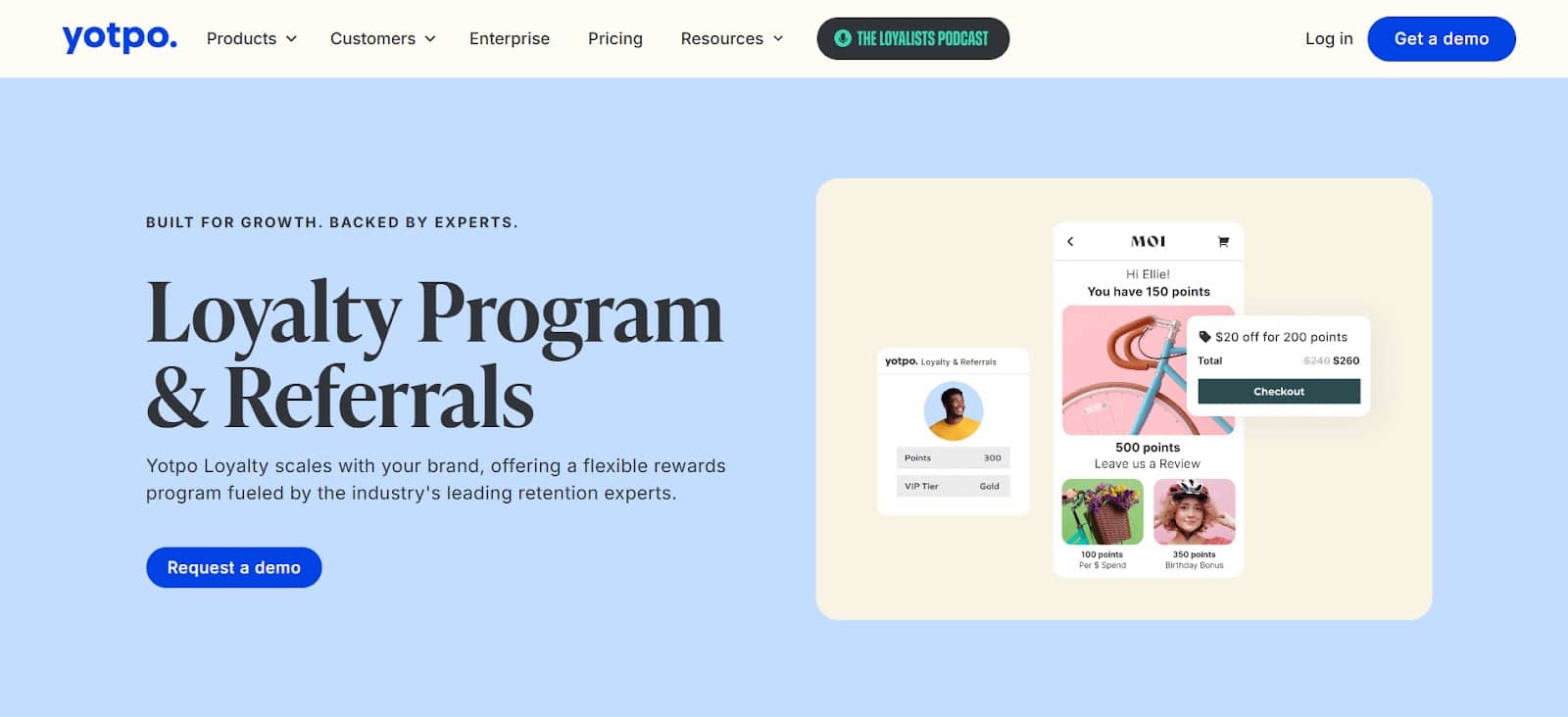
Yotpo Loyalty is designed to be more than just a software tool. It acts as a strategic partner to help you build a program that aligns with your brand’s specific goals. With years of leadership in the space, Yotpo offers deep market understanding, which translates into a stable, reliable, and feature-rich product.
- Strategic Support: Yotpo takes a partnership approach. Every brand gets access to dedicated Customer Success Managers and 24/7 technical support. This provides a partnership focused on helping you refine your strategy and analyze performance, rather than leaving you to figure it out alone.
- Flexibility and Customization: You aren’t locked into a rigid template. Yotpo allows you to create unique loyalty experiences, from custom reward types to campaigns that target customers based on behavior or VIP tier. You can design a program that feels like a seamless extension of your brand.
- Robust Reporting and Insights: You can’t improve what you don’t measure. Yotpo Loyalty delivers deep, accurate reporting that goes beyond surface-level metrics. You can analyze program ROI, track redemption rates, and understand how your loyalty initiatives impact key business metrics.
Fostering Trust with Yotpo Reviews
As we’ve established, trust is a prerequisite for loyalty. The Yotpo Reviews solution is engineered to build this trust by collecting and showcasing high-impact user-generated content. Used independently, it is a complete solution for managing your brand’s reputation and leveraging social proof to accelerate growth.
- Focus on Conversion: The platform is designed not just to collect reviews, but to gather high-impact reviews that feature visuals and address specific product attributes important to shoppers. It simplifies the process for customers to upload photos and videos, providing the compelling social proof that directly influences purchases.
- Strategic Review Display: Yotpo offers a variety of customizable on-site widgets designed to increase shopper engagement. From review carousels to visual galleries, you can present UGC in a way that helps shoppers make informed decisions.
- Deeper Insights: Yotpo delivers analysis that moves beyond basic star ratings. You can analyze customer sentiment, identify emerging trends, and get actionable feedback to refine your products—a critical part of building long-term loyalty.
- Cross-Channel Impact: Your reviews aren’t limited to your website. Yotpo enables you to syndicate your reviews to critical channels like Google Shopping, Facebook, and retail partners such as Target, reinforcing trust at every touchpoint.
Actionable Best Practices
To begin building your loyalty system, consider these five actionable best practices.
- Establish Clear Objectives. Define your primary goal from the start. Whether it is to increase your repeat purchase rate by a specific percentage or to boost LTV, a clear objective will guide your program’s design.
- Simplify Onboarding and Earning. Minimize friction. Let customers join your program with a single click. Make sure the path to earning their first reward is clear, straightforward, and quick to deliver an early sense of value.
- Reward a Spectrum of Behaviors. Encourage a wider range of actions beyond just buying. Offer points for leaving a review, uploading a photo, engaging on social media, or referring a friend. This approach cultivates a community, not just a customer list.
- Communicate Program Value Consistently. Don’t let your loyalty program become an afterthought. Promote it on your homepage, product pages, and in your email marketing. Regularly update customers on their point balance and the rewards available to them.
- Leverage Social Proof at Every Stage. Integrate reviews and UGC directly into your loyalty communications. Remind customers that their feedback not only helps others but also earns them rewards, creating a virtuous cycle of engagement and trust.
Conclusion
A modern customer loyalty management system is a strategic asset for building deep, lasting, and profitable customer relationships. By understanding the psychology of loyalty and combining foundational components like points, tiers, and referrals with the trust-building power of customer reviews, you can create an ecosystem that drives sustainable growth. Executing these strategies requires sophisticated tools, and solutions from providers like Yotpo give you the specific capabilities to implement them effectively.
Frequently Asked Questions
Why are product reviews so important for customer loyalty?
Product reviews are critical because they build the foundational trust required for a customer to become loyal. When potential buyers see authentic feedback from real people, it increases their confidence to make that first purchase. A positive initial experience is essential for building a long-term relationship.
What’s the difference between a points-based and a tiered program?
A points-based program is straightforward: customers perform actions (like making a purchase) to earn points, which they can redeem for rewards. A tiered program adds layers to this. Customers “level up” to new tiers based on their spending or engagement, unlocking better, more exclusive benefits at each stage.
How can I encourage customers to actively participate in my loyalty program?
Active engagement is key. First, your value proposition must be clear and compelling. Second, reward a variety of actions beyond just purchasing, such as writing reviews or following on social media. Finally, communicate consistently. Remind customers of their points balance and the cool rewards they can earn.
How do I measure the ROI of my loyalty program?
To measure ROI, you should track key metrics like repeat purchase rate, customer lifetime value (LTV), and average order value (AOV). Compare these metrics for members of your loyalty program versus non-members. Yotpo Loyalty provides robust dashboards to track revenue generated from the program and other key performance indicators.
Can I use Yotpo Loyalty as a standalone product?
Yes. Yotpo’s products are designed to be powerful and effective solutions, even when used individually. A business can choose to implement only Yotpo Loyalty to build and manage a sophisticated rewards program and achieve significant results in customer retention.
What are some common mistakes to avoid when launching a loyalty program?
Common mistakes include making the program too complicated for customers to understand, not offering compelling rewards, and failing to promote the program effectively. It’s also a mistake to “set it and forget it”; a good program requires ongoing analysis and iteration.
How important is personalization in a loyalty strategy?
Personalization is extremely important. Generic, one-size-fits-all promotions don’t inspire genuine loyalty. Using data to segment customers allows you to create targeted campaigns. For example, you can offer your most valuable customers exclusive access to new products while sending a special re-engagement offer to at-risk customers.
Can I use Yotpo Reviews without using Yotpo Loyalty?
Absolutely. Yotpo Reviews is a complete, best-in-class solution for managing your brand’s reputation and using social proof to drive sales. Many brands use it on its own to build trust and increase conversion rates.
What types of reviews can I collect with Yotpo?
Yotpo Reviews enables you to collect a wide range of feedback. This includes standard product and site reviews with star ratings and written comments. Crucially, you can also gather high-impact visual UGC, like customer photos and videos, along with Q&A sections.
How does Yotpo help with requesting customer reviews?
Yotpo automates the review request process through email and SMS, helping ensure you ask for feedback at the optimal time after a purchase. It offers customizable, mobile-friendly templates with in-mail forms, which simplifies the submission process for customers.
How long does it take to see results from a loyalty program?
While you can see immediate engagement, the most significant results—like a substantial increase in LTV and repeat purchase rate—typically build over several months. The key is consistent promotion and offering real value to keep customers engaged long-term.
What role does customer service play in loyalty?
Customer service plays a massive role. A great loyalty program can be completely undermined by poor customer service. Excellent service resolves issues, builds trust, and makes customers feel valued, reinforcing the positive feelings created by your loyalty initiatives.
Should I reward customers for leaving reviews?
Yes, rewarding customers for leaving reviews can be a powerful strategy. It incentivizes the submission of high-quality UGC, which builds trust with new shoppers. It also deepens customer engagement with your loyalty program, creating a win-win situation.


 Join a free demo, personalized to fit your needs