












In the competitive world of eCommerce, acquiring new customers costs a lot more than keeping the ones you already have. This simple fact points to a huge opportunity: you can build a more profitable business by focusing on efficiency. This is where customer loyalty comes in. Shifting your focus from acquisition to retention is a smart move for sustainable growth.
A well-designed customer loyalty marketing strategy turns one-time buyers into repeat purchasers and, eventually, brand advocates. This guide gives you a step-by-step framework for building a strategy that creates genuine, lasting customer relationships and drives profitable growth for your business.
Key Takeaways
- Strategy First, Program Second: A loyalty program (points, tiers) is a tactic. A loyalty strategy is the comprehensive plan that defines your goals, audience, and value proposition.
- Data is Your Foundation: Use customer data (Recency, Frequency, Monetary Value) to identify your most valuable segments and tailor your strategy to them.
- Choose the Right Model: Select a program model—like points-based, tiered, or value-based—that aligns with your brand identity and business goals.
- Technology is a Partner, Not Just a Tool: Select a dedicated loyalty solution that offers deep customization, robust reporting, and strategic support to help you grow.
- Launch and Promote: A successful program requires a multi-channel launch plan to build excitement and drive enrollment.
- Measure and Optimize: Continuously track key metrics like Repeat Purchase Rate and Customer Lifetime Value to analyze performance and refine your strategy over time.
What is Customer Loyalty Marketing? (And Why It’s Not Just a Program)
Before you jump into tactics, it’s important to understand the core concepts. Many business owners think “loyalty” is just a points system, but that’s only one piece of a much larger strategy. True loyalty marketing is a far more comprehensive and strategic effort.
Defining Customer Loyalty Marketing
Customer loyalty marketing is a strategic approach focused on growing and maintaining long-term relationships with your existing customers. It’s an ongoing effort that requires a deep understanding of customer behavior and the consistent delivery of value that encourages them to keep coming back.
This approach goes beyond simple transactions to build an emotional connection between the customer and the brand. Truly loyal customers do more than just make purchases. They actively choose your brand over competitors, recommend you to others, and show a real affinity for what you do. They become advocates who contribute directly to your organic growth.
The Critical Difference: Loyalty Marketing vs. Loyalty Programs
People often use these terms interchangeably, but they represent different strategic levels.
A customer loyalty program is a specific tactic or tool. It’s a structured system designed to reward customers for repeat purchases and other supportive behaviors. Examples include points-for-purchase systems, tiered memberships, and exclusive VIP perks. A program is how you bring a strategy to life.
A customer loyalty marketing strategy is the complete plan. It sets up the “why” and “how” behind your program. It defines your goals, identifies target customer segments, determines the value you’ll offer, and outlines your communication plans.
A loyalty program can exist without a solid strategy, but it probably won’t be very effective. It might feel generic or fail to motivate the right behaviors. On the other hand, a strong strategy ensures your loyalty program is purposeful, profitable, and perfectly aligned with your brand’s identity and what your customers expect.
Why Your eCommerce Brand Can’t Afford to Ignore Loyalty
In a crowded digital marketplace, focusing on customer loyalty isn’t just nice to have; it’s a financial necessity. Data consistently shows that retaining customers is one of the most powerful ways to achieve sustainable growth.
Consider these powerful statistics:
- It’s more cost-effective: Acquiring a new customer can be 5 to 25 times more expensive than keeping an existing one.
- Loyal customers spend more: Existing customers are 50% more likely to try new products and spend 31% more on average compared to new customers.
- Increasing retention boosts profits: A mere 5% increase in customer retention can increase company profitability by 25% to 95%.
These numbers paint a clear picture. While attracting new shoppers is important for expansion, building loyalty among your current customers is the key to creating a resilient and profitable eCommerce business. They are your most valuable asset.
Step 1: Laying the Foundation for Your Loyalty Strategy
Starting a loyalty program without a strategic foundation is like building a house without a blueprint. It might stand for a while, but it won’t be stable, efficient, or aligned with your goals. An effective loyalty strategy starts with clear objectives, a deep understanding of your audience, and an honest look at your current brand experience.
Defining Your Goals: What Do You Want to Achieve?
First, you need to define the main purpose of this initiative. A loyalty strategy can be designed to drive various business outcomes. Setting specific, measurable goals is essential for shaping every decision that follows. Vague goals like “increasing loyalty” just aren’t specific enough to be effective.
Common goals for an eCommerce loyalty strategy include:
- Increase Repeat Purchase Rate: Motivate first-time buyers to make a second purchase.
- Boost Customer Lifetime Value (CLV): Increase the total revenue a customer brings in over their entire relationship with your brand.
- Drive High-Quality Referrals: Encourage your best customers to become brand advocates.
- Increase Average Order Value (AOV): Nudge customers to add more to their cart through strategic rewards.
- Gather More User-Generated Content (UGC): Reward customers for submitting reviews, photos, and videos to build social proof.
- Reduce Customer Churn: Identify at-risk customers and re-engage them with targeted offers.
Pick one or two primary goals to start. This focus will help you design a targeted and effective program, rather than one that tries to do too much at once.
Understanding Your Customers: Who Are You Trying to Keep?
Not all customers provide the same value. To build a successful loyalty strategy, you have to identify and understand your most valuable customer segments. Data analysis is how you get there.
A great framework for this analysis is RFM segmentation:
- Recency: How recently did the customer buy something?
- Frequency: How often do they buy?
- Monetary Value: How much have they spent in total?
Analyzing this data lets you group customers into actionable segments:
- Champions: Your best customers in all three categories. Your main goal is to reward and keep them.
- Loyal Customers: They buy regularly and provide stable revenue. Your goal is to nurture this relationship and encourage them to advocate for you.
- Potential Loyalists: Recent customers who show promise. Your goal is to keep them engaged and encourage more purchases.
- At-Risk Customers: Former frequent buyers who have gone quiet. Your goal is to win them back with targeted campaigns.
- New Customers: First-time buyers. Your goal is to give them an amazing post-purchase experience to encourage a second sale.
This segmentation allows for a more personalized and effective loyalty strategy.
Analyzing Your Brand Experience
Finally, take an objective look at your current customer journey. A loyalty program can’t fix a fundamentally bad customer experience. Before you ask for loyalty, you have to deliver an experience that’s worthy of it.
Map the typical customer journey:
- Awareness: How people find your brand.
- Consideration: The on-site experience, from navigation to product pages.
- Purchase: How easy and clear the checkout process is.
- Fulfillment: The speed and quality of your shipping and packaging.
- Post-Purchase: All communication after an order, including customer service.
Identify both friction points (where things get frustrating) and moments of delight (where you excel). Your loyalty strategy should aim to fix the friction and amplify the delight. For example, if shipping delays are a known issue, offering “expedited shipping” as a loyalty reward directly addresses a customer pain point.
This foundational work is a non-negotiable first step. By setting clear goals, understanding your customers, and auditing your brand experience, you create the blueprint needed to design a loyalty program that connects with customers and delivers real results.
Step 2: Designing Your Customer Loyalty Program
With your foundation set, it’s time for the architectural phase: designing the loyalty program. Here, you’ll decide on the structure, earning rules, and rewards that will motivate your customers. The goal is to create a program that is easy for users to understand, valuable to members, and profitable for your business.
Choosing the Right Loyalty Program Model
No single loyalty model is perfect for every business. The best choice depends on your products, customer base, and strategic goals. Here are the most common models in eCommerce.
The Points-Based Program (The Classic)
This is the most traditional and simple model. Customers earn points for specific actions, which they can then redeem for rewards.
- How it works: Customers earn a set number of points per dollar spent (e.g., $1 = 1 point). They can then redeem points for a discount (e.g., 200 points = $10 off).
- Best for: Brands that want to increase purchase frequency. Its simplicity makes it easy for customers to understand and for businesses to manage.
The Tiered Program (Gamification and Exclusivity)
Tiered programs create a sense of aspiration and status. Customers unlock better benefits as their spending or engagement increases.
- How it works: Members move through named tiers (e.g., Bronze, Silver, Gold) by meeting certain thresholds. They unlock perks like free shipping or early product access at each level.
- Best for: Aspirational brands in fashion, beauty, or high-end hobbies, where status is a strong motivator.
The VIP Program (Rewarding Your Best Customers)
Unlike an open-tiered system, a VIP program is often exclusive. It might require a paid membership or an invitation based on lifetime spending.
- How it works: It provides amazing value to a brand’s top customers. Perks are often experiential, like personal shopping services or exclusive events.
- Best for: High-end and luxury brands where exclusivity reinforces the brand’s premium feel.
The Value-Based Program (Connecting with a Cause)
This model connects customer loyalty to a shared social or environmental value. Customers’ actions can trigger charitable donations from the brand.
- How it works: Instead of redeeming points for personal rewards, customers can have the brand donate to a partner charity.
- Best for: Mission-driven brands with a customer base that cares about social responsibility.
The Hybrid Model (The Best of All Worlds)
Many successful loyalty programs combine elements from multiple models. A common hybrid uses a points-based system with VIP tiers that are unlocked through lifetime point accumulation. This provides both short-term value and long-term aspirational goals.
Determining How Customers Earn Rewards
After choosing a model, define the specific actions that will generate rewards. A modern loyalty strategy goes beyond purchases to reward a whole range of brand-building behaviors.
Transactional Rewards: Tied directly to spending.
- Making a purchase
- Reaching spending thresholds
- Purchasing specific products
Engagement Rewards: Incentivize actions that build community.
- Creating a customer account
- Writing a product review
- Following on social media
- Referring a friend
- Celebrating a birthday
Rewarding engagement builds a relationship that isn’t just about transactions. It shows that you value a customer’s entire contribution to your brand.
Crafting Desirable and Profitable Rewards
The rewards you offer are the main reason people will join your program. They have to be attractive enough to motivate customers while remaining financially sustainable for your business.
Financial Rewards: Offer clear monetary value.
- Percentage or fixed-amount discounts
- Free shipping
- Store credit or gift cards
Experiential Rewards: Offer exclusive access and status.
- Early access to sales and new products
- Access to limited-edition products
- Invitations to exclusive events
When setting reward values, it’s crucial to calculate your point liability to ensure profitability. A common benchmark is to set the reward value at 1-5% of the spending required to earn it. For example, if a customer spends $100 to earn 100 points, a 100-point reward could be valued between $1 and $5.
Step 3: Selecting the Right Technology Partner
You’ve defined the strategy and designed the program. Now you need the technology to make it all work. In today’s eCommerce world, trying to manage a sophisticated loyalty program manually or with a basic app will lead to major headaches. A dedicated technology partner that can handle complexity, provide deep insights, and scale with your brand is essential.
Why a Dedicated Loyalty Platform is a Must-Have
While it might be tempting to use a simple, built-in feature of your eCommerce platform, these solutions often fall short as a business grows. A dedicated platform is a non-negotiable investment for a few key reasons:
- Scalability: It’s designed to handle millions of members without slowing down your site.
- Customization: It provides the flexibility to design a unique program that reflects your brand identity.
- Robust Reporting: It delivers deep analytics on member behavior, redemption rates, and ROI, so you can make data-driven decisions.
- Integration: A powerful platform integrates smoothly with your other marketing tools to create a cohesive customer experience.
- Security: Managing points and customer data demands a secure, reliable system.
Key Capabilities to Look for in a Loyalty Solution
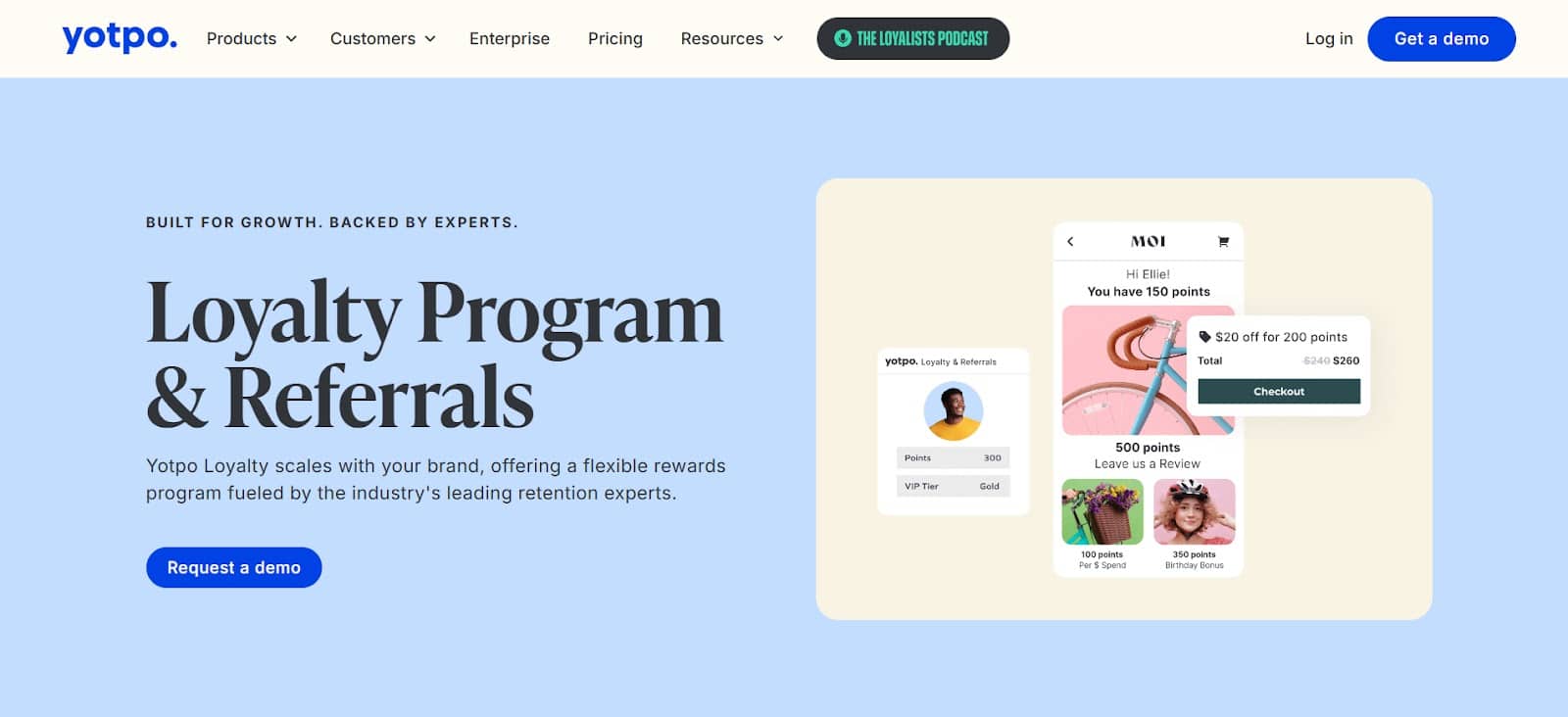
When evaluating technology partners, you’re looking for more than a feature checklist. You are choosing a partner that will be central to your retention efforts. A solution like Yotpo Loyalty is designed not just as a tool, but as a strategic asset for eCommerce brands. Let’s look at the key capabilities a loyalty partner must provide.
Strategic Partnership and Support
Implementing a successful loyalty program is an ongoing process. Many platforms just give you the software and leave the rest to you. A superior partner acts as an extension of your team.
- The Yotpo Approach: Yotpo Loyalty is built on a partnership model. You get access to a team of eCommerce loyalty experts, including a dedicated Customer Success Manager (CSM) who provides strategic guidance tailored to your business goals. This team helps with program optimization, performance analysis, and strategy. This level of hands-on support is a key differentiator from more self-service platforms like Smile or Stamped, where you are often on your own to interpret data and plan your strategy.
Flexibility and Deep Customization
Your brand is unique, and your loyalty program should be too. A rigid, template-based program looks generic and fails to create a strong emotional connection. You need a platform that gives you the creative freedom to build the exact experience you want.
- The Yotpo Approach: Yotpo Loyalty offers extensive flexibility, allowing brands to build complex earning rules, design unique VIP tiers, and use dynamic segmentation for personalized experiences. This lets you create a program that feels like a natural part of your brand, not a third-party add-on. While other platforms like Loyalty Lion also offer customization, Yotpo’s focus on deep segmentation provides a more powerful toolkit for sophisticated marketers.
Robust Reporting and Actionable Insights
Data is only valuable when it gives you insights. Your loyalty platform must not only track metrics but also help you understand what they mean for your business. You need clear, accurate reports that connect program activity to your bottom line.
- The Yotpo Approach: Yotpo Loyalty provides robust and accurate reporting designed for eCommerce marketers. Its dashboards make it easy to track KPIs like repeat purchase rate, customer lifetime value, and program ROI. The platform helps you show the direct revenue impact of your loyalty program, so you can prove its value and make smarter decisions.
Seamless Integration Capabilities
Your loyalty program should enhance your entire marketing ecosystem. The data from your loyalty members is a priceless asset that should flow to your other marketing channels.
- The Yotpo Approach: While Yotpo Loyalty is a powerful standalone solution, it’s designed to integrate smoothly with other best-in-class tools. A great example of this synergy is its connection with Yotpo Reviews. You can create a powerful cycle of engagement by rewarding customers with loyalty points for submitting reviews. Offering bonus points for including photos or videos enriches your loyalty program while generating the social proof needed to drive sales.
Choosing a loyalty platform is a major business decision. Yotpo has been a leader in the loyalty space since 2016, giving the platform a level of market maturity and experience that is hard to match. This experience shows in a product built around the real-world needs of eCommerce brands. While many loyalty tools exist, including Rivo and Okendo, Yotpo’s combination of a powerful, flexible product and a deep strategic partnership makes it a standout choice.
Step 4: Launching and Promoting Your Loyalty Program
You have the strategy, the program design, and the technology. Now it’s time to introduce it to your audience. A successful launch is more than just flipping a switch. It requires a coordinated promotional effort to build excitement, drive enrollment, and teach customers how to get the most value from the program.
Building a Pre-Launch Hype Strategy
Start promoting your new loyalty program before it officially launches. A teaser campaign can build anticipation and make your customers feel like insiders.
Ideas include:
- “Coming Soon” Email Series: Send a series of emails to your subscribers hinting at a new, rewarding experience.
- Social Media Teasers: Post countdowns or sneak peeks on your social channels.
- Early Access for VIPs: Let your best customers enroll before everyone else. This rewards their past loyalty and makes them feel valued.
Your Multi-Channel Launch Plan
On launch day, roll out a complete promotional plan. Announce the program across every channel where you interact with customers to get maximum visibility.
Your launch plan should include:
- On-Site Promotion: Use a prominent homepage banner and a dedicated landing page that explains everything about the program.
- Email Marketing: Send a dedicated launch email to your entire list and add a promotional banner to your transactional emails (like order confirmations).
- SMS Marketing: Send a short text message to your subscribers with a direct link to the loyalty landing page.
- Social Media Campaigns: Announce the program on all your platforms and update your profile bios to link to the landing page.
Onboarding New Members Effectively
Getting a sign-up is just the first step. You have to make sure members understand the program and are motivated to engage with it.
Key elements of effective onboarding:
- Clear Welcome Email: As soon as someone joins, send a welcome email that confirms their enrollment, shows their starting points balance (a sign-up bonus works well here), and explains the top ways to start earning.
- Easy-to-Understand Explanations: Use clear visuals and simple language in the member’s account dashboard to show how to earn and redeem points.
- The First Redemption: The sooner a customer redeems their first reward, the more likely they are to stay engaged. Consider offering an easy-to-get initial reward to provide a quick win.
Step 5: Measuring, Analyzing, and Optimizing Your Strategy
Your loyalty program is live. Now you move into an ongoing phase of management and optimization. A customer loyalty strategy is a living part of your business. To ensure it stays effective and profitable, you must consistently measure performance, analyze data, and make improvements.
Key Loyalty Metrics You Must Track
To understand the health of your program, you have to track the right Key Performance Indicators (KPIs).
- Repeat Purchase Rate (RPR): The percentage of customers who have made more than one purchase. This is a primary indicator of retention.
- Customer Lifetime Value (CLV): The total revenue a customer is projected to generate. You should track this for loyalty members versus non-members to prove ROI.
- Redemption Rate: The percentage of issued points that are actually redeemed. A low rate might mean your rewards aren’t desirable or are too hard to get.
- Participation Rate: The percentage of your total customer base enrolled in your program. This shows how effective your promotions are.
- Net Promoter Score (NPS): A measure of customer satisfaction, determined by asking customers how likely they are to recommend your brand.
Using Data to Personalize and Evolve Your Program
The data from your program is a goldmine for refinement. It allows you to create personalized experiences that deepen customer relationships.
- Segment Your Members: Segment members by tier, points balance, or engagement level to send them more relevant offers and messages.
- A/B Test Rewards: Continuously test different aspects of your program. Offer two different rewards at the same point value to see which is more popular.
- Gather Feedback: The best way to find areas for improvement is to ask your members. Send occasional surveys to get their feedback.
Avoiding Common Loyalty Program Pitfalls
As you manage your program, watch out for common mistakes:
- Excessive Complexity: If earning and redeeming are confusing, engagement will drop. Keep it simple.
- Uninspiring Rewards: Rewards must be genuinely valuable to your audience.
- Insufficient Communication: Regularly update customers on their status and new opportunities.
- Lack of Personalization: Use data to create tailored experiences that make customers feel seen.
- A Passive Approach: A loyalty program is not “set it and forget it.” It requires active management to deliver results.
Conclusion: Loyalty is a Relationship, Not a Transaction
Developing a successful customer loyalty marketing strategy is a long-term commitment. It requires a thoughtful process that starts with a solid foundation, moves through careful design and technology selection, and continues with a dynamic cycle of promotion and optimization.
When done right, a loyalty strategy becomes more than a marketing initiative. It becomes a core part of your brand’s identity and a powerful engine for sustainable, profitable growth. It’s the process by which you turn shoppers into customers, and customers into lifelong brand advocates.
Frequently Asked Questions
How much does a customer loyalty program cost?
The cost varies based on the technology and the generosity of your rewards. While some basic apps have low monthly fees, they often lack the customization and support of a dedicated platform. A solution like Yotpo Loyalty is an investment designed to deliver a clear ROI by increasing customer lifetime value. The other main cost is the point liability, which you control by setting the earning and redemption rates.
How long does it take to see results from a loyalty program?
You can see initial results like sign-ups almost immediately after a good launch. However, the biggest metrics, like a measurable increase in Repeat Purchase Rate and Customer Lifetime Value, typically take more time. You can generally expect to see a clear impact on these core business metrics within three to six months.
Can a loyalty program work for a small business?
Absolutely. A loyalty program can be a powerful tool for small businesses. It helps you compete with larger retailers by building strong, personal relationships. For a small business, every repeat customer is incredibly valuable. A well-designed program helps you identify your best customers and turn them into advocates who drive growth through word-of-mouth.
What’s the difference between a loyalty program and a referral program?
A loyalty program is a broad strategy to reward customers for many behaviors, mainly repeat purchases. A referral program is a specific tactic focused on one action: rewarding existing customers for bringing in new ones. Most modern loyalty platforms, including Yotpo Loyalty, build referral capabilities right in, so you can reward both loyalty and advocacy in one system.
How do I choose the right rewards for my customers?
Start by looking at your customer data and best-selling products. What do your customers actually buy? Offering your most popular products as rewards is often a safe bet. You can also survey your most loyal customers to ask them directly what they’d like to see. A good mix of financial rewards (discounts) and experiential rewards (early access) usually works well.
What are the biggest mistakes brands make with loyalty programs?
The most common mistakes are making the program too complicated, offering boring rewards, not promoting it enough, and taking a “set it and forget it” approach. A successful program needs to be simple, valuable, and actively managed.
Should my loyalty program be free to join?
For most eCommerce brands, yes. A free program creates the lowest barrier to entry and encourages the most sign-ups. Paid or subscription-based VIP programs can work, but they are usually best for high-end brands where exclusivity is a core part of the appeal.
How do I keep members engaged after they sign up?
Consistent communication is key. Send regular emails with point balance updates, reminders about available rewards, and exclusive offers for members. Create special promotions, like “Double Points Weekends,” to generate excitement and encourage earning.
How do I measure the ROI of my loyalty program?
The best way is to compare the behavior of loyalty members to non-members. Track metrics like Customer Lifetime Value (CLV), Average Order Value (AOV), and Repeat Purchase Rate for both groups. A robust platform like Yotpo Loyalty will provide reporting that clearly shows the lift in revenue generated by your program members.
What’s the best way to handle point expiration?
Point expiration can encourage customers to redeem rewards, but it can also feel punitive if not handled well. A common best practice is to have points expire after a period of inactivity (e.g., 12 months with no purchase), not from the date they were earned. Always send multiple warning emails before points expire to give customers a chance to use them.
Can a loyalty program help me get more product reviews?
Yes, it’s one of the best ways to do it. Rewarding customers with loyalty points for leaving a review is a powerful incentive. You can even offer bonus points for including a photo or video. This creates a great synergy where your loyalty program helps build the social proof you need to attract new customers.
Is it better to offer a percentage discount or a fixed-amount discount?
It depends on your Average Order Value (AOV). If you have a high AOV, a fixed-amount discount (e.g., “$20 off”) can feel more substantial and be more profitable for you. If you have a lower AOV, a percentage discount (e.g., “15% off”) is often more appealing to customers. It’s a good idea to A/B test both to see what your audience responds to best.
How can I personalize the loyalty experience?
Use the data you have! Create customer segments based on tiers or purchase history to send targeted offers. For example, send a special reward to your top-tier members or an exclusive offer for a product category a customer frequently buys from. Personal touches like a birthday point bonus also make a big difference.


 Join a free demo, personalized to fit your needs